 Explore
 Validate
 Learn
Learn Western blot
 Immunocytochemistry
Antibody data
- Antibody Data
- Antigen structure
- References [2]
- Comments [0]
- Validations
- Immunocytochemistry [1]
Submit
Validation data
Reference
Comment
Report error
- Product number
- GTX25231 - Provider product page

- Provider
- GeneTex
- Proper citation
- GeneTex Cat#GTX25231, RRID:AB_380486
- Product name
- p70 S6K (phospho Thr229) antibody
- Antibody type
- Polyclonal
- Reactivity
- Human, Rat
- Host
- Rabbit
Submitted references mTOR is involved in stroke-induced seizures and the anti-seizure effect of mild hypothermia.
A systems study reveals concurrent activation of AMPK and mTOR by amino acids.
Yang GS, Zhou XY, An XF, Liu XJ, Zhang YJ, Yu D
Molecular medicine reports 2018 Apr;17(4):5821-5829
Molecular medicine reports 2018 Apr;17(4):5821-5829
A systems study reveals concurrent activation of AMPK and mTOR by amino acids.
Dalle Pezze P, Ruf S, Sonntag AG, Langelaar-Makkinje M, Hall P, Heberle AM, Razquin Navas P, van Eunen K, Tölle RC, Schwarz JJ, Wiese H, Warscheid B, Deitersen J, Stork B, Fäßler E, Schäuble S, Hahn U, Horvatovich P, Shanley DP, Thedieck K
Nature communications 2016 Nov 21;7:13254
Nature communications 2016 Nov 21;7:13254
No comments: Submit comment
Supportive validation
- Submitted by
- GeneTex (provider)
- Main image
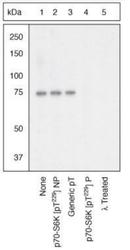
- Experimental details
- Up-regulation and Antibody-Peptide Competition. Peptide Competition and Phosphatase Stripping. Extracts of Jurkat cells were resolved by SDS-PAGE on a 10% Tris-glycine gel and transferred to PVDF. The membrane was either untreated (1-4) or treated with lambda phosphatase (5), blocked with a 5% BSA-TBST buffer for one hour at room temperature, then incubated with the p70-S6K [pT229] antibody for two hours at room temperature in a 3% BSA-TBST buffer, following its prior incubation with: no peptide (1,5), the non-phosphorylated peptide corresponding to the phosphopeptide immunogen (2), a generic phosphothreonine-containing peptide (3), or the phosphopeptide immunogen (4). The data show that only the phosphopeptide corresponding to p70-S6K [pT229] blocks the antibody signal, demonstrating the specificity of the antibody. The data also show that phosphatase stripping eliminates the signal, further verifying that the antibody is phospho-specific.
