Explore
 Validate
 Learn
Learn Western blot
 Immunocytochemistry
Antibody data
- Antibody Data
- Antigen structure
- References [7]
- Comments [0]
- Validations
- Immunocytochemistry [2]
- Other assay [1]
Submit
Validation data
Reference
Comment
Report error
- Product number
- PA3-020 - Provider product page

- Provider
- Invitrogen Antibodies
- Product name
- FKBP4 Polyclonal Antibody
- Antibody type
- Polyclonal
- Antigen
- Synthetic peptide
- Description
- PA3-020 detects heat shock protein 56 (HSP56), also known as FKBP4/FKBP52, from human, monkey, mouse and rabbit tissues. PA3-020 has been successfully used in Western blot and immunofluorescence procedures. By Western blot, this antibody detects a prominent ~52 kDa band representing HSP56 HeLa cell lysate. The PA3-020 immunogen is a synthetic peptide corresponding to residues C(441) K D E R N D V A G S Q S Q V E T E A(458) of rabbit Heat Shock Protein 56. Reconstitute in 100 µL PBS to create a stock of 1 mg/mL.
- Reactivity
- Human, Mouse, Rabbit
- Host
- Rabbit
- Isotype
- IgG
- Vial size
- 100 μg
- Concentration
- 1 mg/mL
- Storage
- -20°C, Avoid Freeze/Thaw Cycles
Submitted references FK506-binding protein 52 is essential to uterine reproductive physiology controlled by the progesterone receptor A isoform.
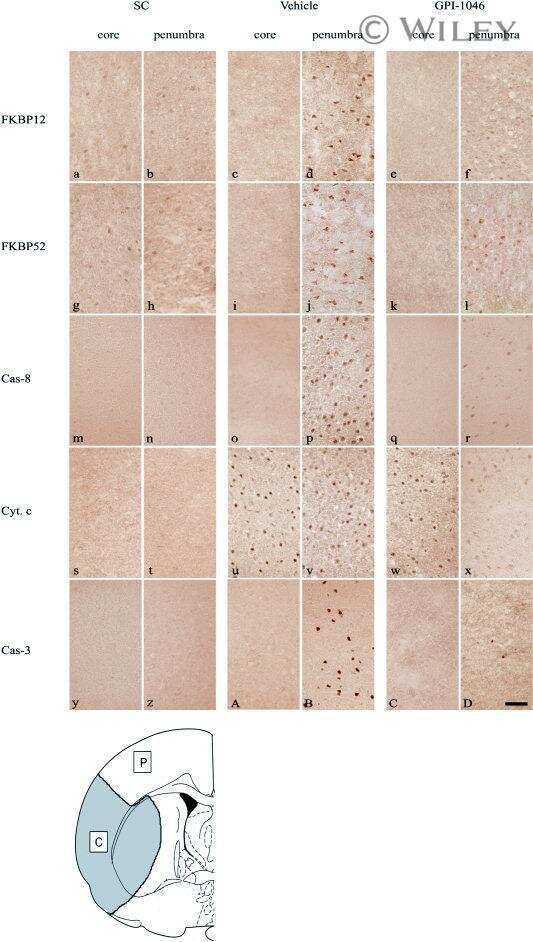
Protection against ischemic brain damage in rats by immunophilin ligand GPI-1046.
Early decrease of the immunophilin FKBP 52 in the spinal cord of a transgenic model for amyotrophic lateral sclerosis.
Early decrease of the immunophilin FKBP 52 in the spinal cord of a transgenic model for amyotrophic lateral sclerosis.
Cholesteryl ester is transported from caveolae to internal membranes as part of a caveolin-annexin II lipid-protein complex.
Progesterone receptor structure and function altered by geldanamycin, an hsp90-binding agent.
Progesterone receptor structure and function altered by geldanamycin, an hsp90-binding agent.
Yang Z, Wolf IM, Chen H, Periyasamy S, Chen Z, Yong W, Shi S, Zhao W, Xu J, Srivastava A, Sánchez ER, Shou W
Molecular endocrinology (Baltimore, Md.) 2006 Nov;20(11):2682-94
Molecular endocrinology (Baltimore, Md.) 2006 Nov;20(11):2682-94
Protection against ischemic brain damage in rats by immunophilin ligand GPI-1046.
Li F, Omori N, Hayashi T, Jin G, Sato K, Nagano I, Shoji M, Abe K
Journal of neuroscience research 2004 May 1;76(3):383-9
Journal of neuroscience research 2004 May 1;76(3):383-9
Early decrease of the immunophilin FKBP 52 in the spinal cord of a transgenic model for amyotrophic lateral sclerosis.
Manabe Y, Warita H, Murakami T, Shiote M, Hayashi T, Omori N, Nagano I, Shoji M, Abe K
Brain research 2002 May 10;935(1-2):124-8
Brain research 2002 May 10;935(1-2):124-8
Early decrease of the immunophilin FKBP 52 in the spinal cord of a transgenic model for amyotrophic lateral sclerosis.
Manabe Y, Warita H, Murakami T, Shiote M, Hayashi T, Omori N, Nagano I, Shoji M, Abe K
Brain research 2002 May 10;935(1-2):124-8
Brain research 2002 May 10;935(1-2):124-8
Cholesteryl ester is transported from caveolae to internal membranes as part of a caveolin-annexin II lipid-protein complex.
Uittenbogaard A, Everson WV, Matveev SV, Smart EJ
The Journal of biological chemistry 2002 Feb 15;277(7):4925-31
The Journal of biological chemistry 2002 Feb 15;277(7):4925-31
Progesterone receptor structure and function altered by geldanamycin, an hsp90-binding agent.
Smith DF, Whitesell L, Nair SC, Chen S, Prapapanich V, Rimerman RA
Molecular and cellular biology 1995 Dec;15(12):6804-12
Molecular and cellular biology 1995 Dec;15(12):6804-12
Progesterone receptor structure and function altered by geldanamycin, an hsp90-binding agent.
Smith DF, Whitesell L, Nair SC, Chen S, Prapapanich V, Rimerman RA
Molecular and cellular biology 1995 Dec;15(12):6804-12
Molecular and cellular biology 1995 Dec;15(12):6804-12
No comments: Submit comment
Supportive validation
- Submitted by
- Invitrogen Antibodies (provider)
- Main image
- Experimental details
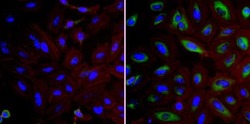
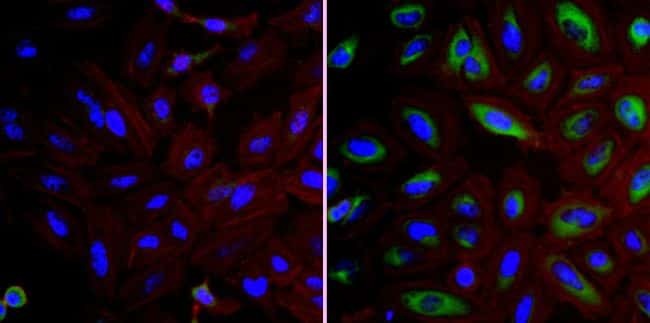
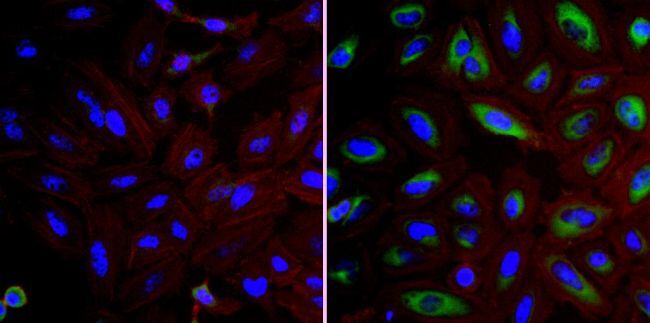
- Immunofluorescent analysis of Heat Shock protein 56 (HSP56, green) in HeLa cells. Formalin fixed cells were permeabilized with 0.1% Triton X-100 in TBS for 10 minutes at room temperature and blocked with 1% Blocker BSA (Product # 37525) for 15 minutes at room temperature. Cells were probed without (left panel) or with (right panel) a HSP56 polyclonal antibody (Product # PA3-020) at a dilution of 1:100 for at least 1 hour at room temperature, washed with PBS, and incubated with DyLight 488 goat anti-rabbit IgG secondary antibody (Product # 35552) at a dilution of 1:400 for 30 minutes at room temperature. Nuclei (blue) were stained with Hoechst 33342 dye (Product # 62249). Images were taken on Thermo Scientific ArrayScan or ToxInsight Instrument at 20X magnification.
- Submitted by
- Invitrogen Antibodies (provider)
- Main image
- Experimental details
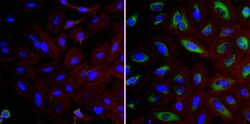
- Immunofluorescent analysis of Heat Shock protein 56 (HSP56, green) in HeLa cells. Formalin fixed cells were permeabilized with 0.1% Triton X-100 in TBS for 10 minutes at room temperature and blocked with 1% Blocker BSA (Product # 37525) for 15 minutes at room temperature. Cells were probed without (left panel) or with (right panel) a HSP56 polyclonal antibody (Product # PA3-020) at a dilution of 1:100 for at least 1 hour at room temperature, washed with PBS, and incubated with DyLight 488 goat anti-rabbit IgG secondary antibody (Product # 35552) at a dilution of 1:400 for 30 minutes at room temperature. Nuclei (blue) were stained with Hoechst 33342 dye (Product # 62249). Images were taken on Thermo Scientific ArrayScan or ToxInsight Instrument at 20X magnification.
Supportive validation
- Submitted by
- Invitrogen Antibodies (provider)
- Main image
- Experimental details
- NULL