 Explore
 Validate
 Learn
Learn Western blot
 ELISA
ELISAAntibody data
- Antibody Data
- Antigen structure
- References [10]
- Comments [0]
- Validations
- Western blot [1]
Submit
Validation data
Reference
Comment
Report error
- Product number
- 12077-1-AP - Provider product page

- Provider
- Proteintech Group
- Proper citation
- Proteintech Cat#12077-1-AP, RRID:AB_2058942
- Product name
- TINAGL1 antibody
- Antibody type
- Polyclonal
- Description
- KD/KO validated TINAGL1 antibody (Cat. #12077-1-AP) is a rabbit polyclonal antibody that shows reactivity with human, mouse, rat and has been validated for the following applications: IHC, IP, WB,ELISA.
- Reactivity
- Human, Mouse, Rat
- Host
- Rabbit
- Conjugate
- Unconjugated
- Isotype
- IgG
- Vial size
- 20ul, 150ul
Submitted references Tubulointerstitial nephritis antigen-like 1 promotes the progression of liver fibrosis after HCV eradication with direct-acting antivirals.
Paracancerous binuclear hepatocytes assessed by computer program is a novel biomarker for short term recurrence of hepatocellular carcinoma after surgery.
Anti-cancer effects of genistein supplementation and moderate-intensity exercise in high-fat diet-induced breast cancer via regulation of inflammation and adipose tissue metabolism in vivo and in vitro.
YTHDF1 facilitates esophageal cancer progression via augmenting m6A-dependent TINAGL1 translation.
Tubulointerstitial nephritis antigen-like 1 from cancer-associated fibroblasts contribute to the progression of diffuse-type gastric cancers through the interaction with integrin β1.
Matrisome proteomics reveals novel mediators of muscle remodeling with aerobic exercise training.
Functional analysis reveals that Tinagl1 is required for normal muscle development in mice through the activation of ERK signaling.
Down-regulated TINAGL1 in fibroblasts impairs wound healing in diabetes.
TINAGL1 promotes hepatocellular carcinogenesis through the activation of TGF-β signaling-medicated VEGF expression.
Tinagl1 Suppresses Triple-Negative Breast Cancer Progression and Metastasis by Simultaneously Inhibiting Integrin/FAK and EGFR Signaling.
Lei L, Li H, Wang XK, Li JR, Sun H, Li HY, Li JY, Tang M, Xu JC, Dong B, Gong Y, Song DQ, Jiang JD, Peng ZG
International journal of biological sciences 2025;21(2):802-822
International journal of biological sciences 2025;21(2):802-822
Paracancerous binuclear hepatocytes assessed by computer program is a novel biomarker for short term recurrence of hepatocellular carcinoma after surgery.
Zhang Y, Lu Y, Wang N, Hao F, Chen Y, Fei X, Wang J
Scientific reports 2025 Mar 20;15(1):9583
Scientific reports 2025 Mar 20;15(1):9583
Anti-cancer effects of genistein supplementation and moderate-intensity exercise in high-fat diet-induced breast cancer via regulation of inflammation and adipose tissue metabolism in vivo and in vitro.
Kwon H, Han H, Oh Y, Kim Y, Kim JH
BMC complementary medicine and therapies 2025 Jul 2;25(1):223
BMC complementary medicine and therapies 2025 Jul 2;25(1):223
YTHDF1 facilitates esophageal cancer progression via augmenting m6A-dependent TINAGL1 translation.
Zhang L, Cai E, Xu Y, Liu Z, Zheng M, Sun Z, Pei D, Wang Q
Cellular signalling 2024 Oct;122:111332
Cellular signalling 2024 Oct;122:111332
Tubulointerstitial nephritis antigen-like 1 from cancer-associated fibroblasts contribute to the progression of diffuse-type gastric cancers through the interaction with integrin β1.
Lee D, Ham IH, Oh HJ, Lee DM, Yoon JH, Son SY, Kim TM, Kim JY, Han SU, Hur H
Journal of translational medicine 2024 Feb 14;22(1):154
Journal of translational medicine 2024 Feb 14;22(1):154
Matrisome proteomics reveals novel mediators of muscle remodeling with aerobic exercise training.
Pattamaprapanont P, Cooney EM, MacDonald TL, Paulo JA, Pan H, Dreyfuss JM, Lessard SJ
Matrix biology plus 2024 Aug;23:100159
Matrix biology plus 2024 Aug;23:100159
Functional analysis reveals that Tinagl1 is required for normal muscle development in mice through the activation of ERK signaling.
Sato Y, Kawashima K, Fukui E, Matsumoto H, Yoshizawa F, Sato Y
Biochimica et biophysica acta. Molecular cell research 2022 Sep;1869(9):119294
Biochimica et biophysica acta. Molecular cell research 2022 Sep;1869(9):119294
Down-regulated TINAGL1 in fibroblasts impairs wound healing in diabetes.
Tian WQ, Chen SY, Chuan FN, Zhao WR, Zhou B
FASEB journal : official publication of the Federation of American Societies for Experimental Biology 2022 Mar;36(3):e22235
FASEB journal : official publication of the Federation of American Societies for Experimental Biology 2022 Mar;36(3):e22235
TINAGL1 promotes hepatocellular carcinogenesis through the activation of TGF-β signaling-medicated VEGF expression.
Sun L, Dong Z, Gu H, Guo Z, Yu Z
Cancer management and research 2019;11:767-775
Cancer management and research 2019;11:767-775
Tinagl1 Suppresses Triple-Negative Breast Cancer Progression and Metastasis by Simultaneously Inhibiting Integrin/FAK and EGFR Signaling.
Shen M, Jiang YZ, Wei Y, Ell B, Sheng X, Esposito M, Kang J, Hang X, Zheng H, Rowicki M, Zhang L, Shih WJ, Celià-Terrassa T, Liu Y, Cristea I, Shao ZM, Kang Y
Cancer cell 2019 Jan 14;35(1):64-80.e7
Cancer cell 2019 Jan 14;35(1):64-80.e7
No comments: Submit comment
Supportive validation
- Submitted by
- Proteintech Group (provider)
- Main image
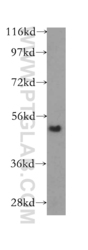
- Experimental details
- The TINAGL1 antibody from Proteintech is a rabbit polyclonal antibody to a recombinant protein of human TINAGL1. This antibody recognizes human, mouse, rat antigen. The TINAGL1 antibody has been validated for the following applications: ELISA, WB analysis.
