 Explore
 Validate
 Learn
Learn13581-1-AP
antibody from Proteintech Group
Targeting: FAU
asr1, FLJ22986, Fub1, Fubi, MNSFbeta, RPS30, S30
 Western blot
 ELISA
ELISAAntibody data
- Antibody Data
- Antigen structure
- References [6]
- Comments [0]
- Validations
- Western blot [1]
- Immunohistochemistry [1]
Submit
Validation data
Reference
Comment
Report error
- Product number
- 13581-1-AP - Provider product page

- Provider
- Proteintech Group
- Proper citation
- Proteintech Cat#13581-1-AP, RRID:AB_2100970
- Product name
- FAU antibody
- Antibody type
- Polyclonal
- Description
- FAU antibody (Cat. #13581-1-AP) is a rabbit polyclonal antibody that shows reactivity with human, mouse, rat and has been validated for the following applications: IHC, WB,ELISA.
- Reactivity
- Human, Mouse, Rat
- Host
- Rabbit
- Conjugate
- Unconjugated
- Isotype
- IgG
- Vial size
- 20ul, 150ul
Submitted references DNA damage in macrophages drives immune autoreactivity via nuclear antigen presentation.
Advantages of cell proliferation and immune regulation in CD146+NESTIN+ HUMSCs: insights from single-cell RNA sequencing.
Fangchinoline suppresses melanoma metastasis by inducing senescence of circulating tumor cells.
Proteomics-based characterization of ribosome heterogeneity in adult mouse organs.
Molecular basis for ubiquitin/Fubi cross-reactivity in USP16 and USP36.
Large tumor suppressor homologs 1 and 2 regulate mouse liver progenitor cell proliferation and maturation through antagonism of the coactivators YAP and TAZ.
Niotis G, Arvanitaki ES, Theodorakis E, Schmalen A, Juretschke T, Argyros O, Tsolis KC, Bertsias G, Drakos E, Beli P, Garinis GA
Nature aging 2026 Feb;6(2):393-413
Nature aging 2026 Feb;6(2):393-413
Advantages of cell proliferation and immune regulation in CD146+NESTIN+ HUMSCs: insights from single-cell RNA sequencing.
Huang P, Qin X, Fan C, Zhong H, Wang M, Chen F, Liao M, Zheng N, Wang H, Lin B, Ma L
Stem cells (Dayton, Ohio) 2025 Jun 24;43(7)
Stem cells (Dayton, Ohio) 2025 Jun 24;43(7)
Fangchinoline suppresses melanoma metastasis by inducing senescence of circulating tumor cells.
Chen J, Hu J, He J, Zhang B, Tan H, Wang Q, Hu H, Xu S, Tan CSH, Zhang J, Hong X
Biomedicine & pharmacotherapy = Biomedecine & pharmacotherapie 2025 Dec;193:118770
Biomedicine & pharmacotherapy = Biomedecine & pharmacotherapie 2025 Dec;193:118770
Proteomics-based characterization of ribosome heterogeneity in adult mouse organs.
Brunchault MR, Hesse AM, Schaeffer J, Fröhlich A, Saintpierre A, Decourt C, Combes F, Nawabi H, Couté Y, Belin S
Cellular and molecular life sciences : CMLS 2025 Apr 24;82(1):175
Cellular and molecular life sciences : CMLS 2025 Apr 24;82(1):175
Molecular basis for ubiquitin/Fubi cross-reactivity in USP16 and USP36.
O'Dea R, Kazi N, Hoffmann-Benito A, Zhao Z, Recknagel S, Wendrich K, Janning P, Gersch M
Nature chemical biology 2023 Nov;19(11):1394-1405
Nature chemical biology 2023 Nov;19(11):1394-1405
Large tumor suppressor homologs 1 and 2 regulate mouse liver progenitor cell proliferation and maturation through antagonism of the coactivators YAP and TAZ.
Yi J, Lu L, Yanger K, Wang W, Sohn BH, Stanger BZ, Zhang M, Martin JF, Ajani JA, Chen J, Lee JS, Song S, Johnson RL
Hepatology (Baltimore, Md.) 2016 Nov;64(5):1757-1772
Hepatology (Baltimore, Md.) 2016 Nov;64(5):1757-1772
No comments: Submit comment
Supportive validation
- Submitted by
- Proteintech Group (provider)
- Main image

- Experimental details
- mouse liver tissue were subjected to SDS PAGE followed by western blot with 13581-1-AP(FAU antibody) at dilution of 1:300
- Sample type
- tissue
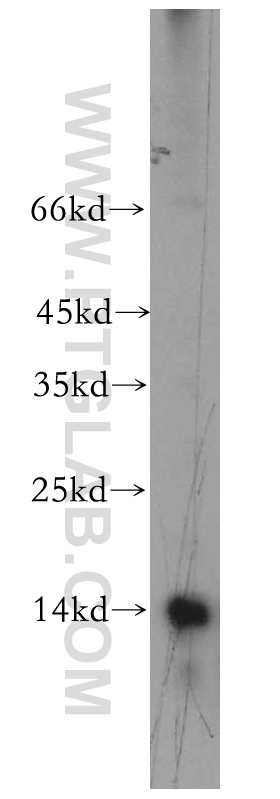
Supportive validation
- Submitted by
- Proteintech Group (provider)
- Main image

- Experimental details
- The FAU antibody from Proteintech is a rabbit polyclonal antibody to a recombinant protein of human FAU. This antibody recognizes human,mouse,rat antigen. The FAU antibody has been validated for the following applications: ELISA, WB, IHC analysis.
