Explore
 Validate
 Learn
Learn Western blot
 ELISA
ELISAAntibody data
- Antibody Data
- Antigen structure
- References [11]
- Comments [0]
- Validations
- Western blot [1]
- Immunohistochemistry [2]
Submit
Validation data
Reference
Comment
Report error
- Product number
- 16054-1-AP - Provider product page

- Provider
- Proteintech Group
- Proper citation
- Proteintech Cat#16054-1-AP, RRID:AB_2062501
- Product name
- ATP6V1C1 antibody
- Antibody type
- Polyclonal
- Description
- ATP6V1C1 antibody (Cat. #16054-1-AP) is a rabbit polyclonal antibody that shows reactivity with human, mouse, rat and has been validated for the following applications: IHC, WB,ELISA.
- Reactivity
- Human, Mouse, Rat
- Host
- Rabbit
- Conjugate
- Unconjugated
- Isotype
- IgG
- Vial size
- 20ul, 150ul
Submitted references A heterotrimeric protein complex assembles the metazoan V-ATPase upon dissipation of proton gradients.
Oxr1 and Ncoa7 regulate V-ATPase to achieve optimal pH for glycosylation within the Golgi apparatus and trans-Golgi network.
Direct and indirect effects of transforming growth factor-beta on osteoclast-mediated bone remodeling using a new in vitro bone matrix model.
Cell-Type Resolved Protein Atlas of Brain Lysosomes Identifies SLC45A1-Associated Disease as a Lysosomal Disorder.
ATP6V1C1, associated with the tumor microenvironment and mTORC1 signaling pathway, is a potential diagnostic, prognostic, and therapeutic biomarker for hepatocellular carcinoma.
Inhibition of autophagy and induction of glioblastoma cell death by NEO214, a perillyl alcohol-rolipram conjugate.
A novel four-gene of iron metabolism-related and methylated for prognosis prediction of hepatocellular carcinoma.
A substrate-trapping strategy to find E3 ubiquitin ligase substrates identifies Parkin and TRIM28 targets.
Lysosome-associated membrane protein-2 deficiency increases the risk of reactive oxygen species-induced ferroptosis in retinal pigment epithelial cells.
Caspase-8 Induces Lysosome-Associated Cell Death in Cancer Cells.
A brain-enriched Drp1 isoform associates with lysosomes, late endosomes, and the plasma membrane.
Nardone C, Mintseris J, He D, Rutter JC, Ebert BL, Gygi SP, Rapoport T
Nature structural & molecular biology 2025 Oct;32(10):2076-2087
Nature structural & molecular biology 2025 Oct;32(10):2076-2087
Oxr1 and Ncoa7 regulate V-ATPase to achieve optimal pH for glycosylation within the Golgi apparatus and trans-Golgi network.
Yoshimura SI, Sobajima T, Kunii M, Harada A
Proceedings of the National Academy of Sciences of the United States of America 2025 Jun 3;122(22):e2505975122
Proceedings of the National Academy of Sciences of the United States of America 2025 Jun 3;122(22):e2505975122
Direct and indirect effects of transforming growth factor-beta on osteoclast-mediated bone remodeling using a new in vitro bone matrix model.
Chiba-Ohkuma R, Karakida T, Yamamoto R, Yamakoshi Y
JBMR plus 2025 Aug;9(8):ziaf104
JBMR plus 2025 Aug;9(8):ziaf104
Cell-Type Resolved Protein Atlas of Brain Lysosomes Identifies SLC45A1-Associated Disease as a Lysosomal Disorder.
Ghoochani A, Heiby JC, Rawat ES, Medoh UN, Di Fraia D, Dong W, Gastou M, Nyame K, Laqtom NN, Gomez-Ospina N, Ori A, Abu-Remaileh M
bioRxiv : the preprint server for biology 2024 Oct 14;
bioRxiv : the preprint server for biology 2024 Oct 14;
ATP6V1C1, associated with the tumor microenvironment and mTORC1 signaling pathway, is a potential diagnostic, prognostic, and therapeutic biomarker for hepatocellular carcinoma.
Pan Y, Chen H, Lv C, He W, Xu Y, Xuan Q
Discover oncology 2024 Nov 18;15(1):673
Discover oncology 2024 Nov 18;15(1):673
Inhibition of autophagy and induction of glioblastoma cell death by NEO214, a perillyl alcohol-rolipram conjugate.
Ou M, Cho HY, Fu J, Thein TZ, Wang W, Swenson SD, Minea RO, Stathopoulos A, Schönthal AH, Hofman FM, Tang L, Chen TC
Autophagy 2023 Dec;19(12):3169-3188
Autophagy 2023 Dec;19(12):3169-3188
A novel four-gene of iron metabolism-related and methylated for prognosis prediction of hepatocellular carcinoma.
Shen H, Wu H, Sun F, Qi J, Zhu Q
Bioengineered 2021 Dec;12(1):240-251
Bioengineered 2021 Dec;12(1):240-251
A substrate-trapping strategy to find E3 ubiquitin ligase substrates identifies Parkin and TRIM28 targets.
Watanabe M, Saeki Y, Takahashi H, Ohtake F, Yoshida Y, Kasuga Y, Kondo T, Yaguchi H, Suzuki M, Ishida H, Tanaka K, Hatakeyama S
Communications biology 2020 Oct 20;3(1):592
Communications biology 2020 Oct 20;3(1):592
Lysosome-associated membrane protein-2 deficiency increases the risk of reactive oxygen species-induced ferroptosis in retinal pigment epithelial cells.
Lee JJ, Ishihara K, Notomi S, Efstathiou NE, Ueta T, Maidana D, Chen X, Iesato Y, Caligiana A, Vavvas DG
Biochemical and biophysical research communications 2020 Jan 8;521(2):414-419
Biochemical and biophysical research communications 2020 Jan 8;521(2):414-419
Caspase-8 Induces Lysosome-Associated Cell Death in Cancer Cells.
Zhong B, Liu M, Bai C, Ruan Y, Wang Y, Qiu L, Hong Y, Wang X, Li L, Li B
Molecular therapy : the journal of the American Society of Gene Therapy 2020 Apr 8;28(4):1078-1091
Molecular therapy : the journal of the American Society of Gene Therapy 2020 Apr 8;28(4):1078-1091
A brain-enriched Drp1 isoform associates with lysosomes, late endosomes, and the plasma membrane.
Itoh K, Adachi Y, Yamada T, Suzuki TL, Otomo T, McBride HM, Yoshimori T, Iijima M, Sesaki H
The Journal of biological chemistry 2018 Jul 27;293(30):11809-11822
The Journal of biological chemistry 2018 Jul 27;293(30):11809-11822
No comments: Submit comment
Supportive validation
- Submitted by
- Proteintech Group (provider)
- Main image
- Experimental details
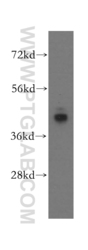
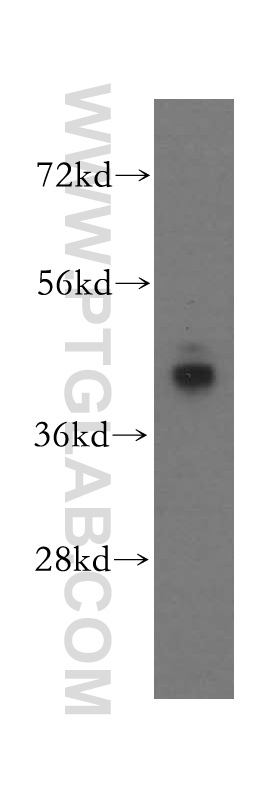
- NIH/3T3 cells were subjected to SDS PAGE followed by western blot with 16054-1-AP(ATP6V1C1 antibody) at dilution of 1:400
- Sample type
- cell line
Supportive validation
- Submitted by
- Proteintech Group (provider)
- Main image
- Experimental details
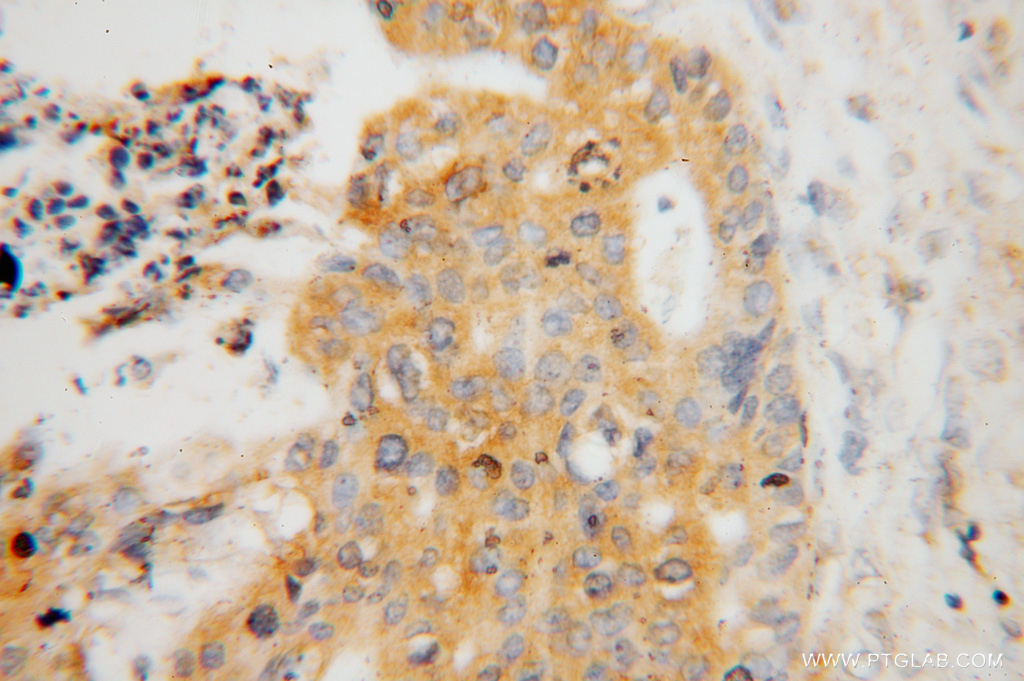
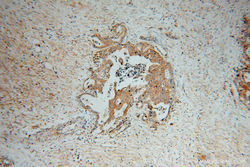
- Immunohistochemical of paraffin-embedded human stomach cancer using 16054-1-AP(ATP6V1C1 antibody) at dilution of 1:50 (under 10x lens)
- Sample type
- tissue

- Submitted by
- Proteintech Group (provider)
- Main image
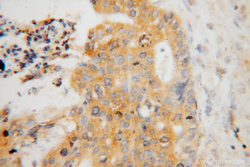
- Experimental details
- The ATP6V1C1 antibody from Proteintech is a rabbit polyclonal antibody to a recombinant protein of human ATP6V1C1. This antibody recognizes human, mouse, rat antigen. The ATP6V1C1 antibody has been validated for the following applications: ELISA, WB, IHC analysis.