 Explore
 Validate
 Learn
Learn Western blot
Antibody data
- Antibody Data
- Antigen structure
- References [3]
- Comments [0]
- Validations
- Western blot [3]
Submit
Validation data
Reference
Comment
Report error
- Product number
- PAB9933 - Provider product page

- Provider
- Abnova Corporation
- Proper citation
- Abnova Corporation Cat#PAB9933, RRID:AB_1672102
- Product name
- AKT2 polyclonal antibody
- Antibody type
- Polyclonal
- Description
- Rabbit polyclonal antibody raised against synthetic peptide of AKT2.
- Antigen sequence
RYDSLGLLELDQRT- Storage
- Store at 4°C. For long term storage store at -20°C.Aliquot to avoid repeated freezing and thawing.
Submitted references Dwarfism, impaired skin development, skeletal muscle atrophy, delayed bone development, and impeded adipogenesis in mice lacking Akt1 and Akt2.
Insulin resistance and a diabetes mellitus-like syndrome in mice lacking the protein kinase Akt2 (PKB beta).
Amplification of AKT2 in human pancreatic cells and inhibition of AKT2 expression and tumorigenicity by antisense RNA.
Peng XD, Xu PZ, Chen ML, Hahn-Windgassen A, Skeen J, Jacobs J, Sundararajan D, Chen WS, Crawford SE, Coleman KG, Hay N
Genes & development 2003 Jun 1;17(11):1352-65
Genes & development 2003 Jun 1;17(11):1352-65
Insulin resistance and a diabetes mellitus-like syndrome in mice lacking the protein kinase Akt2 (PKB beta).
Cho H, Mu J, Kim JK, Thorvaldsen JL, Chu Q, Crenshaw EB 3rd, Kaestner KH, Bartolomei MS, Shulman GI, Birnbaum MJ
Science (New York, N.Y.) 2001 Jun 1;292(5522):1728-31
Science (New York, N.Y.) 2001 Jun 1;292(5522):1728-31
Amplification of AKT2 in human pancreatic cells and inhibition of AKT2 expression and tumorigenicity by antisense RNA.
Cheng JQ, Ruggeri B, Klein WM, Sonoda G, Altomare DA, Watson DK, Testa JR
Proceedings of the National Academy of Sciences of the United States of America 1996 Apr 16;93(8):3636-41
Proceedings of the National Academy of Sciences of the United States of America 1996 Apr 16;93(8):3636-41
No comments: Submit comment
Supportive validation
- Submitted by
- Abnova Corporation (provider)
- Main image
- Experimental details
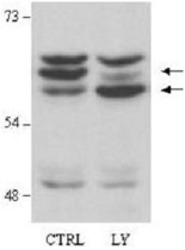
- Immunoblotting of AKT2 polyclonal antibody (Cat # PAB9933) detects both unphosphorylated and phosphorylated AKT2.As before approximately 20 mg/lane of crude HEK293 lysate was loaded for SDS-PAGE, separated and then transferred to nitrocellulose.The right lane contains lysate pretreated for 15 min with 25 &mciro;M LY294002 which affects the phosphorylation of endogenous AKT2, but has no effect on phosphorylation of the myristoylated construct.This antibody clearly detects both the phosphorylated (top arrow) and the non-phosphorylated (bottom arrow) forms of endogenous AKT2.

- Submitted by
- Abnova Corporation (provider)
- Main image
- Experimental details
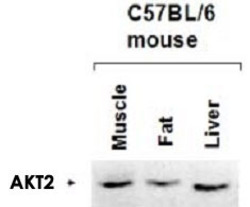
- Immunoblotting of AKT2 polyclonal antibody (Cat # PAB9933) to AKT2 was used at a 1 : 1,000 dilution to detect AKT2 by Western blot in lysates from mouse tissues.The antibody is shown to react with AKT2 in mouse liver, skeletal muscle and fat using standard immunoblotting methods.

- Submitted by
- Abnova Corporation (provider)
- Main image
- Experimental details
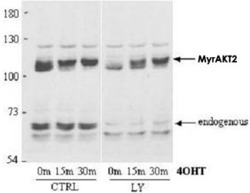
- Immunoblotting of AKT2 polyclonal antibody (Cat # PAB9933) to AKT2 wasused at a 1 : 1,000 dilution to detect AKT2 by Western blot.A lysate from a stable HEK293 cell line expressing an inducible, myristoylated form of AKT2 (MyrAKT2-ER) was loaded for SDS-PAGE, separated and then transferred to nitrocellulose.The blot was reacted with primary antibody for 1h at room temperature.Inresponse to 4OHT (tamoxifen), the AKT2 is recruited to the plasma membrane via its myristoylation sequence and becomes phosphorylated and activated.The blot (right panel) shows 0 m, 15m, and 30 m of 4OHT treatment.This treatment has no effect on endogenous AKT2, but causes a band shift upwards in the MyrAKT2.Endogenous AKT2 runs at about 60 KDa whereas the myristoylated construct runs at around 110 KDa.
