 Explore
 Validate
 Learn
LearnMA5-14934
antibody from Invitrogen Antibodies
Targeting: KDM1A
AOF2, BHC110, KDM1, KIAA0601, LSD1
 Western blot
 Immunocytochemistry
 Immunoprecipitation Immunohistochemistry Chromatin Immunoprecipitation
Antibody data
- Antibody Data
- Antigen structure
- References [0]
- Comments [0]
- Validations
- Immunocytochemistry [3]
- Immunohistochemistry [1]
- Chromatin Immunoprecipitation [2]
Submit
Validation data
Reference
Comment
Report error
- Product number
- MA5-14934 - Provider product page

- Provider
- Invitrogen Antibodies
- Product name
- LSD1 Monoclonal Antibody (K.884.2)
- Antibody type
- Monoclonal
- Antigen
- Synthetic peptide
- Description
- It is not recommended to aliquot this antibody.
- Reactivity
- Human, Mouse, Rat
- Host
- Rabbit
- Isotype
- IgG
- Antibody clone number
- K.884.2
- Vial size
- 100 μL
- Concentration
- 17 μg/mL
- Storage
- -20°C
No comments: Submit comment
Supportive validation
- Submitted by
- Invitrogen Antibodies (provider)
- Main image
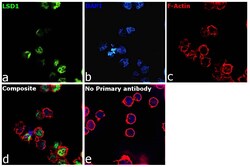
- Experimental details
- Immunofluorescence analysis of LSD1 was performed using 70 % confluent log phase K-562 cells. The cells were fixed with 4% paraformaldehyde for 5 minutes, permeabilized with 0.1% Triton™ X-100 for 10 minutes, and blocked with 2% BSA for 1 hour at room temperature. The cells were labeled with LSD1 Monoclonal Antibody (K.884.2) (Product # MA5-14934) at 1:100 dilution in 0.1% BSA, incubated at 4 degree celsius overnight and then labeled with Donkey anti-Rabbit IgG (H+L) Highly Cross-Adsorbed Secondary Antibody, Alexa Fluor Plus 488 (Product # A32790), (1:2000 dilution), for 45 minutes at room temperature (Panel a: Green). Nuclei (Panel b:Blue) were stained with ProLong™ Diamond Antifade Mountant with DAPI (Product # P36962). F-actin (Panel c: Red) was stained with Rhodamine Phalloidin (Product # R415, 1:300). Panel d represents the merged image showing predominantly nuclear localization. Panel e represents control cells with no primary antibody to assess background. The images were captured at 60X magnification.

- Submitted by
- Invitrogen Antibodies (provider)
- Main image
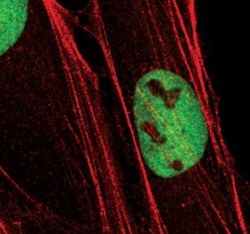
- Experimental details
- Immunofluorescent analysis of LSD1 in HeLa cells using a LSD1 monoclonal antibody (Product # MA5-14934) (green). Actin filaments are labeled with a fluorescent red phalloidin.

- Submitted by
- Invitrogen Antibodies (provider)
- Main image
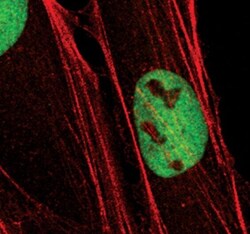
- Experimental details
- Immunofluorescent analysis of LSD1 in HeLa cells using a LSD1 monoclonal antibody (Product # MA5-14934) (green). Actin filaments are labeled with a fluorescent red phalloidin.

Supportive validation
- Submitted by
- Invitrogen Antibodies (provider)
- Main image
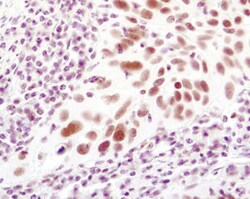
- Experimental details
- Immunohistochemical analysis of LSD1 in paraffin-embedded human lung carcinoma using a LSD1 monoclonal antibody (Product # MA5-14934).

Supportive validation
- Submitted by
- Invitrogen Antibodies (provider)
- Main image
- Experimental details
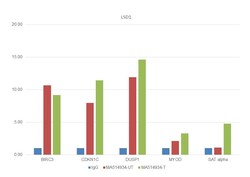
- Chromatin Immunoprecipitation (ChIP) assay of endogenous LSD1 protein using LSD1 Antibody: ChIP was performed using LSD1 Polyclonal Antibody (Product # MA5-14934, 5 µg) on sheared chromatin from A549 and A549 cells treated with Dexamethasone (100 nM, 2hours) using the MAGnify ChIP System kit (Product # 49-2024). Normal Rabbit IgG was used as a negative IP control. The purified DNA was analyzed by qPCR using primers binding to BIRC3, CDKN1C, DUSP1 (active) and MYOD, SAT alpha (Inactive). Data is presented as fold enrichment of the antibody signal versus the negative control IgG using the comparative CT method.

- Submitted by
- Invitrogen Antibodies (provider)
- Main image
- Experimental details
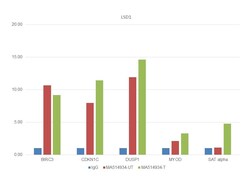
- Chromatin Immunoprecipitation (ChIP) assay of endogenous LSD1 protein using LSD1 Antibody: ChIP was performed using LSD1 Polyclonal Antibody (Product # MA5-14934, 5 µg) on sheared chromatin from A549 and A549 cells treated with Dexamethasone (100 nM, 2hours) using the MAGnify ChIP System kit (Product # 49-2024). Normal Rabbit IgG was used as a negative IP control. The purified DNA was analyzed by qPCR using primers binding to BIRC3, CDKN1C, DUSP1 (active) and MYOD, SAT alpha (Inactive). Data is presented as fold enrichment of the antibody signal versus the negative control IgG using the comparative CT method.
