 Explore
 Validate
 Learn
Learn Immunohistochemistry
Antibody data
- Antibody Data
- Antigen structure
- References [1]
- Comments [0]
- Validations
- Immunohistochemistry [2]
- Other assay [1]
Submit
Validation data
Reference
Comment
Report error
- Product number
- PA5-32322 - Provider product page

- Provider
- Invitrogen Antibodies
- Product name
- CD34 Polyclonal Antibody
- Antibody type
- Polyclonal
- Antigen
- Synthetic peptide
- Description
- Heat-mediated antigen retrieval is recommended prior to staining, using a 10mM citrate buffer, pH 6.0, for 10 minutes followed by cooling at room temperature for 20 min. Following antigen retrieval, incubate samples with primary antibody for 30 min at room temperature. A suggested positive control is angiosarcoma, lung or tonsil tissue.
- Reactivity
- Human
- Host
- Rabbit
- Isotype
- IgG
- Vial size
- 500 µL
- Concentration
- 0.16 mg/mL
- Storage
- -20° C, Avoid Freeze/Thaw Cycles
Submitted references Morphological changes of telocytes in camel efferent ductules in response to seasonal variations during the reproductive cycle.
Abdel-Maksoud FM, Abd-Elhafeez HH, Soliman SA
Scientific reports 2019 Mar 14;9(1):4507
Scientific reports 2019 Mar 14;9(1):4507
No comments: Submit comment
Supportive validation
- Submitted by
- Invitrogen Antibodies (provider)
- Main image
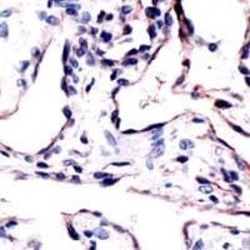
- Experimental details
- Immunohistochemical analysis of CD34 using a polyclonal antibody (Product # PA1-39456).

- Submitted by
- Invitrogen Antibodies (provider)
- Main image

- Experimental details
- Immunohistochemical analysis of CD34 using anti-CD34 Polyclonal Antibody (Product # PA5-32322) in Angiosarcoma Tissue. The recommened dilution for this antibody in immunohistochemistry applications is 1:100.

Supportive validation
- Submitted by
- Invitrogen Antibodies (provider)
- Main image
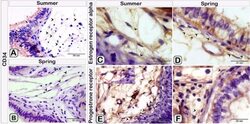
- Experimental details
- Figure 4 TCs immunoreactivity for CD34, ESR1 and PR in camel efferent ductules during the spring and summer seasons. Paraffin sections of the efferent ductule of camel in the summer and spring that underwent immunohistochemical staining for CD34 ( A , B ), ESR1 ( C , D ) and PR ( E , F ). Note that TCs showed a positive reaction for CD34 ( A , B ) in both summer and spring. TCs exhibited strong immunoreactivity for ESR1, complex estrogen receptors positive network in the spring ( D ) than in the summer ( C ). TCs showed a weak affinity for the PR immunostaining in summer samples ( E ) but a strong affinity for the PR immunostaining in the spring samples ( F ).
