Explore
 Validate
 Learn
Learn Western blot
 Immunocytochemistry
Antibody data
- Antibody Data
- Antigen structure
- References [3]
- Comments [0]
- Validations
- Immunocytochemistry [2]
- Immunohistochemistry [5]
- Other assay [1]
Submit
Validation data
Reference
Comment
Report error
- Product number
- PA5-29012 - Provider product page

- Provider
- Invitrogen Antibodies
- Product name
- PGP9.5 Polyclonal Antibody
- Antibody type
- Polyclonal
- Antigen
- Synthetic peptide
- Description
- Recommended positive controls: 293T, A549, H1299, Neuro2A, GL261, rat brain, PC-12, mouse brain. Store product as a concentrated solution. Centrifuge briefly prior to opening the vial.
- Reactivity
- Human, Mouse, Rat
- Host
- Rabbit
- Isotype
- IgG
- Vial size
- 100 μL
- Concentration
- 0.29 mg/mL
- Storage
- Store at 4°C short term. For long term storage, store at -20°C, avoiding freeze/thaw cycles.
Submitted references SARM1 Suppresses Axon Branching Through Attenuation of Axonal Cytoskeletal Dynamics.
Evidence of Altered Peripheral Nerve Function in a Rodent Model of Diet-Induced Prediabetes.
A disease mutation reveals a role for NaV1.9 in acute itch.
Ketschek A, Holland SM, Gallo G
Frontiers in molecular neuroscience 2022;15:726962
Frontiers in molecular neuroscience 2022;15:726962
Evidence of Altered Peripheral Nerve Function in a Rodent Model of Diet-Induced Prediabetes.
Hossain MJ, Kendig MD, Wild BM, Issar T, Krishnan AV, Morris MJ, Arnold R
Biomedicines 2020 Aug 28;8(9)
Biomedicines 2020 Aug 28;8(9)
A disease mutation reveals a role for NaV1.9 in acute itch.
Salvatierra J, Diaz-Bustamante M, Meixiong J, Tierney E, Dong X, Bosmans F
The Journal of clinical investigation 2018 Dec 3;128(12):5434-5447
The Journal of clinical investigation 2018 Dec 3;128(12):5434-5447
No comments: Submit comment
Supportive validation
- Submitted by
- Invitrogen Antibodies (provider)
- Main image
- Experimental details
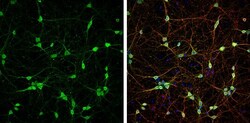
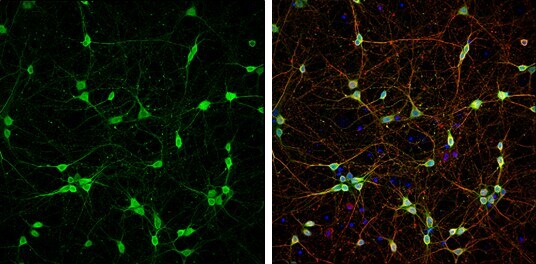
- Immunocytochemistry-Immunofluorescence analysis of PGP9.5 was performed in DIV9 rat E18 primary cortical neurons fixed in 4% paraformaldehyde at RT for 15 min. Green: PGP9.5 Polyclonal Antibody (Product # PA5-29012) diluted at 1:500. Red: beta Tubulin 3/ Tuj1, stained by beta Tubulin 3/ Tuj1 antibody. Blue: Fluoroshield with DAPI.
- Submitted by
- Invitrogen Antibodies (provider)
- Main image
- Experimental details
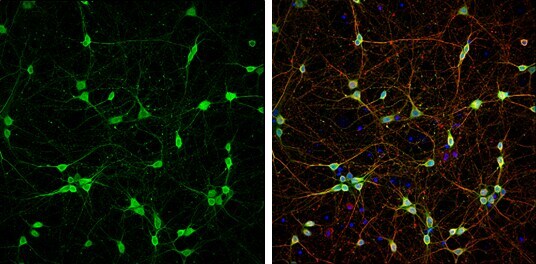
- Immunocytochemistry-Immunofluorescence analysis of PGP9.5 was performed in DIV9 rat E18 primary cortical neurons fixed in 4% paraformaldehyde at RT for 15 min. Green: PGP9.5 Polyclonal Antibody (Product # PA5-29012) diluted at 1:500. Red: beta Tubulin 3/ Tuj1, stained by beta Tubulin 3/ Tuj1 antibody. Blue: Fluoroshield with DAPI.
Supportive validation
- Submitted by
- Invitrogen Antibodies (provider)
- Main image
- Experimental details
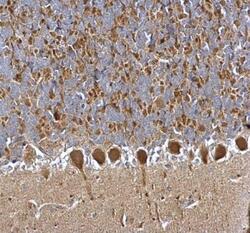
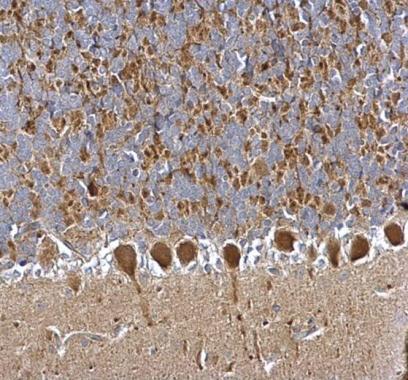
- PGP9.5 Polyclonal Antibody detects PGP9.5 protein at cytosol on rat hind brain by immunohistochemical analysis. Sample: Paraffin-embedded rat hind brain. PGP9.5 Polyclonal Antibody (Product # PA5-29012) dilution: 1:500. Antigen Retrieval: EDTA based buffer, pH 8.0, 15 min.
- Submitted by
- Invitrogen Antibodies (provider)
- Main image
- Experimental details
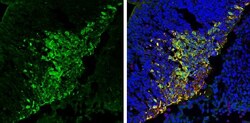
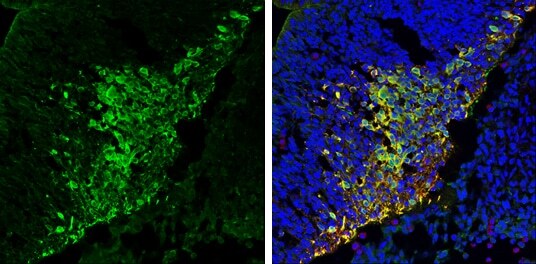
- Immunohistochemistry (Frozen) analysis of PGP9.5 was performed in frozen sectioned E13.5 Rat brain tissue using PGP9.5 Polyclonal Antibody (Product # PA5-29012) at a dilution of 1:250 (Green). Red: beta Tubulin 3/ TUJ1, a mature neuron marker, stained by beta Tubulin 3/ TUJ1 antibody diluted at 1:500. Blue: Fluoroshield with DAPI.
- Submitted by
- Invitrogen Antibodies (provider)
- Main image
- Experimental details
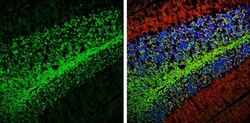
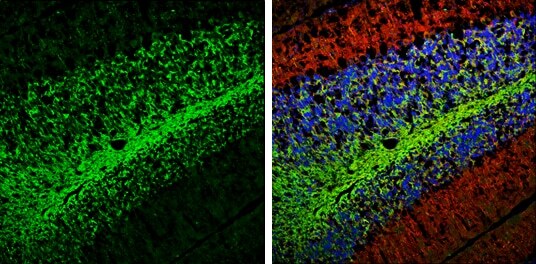
- Immunohistochemistry (Frozen) analysis of PGP9.5 was performed in frozen-sectioned adult mouse cerebellum tissue using PGP9.5 Polyclonal Antibody (Product # PA5-29012) at a dilution of 1:250 (Green). Red: beta Tubulin 3/ TUJ1, stained by beta Tubulin 3/ TUJ1 antibody diluted at 1:500. Blue: Fluoroshield with DAPI.
- Submitted by
- Invitrogen Antibodies (provider)
- Main image
- Experimental details
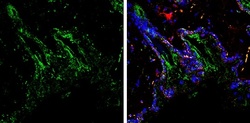
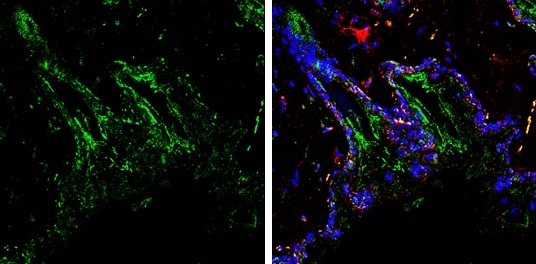
- Immunohistochemistry (Paraffin) analysis of PGP9.5 was performed in paraffin-embedded mouse skin tissue. Green: PGP9.5 stained by PGP9.5 Polyclonal Antibody (Product # PA5-29012) at a dilution of 1:250. Red: beta Tubulin 3/ Tuj1, a marker, stained by beta Tubulin 3/ Tuj1 antibody. Blue: Fluoroshield with DAPI. Antigen Retrieval: Citrate buffer, pH 6.0, 15 min.
- Submitted by
- Invitrogen Antibodies (provider)
- Main image
- Experimental details
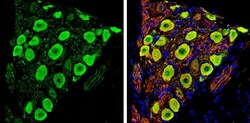
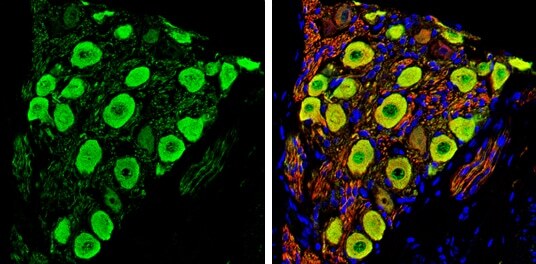
- Immunohistochemistry (Paraffin) analysis of PGP9.5 was performed in paraffin-embedded rat colon tissue. Green: PGP9.5 stained by PGP9.5 Polyclonal Antibody (Product # PA5-29012) at a dilution of 1:250. Red: beta Tubulin 3/ Tuj1, a marker, stained by beta Tubulin 3/ Tuj1 antibody. Blue: Fluoroshield with DAPI. Antigen Retrieval: Citrate buffer, pH 6.0, 15 min.
Supportive validation
- Submitted by
- Invitrogen Antibodies (provider)
- Main image
- Experimental details
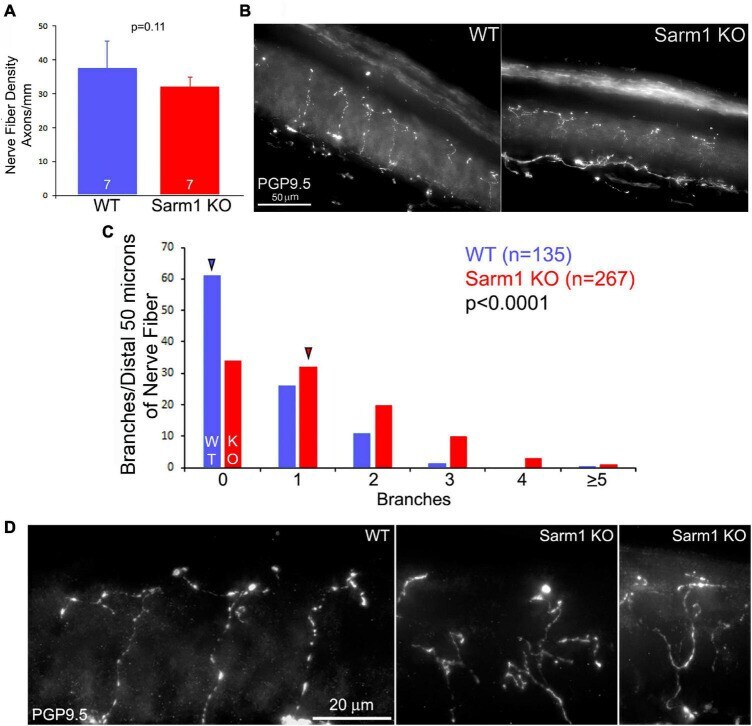
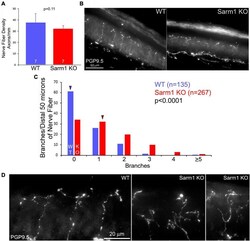
- FIGURE 3 Terminals of SARM1 KO sensory cutaneous axons exhibit more complex types of morphology than those of WT axons in vivo . (A) Graph of the intra-epidermal nerve fiber density in WT and SARM1 KO skin. n = number of mice (120-127 days of age). (B) Examples of WT and SARM1 KO skin sections stained with anti-PGP9.5 used to obtain the intra-epidermal nerve fiber density measurements presented in (A) . (C) Histogram of the number of branches present along the distal 50 microns of sensory fibers. A value of 0 reflects a fiber with no branches and only its terminus. Arrowheads denote the medians. (D) Examples of the morphology of the termini of nerve fibers in WT and SARM1 KO samples.