Explore
 Validate
 Learn
Learn Western blot
 ELISA
ELISAAntibody data
- Antibody Data
- Antigen structure
- References [12]
- Comments [0]
- Validations
- Western blot [1]
Submit
Validation data
Reference
Comment
Report error
- Product number
- 24918-1-AP - Provider product page

- Provider
- Proteintech Group
- Product name
- ST8SIA1 antibody
- Antibody type
- Polyclonal
- Description
- ST8SIA1 antibody (Cat. #24918-1-AP) is a rabbit polyclonal antibody that shows reactivity with human, mouse and has been validated for the following applications: IHC, WB,ELISA.
- Reactivity
- Human, Mouse
- Host
- Rabbit
- Conjugate
- Unconjugated
- Isotype
- IgG
- Vial size
- 20ul, 150ul
Submitted references SA supplementation during lactation promotes learning and memory by reducing H3K27me3 levels.
Targeting GD2 with naxitamab overcomes GD3 synthase-driven immune suppression in triple-negative breast cancer.
Ganglioside GD2 Contributes to a Stem-Like Phenotype in Intrahepatic Cholangiocarcinoma.
Predictive role of SLC1A5 in neuroblastoma prognosis and immunotherapy.
Overexpression of ST8Sia1 inhibits tumor progression by TGF-β1 signaling in rectal adenocarcinoma and promotes the tumoricidal effects of CD8(+) T cells by granzyme B and perforin.
GD2 and its biosynthetic enzyme GD3 synthase promote tumorigenesis in prostate cancer by regulating cancer stem cell behavior.
GD2 and its biosynthetic enzyme GD3 synthase promote tumorigenesis in prostate cancer by regulating cancer stem cell behavior.
Atlas of human dental pulp cells at multiple spatial and temporal levels based on single-cell sequencing analysis.
Identifying an Immune-Related Gene ST8SIA1 as a Novel Target in Patients With Clear-Cell Renal Cell Carcinoma.
PRC2-dependent regulation of ganglioside expression during dedifferentiation contributes to the proliferation and migration of vascular smooth muscle cells.
ST8SIA1 inhibits the proliferation, migration and invasion of bladder cancer cells by blocking the JAK/STAT signaling pathway.
Upregulation of cell surface GD3 ganglioside phenotype is associated with human melanoma brain metastasis.
Huang C, Ai S, Wang M, Li C, Wang K, Nie M, Zhang H, Gu X, Wang HL
Journal of advanced research 2026 Feb;80:301-316
Journal of advanced research 2026 Feb;80:301-316
Targeting GD2 with naxitamab overcomes GD3 synthase-driven immune suppression in triple-negative breast cancer.
Anand V, Oderinde B, Siddiqui M, Tyagi A, Borgman J, Wu C, Andreeff M, Battula VL
NPJ breast cancer 2025 Nov 5;11(1):120
NPJ breast cancer 2025 Nov 5;11(1):120
Ganglioside GD2 Contributes to a Stem-Like Phenotype in Intrahepatic Cholangiocarcinoma.
Mannini A, Pastore M, Giachi A, Correnti M, Spínola Lasso E, Lottini T, Piombanti B, Tusa I, Rovida E, Coulouarn C, Andersen JB, Lewinska M, Campani C, Battula VL, Yuan B, Aureli M, Carsana EV, Peraldo Neia C, Ostano P, Tani A, Nosi D, Vanni A, Maggi L, Di Tommaso L, Comito G, Madiai S, Arcangeli A, Marra F, Raggi C
Liver international : official journal of the International Association for the Study of the Liver 2025 Jan;45(1):e16208
Liver international : official journal of the International Association for the Study of the Liver 2025 Jan;45(1):e16208
Predictive role of SLC1A5 in neuroblastoma prognosis and immunotherapy.
Cheng J, Sun M, Dong X, Yang Y, Qin X, Zhou X, Fu Y, Wang Y, Wang J, Zhang D
BMC cancer 2025 Jan 28;25(1):161
BMC cancer 2025 Jan 28;25(1):161
Overexpression of ST8Sia1 inhibits tumor progression by TGF-β1 signaling in rectal adenocarcinoma and promotes the tumoricidal effects of CD8(+) T cells by granzyme B and perforin.
Zhang C, Wang Y, Yu Y, Pang Y, Xiao X, Hao L
Annals of medicine 2025 Dec;57(1):2439539
Annals of medicine 2025 Dec;57(1):2439539
GD2 and its biosynthetic enzyme GD3 synthase promote tumorigenesis in prostate cancer by regulating cancer stem cell behavior.
Bhat AM, Mohapatra BC, Luan H, Mushtaq I, Chakraborty S, Kumar S, Wu W, Nolan B, Dutta S, Storck MD, Schott M, Meza JL, Lele SM, Lin MF, Cook LM, Corey E, Morrissey C, Coulter DW, Rowley MJ, Natarajan A, Datta K, Band V, Band H
Scientific reports 2024 Jun 12;14(1):13523
Scientific reports 2024 Jun 12;14(1):13523
GD2 and its biosynthetic enzyme GD3 synthase promote tumorigenesis in prostate cancer by regulating cancer stem cell behavior.
Bhat AM, Mohapatra BC, Luan H, Mushtaq I, Chakraborty S, Kumar S, Wu W, Nolan B, Dutta S, Stock MD, Schott M, Meza JL, Lele SM, Lin MF, Cook LM, Corey E, Morrissey C, Coulter DW, Rowley J, Natarajan A, Datta K, Band V, Band H
bioRxiv : the preprint server for biology 2024 Apr 22;
bioRxiv : the preprint server for biology 2024 Apr 22;
Atlas of human dental pulp cells at multiple spatial and temporal levels based on single-cell sequencing analysis.
Ren H, Wen Q, Zhao Q, Wang N, Zhao Y
Frontiers in physiology 2022;13:993478
Frontiers in physiology 2022;13:993478
Identifying an Immune-Related Gene ST8SIA1 as a Novel Target in Patients With Clear-Cell Renal Cell Carcinoma.
Hu X, Yang Y, Wang Y, Ren S, Li X
Frontiers in pharmacology 2022;13:901518
Frontiers in pharmacology 2022;13:901518
PRC2-dependent regulation of ganglioside expression during dedifferentiation contributes to the proliferation and migration of vascular smooth muscle cells.
Sasaki N, Hirano K, Shichi Y, Itakura Y, Ishiwata T, Toyoda M
Frontiers in cell and developmental biology 2022;10:1003349
Frontiers in cell and developmental biology 2022;10:1003349
ST8SIA1 inhibits the proliferation, migration and invasion of bladder cancer cells by blocking the JAK/STAT signaling pathway.
Yu S, Wang S, Sun X, Wu Y, Zhao J, Liu J, Yang D, Jiang Y
Oncology letters 2021 Oct;22(4):736
Oncology letters 2021 Oct;22(4):736
Upregulation of cell surface GD3 ganglioside phenotype is associated with human melanoma brain metastasis.
Ramos RI, Bustos MA, Wu J, Jones P, Chang SC, Kiyohara E, Tran K, Zhang X, Stern SL, Izraely S, Sagi-Assif O, Witz IP, Davies MA, Mills GB, Kelly DF, Irie RF, Hoon DSB
Molecular oncology 2020 Aug;14(8):1760-1778
Molecular oncology 2020 Aug;14(8):1760-1778
No comments: Submit comment
Supportive validation
- Submitted by
- Proteintech Group (provider)
- Main image
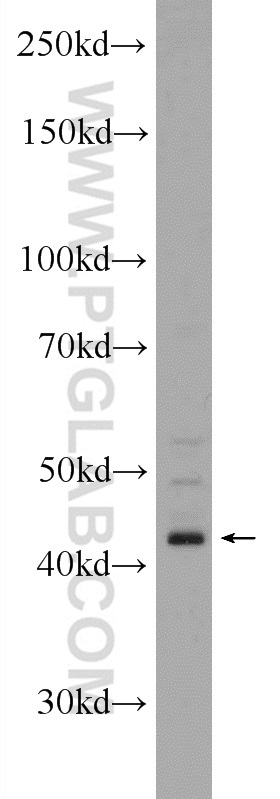
- Experimental details
- The ST8SIA1 antibody from Proteintech is a rabbit polyclonal antibody to a fusion protein of human ST8SIA1. This antibody recognizes human antigen. The ST8SIA1 antibody has been validated for the following applications: ELISA, WB analysis.