Explore
 Validate
 Learn
Learn Western blot
 ELISA
ELISAAntibody data
- Antibody Data
- Antigen structure
- References [8]
- Comments [0]
- Validations
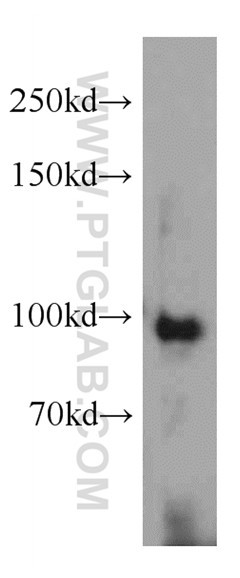
- Western blot [1]
Submit
Validation data
Reference
Comment
Report error
- Product number
- 66176-1-Ig - Provider product page

- Provider
- Proteintech Group
- Product name
- USP13 antibody
- Antibody type
- Monoclonal
- Description
- KD/KO validated USP13 antibody (Cat. #66176-1-Ig) is a mouse monoclonal antibody that shows reactivity with human and has been validated for the following applications: IF, IHC, WB,ELISA.
- Reactivity
- Human
- Host
- Mouse
- Conjugate
- Unconjugated
- Isotype
- IgG
- Antibody clone number
- 6E8C10
- Vial size
- 20ul, 150ul
Submitted references Non-classic deubiquitinase USP13 inhibits bladder cancer metastasis through destabilizing cytoplasmic KDM3A.
USP5 inhibition enables potential therapy for t(8;21) AML through ubiquitin-mediated AML1-ETO degradation in patient-derived xenografts.
ASNS Regulates H(2)O(2)-Induced Senescence, Oxidative Stress, and Glucose Metabolism in ARPE-19 Cells by Modulating USP13 Expression.
Ubiquitin-specific protease 13 promotes colorectal cancer progression by stabilizing mitogen-activated protein kinase kinase 3.
USP13 inhibition exacerbates mitochondrial dysfunction and acute kidney injury by acting on MCL-1.
Ubiquitinome profiling identifies USP13-CMAS axis as critical regulator of hair follicular melanogenesis via K48-linked polyubiquitination.
Hypoxia-induced USP13 expression drives ferroptosis resistance and tumor immune evasion in hepatocellular carcinoma through the stabilization of ACLY.
Deubiquitination of MITF-M Regulates Melanocytes Proliferation and Apoptosis.
Hu H, Zhan X, Xiong Y, Yuan R, Du Y, Dong Q, Li S, Guo B, Li Z, Feng J, Xiong S, Xiong J, Li D, Fu B, Xu S, Guo J
Oncogene 2026 Apr;45(15):1324-1337
Oncogene 2026 Apr;45(15):1324-1337
USP5 inhibition enables potential therapy for t(8;21) AML through ubiquitin-mediated AML1-ETO degradation in patient-derived xenografts.
Ma L, Zhang K, Zhang Z, Wang C, Ma M, Liu Y, Zhao Y, Gong Z, Liu N, Wei M, Liu X, Zhou J, Liu S, Yang C, Yang G
Science translational medicine 2025 Sep 24;17(817):eadt9100
Science translational medicine 2025 Sep 24;17(817):eadt9100
ASNS Regulates H(2)O(2)-Induced Senescence, Oxidative Stress, and Glucose Metabolism in ARPE-19 Cells by Modulating USP13 Expression.
Xin X, Zhao X, Han X, Pu W
BioFactors (Oxford, England) 2025 Nov-Dec;51(6):e70057
BioFactors (Oxford, England) 2025 Nov-Dec;51(6):e70057
Ubiquitin-specific protease 13 promotes colorectal cancer progression by stabilizing mitogen-activated protein kinase kinase 3.
Chang SY, Gu B, Xiong Y, Zhao MS, Li L, Liu Y, Wang BQ, Li GQ, Du RL, Zhang XD
Molecular biomedicine 2025 Nov 27;6(1):122
Molecular biomedicine 2025 Nov 27;6(1):122
USP13 inhibition exacerbates mitochondrial dysfunction and acute kidney injury by acting on MCL-1.
Wang Q, Cao S, Sun Z, Zhu W, Sun L, Li Y, Luo D, Huang S, Zhang Y, Xia W, Zhang A, Jia Z
Biochimica et biophysica acta. Molecular basis of disease 2025 Mar;1871(3):167599
Biochimica et biophysica acta. Molecular basis of disease 2025 Mar;1871(3):167599
Ubiquitinome profiling identifies USP13-CMAS axis as critical regulator of hair follicular melanogenesis via K48-linked polyubiquitination.
Chen Y, Hu S, Wang S, Bao Z, Cai J, Zhao B, Wu X
Cellular signalling 2025 Dec;136:112090
Cellular signalling 2025 Dec;136:112090
Hypoxia-induced USP13 expression drives ferroptosis resistance and tumor immune evasion in hepatocellular carcinoma through the stabilization of ACLY.
Hu K, Li J, Chen K, Mi X, Pan Y, Tang J, Cao J, Zhong X
Cell death discovery 2025 Dec 2;12(1):28
Cell death discovery 2025 Dec 2;12(1):28
Deubiquitination of MITF-M Regulates Melanocytes Proliferation and Apoptosis.
Hu S, Bai S, Dai Y, Yang N, Li J, Zhang X, Wang F, Zhao B, Bao G, Chen Y, Wu X
Frontiers in molecular biosciences 2021;8:692724
Frontiers in molecular biosciences 2021;8:692724
No comments: Submit comment
Supportive validation
- Submitted by
- Proteintech Group (provider)
- Main image
- Experimental details
- The USP13 antibody from Proteintech is a mouse monoclonal antibody to a recombinant protein of human USP13. This antibody recognizes human antigen. The USP13 antibody has been validated for the following applications: ELISA, WB analysis.