Explore
 Validate
 Learn
Learn Western blot
 ELISA
ELISAAntibody data
- Antibody Data
- Antigen structure
- References [7]
- Comments [0]
- Validations
- Western blot [1]
Submit
Validation data
Reference
Comment
Report error
- Product number
- 16802-1-AP - Provider product page

- Provider
- Proteintech Group
- Product name
- RNF26 antibody
- Antibody type
- Polyclonal
- Description
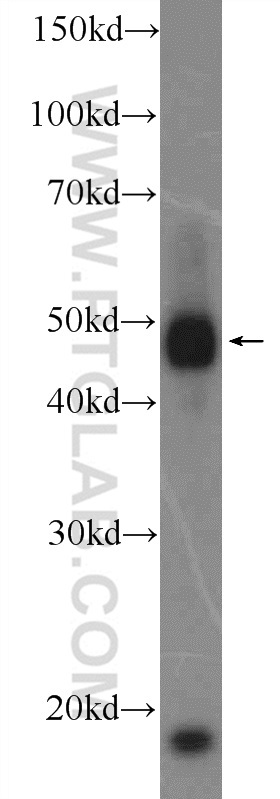
- KD/KO validated RNF26 antibody (Cat. #16802-1-AP) is a rabbit polyclonal antibody that shows reactivity with human, mouse, rat and has been validated for the following applications: WB, ELISA.
- Reactivity
- Human, Mouse, Rat
- Host
- Rabbit
- Conjugate
- Unconjugated
- Isotype
- IgG
- Vial size
- 20ul, 150ul
Submitted references RNF26 regulating tumor immunogenicity of hepatocellular carcinoma by degrading GRP78 and instigating ER stress.
Small intestinal γδ T17 cells promote SAE through STING/C1q-induced microglial synaptic pruning in male mice.
RNF26-mediated ubiquitination of TRIM21 promotes bladder cancer progression.
PTPRZ1 dephosphorylates and stabilizes RNF26 to reduce the efficacy of TKIs and PD-1 blockade in ccRCC.
CDK4/6 inhibitors dephosphorylate RNF26 to stabilize TSC1 and increase the sensitivity of ccRCC to mTOR inhibitors.
The RNF26/CBX7 axis modulates the TNF pathway to promote cell proliferation and regulate sensitivity to TKIs in ccRCC.
The FOXM1/RNF26/p57 axis regulates the cell cycle to promote the aggressiveness of bladder cancer.
Luo J, Zhuo H, Zheng M, Fang Y, Wang X, Jin Y, Li Y, Du S, Wang J, Xue C, Jiang R, Li G
Drug resistance updates : reviews and commentaries in antimicrobial and anticancer chemotherapy 2026 May;86:101375
Drug resistance updates : reviews and commentaries in antimicrobial and anticancer chemotherapy 2026 May;86:101375
Small intestinal γδ T17 cells promote SAE through STING/C1q-induced microglial synaptic pruning in male mice.
Wu Y, Zhang Y, Yu Y, Wang X, Zhen Z, Yuan Y, Xie B, Han M, Wang M, Zhang X, Sun X, Wen X, Hashimoto K, Shang Y, Yuan S, Zhang J
Nature communications 2025 Jul 23;16(1):6779
Nature communications 2025 Jul 23;16(1):6779
RNF26-mediated ubiquitination of TRIM21 promotes bladder cancer progression.
Yao D, Xin F, He X
American journal of cancer research 2024;14(8):4082-4095
American journal of cancer research 2024;14(8):4082-4095
PTPRZ1 dephosphorylates and stabilizes RNF26 to reduce the efficacy of TKIs and PD-1 blockade in ccRCC.
Ma Y, Li W, Liu X, Peng W, Qing B, Ren S, Liu W, Chen X
Oncogene 2024 Dec;43(50):3633-3644
Oncogene 2024 Dec;43(50):3633-3644
CDK4/6 inhibitors dephosphorylate RNF26 to stabilize TSC1 and increase the sensitivity of ccRCC to mTOR inhibitors.
Liu X, Li W, Yi L, Wang J, Liu W, Cheng H, Ren S
British journal of cancer 2024 Aug;131(3):444-456
British journal of cancer 2024 Aug;131(3):444-456
The RNF26/CBX7 axis modulates the TNF pathway to promote cell proliferation and regulate sensitivity to TKIs in ccRCC.
Liu W, Wang H, Jian C, Li W, Ye K, Ren J, Zhu L, Wang Y, Jin X, Yi L
International journal of biological sciences 2022;18(5):2132-2145
International journal of biological sciences 2022;18(5):2132-2145
The FOXM1/RNF26/p57 axis regulates the cell cycle to promote the aggressiveness of bladder cancer.
Yi L, Wang H, Li W, Ye K, Xiong W, Yu H, Jin X
Cell death & disease 2021 Oct 14;12(10):944
Cell death & disease 2021 Oct 14;12(10):944
No comments: Submit comment
Supportive validation
- Submitted by
- Proteintech Group (provider)
- Main image
- Experimental details
- HepG2 cells were subjected to SDS PAGE followed by western blot with 16802-1-AP( RNF26 Antibody) at dilution of 1:300
- Other comments
- WB