Explore
 Validate
 Learn
Learn Western blot
 ELISA
ELISAAntibody data
- Antibody Data
- Antigen structure
- References [14]
- Comments [0]
- Validations
- Western blot [1]
- Immunocytochemistry [1]
- Immunohistochemistry [2]
Submit
Validation data
Reference
Comment
Report error
- Product number
- 13512-1-AP - Provider product page

- Provider
- Proteintech Group
- Proper citation
- Proteintech Cat#13512-1-AP, RRID:AB_2302390
- Product name
- SNRPB2 antibody
- Antibody type
- Polyclonal
- Description
- SNRPB2 antibody (Cat. #13512-1-AP) is a rabbit polyclonal antibody that shows reactivity with human, mouse, rat and has been validated for the following applications: IF, IHC, IP, WB,ELISA.
- Reactivity
- Human, Mouse, Rat
- Host
- Rabbit
- Conjugate
- Unconjugated
- Isotype
- IgG
- Vial size
- 20ul, 150ul
Submitted references Emerging roles for SNRPB2 in governing the cell cycle and steering tumor immune modulation in breast cancer.
SNRPB2 facilitates esophageal squamous cell carcinoma oncogenesis and progression via E2F4 stabilization.
Multi-Omics Analysis of Survival-Related Splicing Factors and Identifies CRNKL1 as a Therapeutic Target in Esophageal Cancer.
Inhibiting intracellular CD28 in cancer cells enhances antitumor immunity and overcomes anti-PD-1 resistance via targeting PD-L1.
Small Nuclear Ribonucleoprotein Polypeptides B and B1 Promote Osteosarcoma Progression via Activating the Ataxia-Telangiectasia Mutated Signaling Pathway through Ribonucleotide Reductase Subunit M2.
SNRPB2 in the pan-cancer landscape: A bioinformatics exploration and validation in hepatocellular carcinoma.
SNRPB2 promotes triple-negative breast cancer progression by controlling alternative splicing of MDM4 pre-mRNA.
A model for DHX15 mediated disassembly of A-complex spliceosomes.
Protocol for proteogenomic dissection of intronic splicing enhancer interactome for prediction of individualized cancer prognosis.
Novel RNA-Affinity Proteogenomics Dissects Tumor Heterogeneity for Revealing Personalized Markers in Precision Prognosis of Cancer.
Stoichiometries of U2AF35, U2AF65 and U2 snRNP reveal new early spliceosome assembly pathways.
CPEB1 coordinates alternative 3'-UTR formation with translational regulation.
Comment on "Drug screening for ALS using patient-specific induced pluripotent stem cells".
Drug screening for ALS using patient-specific induced pluripotent stem cells.
Zhang J, Wang H, Jia Y, Yasheng A, Ai X, Wang X
Molecular biology reports 2026 May 2;53(1)
Molecular biology reports 2026 May 2;53(1)
SNRPB2 facilitates esophageal squamous cell carcinoma oncogenesis and progression via E2F4 stabilization.
Xu F, Zhu CC, Lu C, Ning GY, Zhang RQ
Frontiers in immunology 2025;16:1610721
Frontiers in immunology 2025;16:1610721
Multi-Omics Analysis of Survival-Related Splicing Factors and Identifies CRNKL1 as a Therapeutic Target in Esophageal Cancer.
Gao T, Fan M, Zeng Z, Peng L, Qian CN, Zhao X, Huang B
Genes 2025 Mar 27;16(4)
Genes 2025 Mar 27;16(4)
Inhibiting intracellular CD28 in cancer cells enhances antitumor immunity and overcomes anti-PD-1 resistance via targeting PD-L1.
Yang Z, Liu X, Zhu J, Chai Y, Cong B, Li B, Gao W, Hu Y, Wen M, Liu Y, Fu L, Cao X
Cancer cell 2025 Jan 13;43(1):86-102.e10
Cancer cell 2025 Jan 13;43(1):86-102.e10
Small Nuclear Ribonucleoprotein Polypeptides B and B1 Promote Osteosarcoma Progression via Activating the Ataxia-Telangiectasia Mutated Signaling Pathway through Ribonucleotide Reductase Subunit M2.
Shi Y, Wang Z, Zhang J, He P, Yang M, Zhao C, Li B, Qian M
The American journal of pathology 2024 Nov;194(11):2163-2178
The American journal of pathology 2024 Nov;194(11):2163-2178
SNRPB2 in the pan-cancer landscape: A bioinformatics exploration and validation in hepatocellular carcinoma.
Li B, Liu J, Huang L, Cai J, Guo L, Xu L, Xu Q, Liu J, Huang J, Hu W, Tang X, Liu Z, Liu T
Cellular signalling 2024 Dec;124:111445
Cellular signalling 2024 Dec;124:111445
SNRPB2 promotes triple-negative breast cancer progression by controlling alternative splicing of MDM4 pre-mRNA.
Yu S, Si Y, Yu J, Jiang C, Cheng F, Xu M, Fan Z, Liu F, Liu C, Wang Y, Wang N, Liu C, Bi C, Sun H
Cancer science 2024 Dec;115(12):3915-3927
Cancer science 2024 Dec;115(12):3915-3927
A model for DHX15 mediated disassembly of A-complex spliceosomes.
Maul-Newby HM, Amorello AN, Sharma T, Kim JH, Modena MS, Prichard BE, Jurica MS
RNA (New York, N.Y.) 2022 Apr;28(4):583-595
RNA (New York, N.Y.) 2022 Apr;28(4):583-595
Protocol for proteogenomic dissection of intronic splicing enhancer interactome for prediction of individualized cancer prognosis.
Wang L, Wrobel JA, Xie L, Chen X
STAR protocols 2021 Mar 19;2(1):100338
STAR protocols 2021 Mar 19;2(1):100338
Novel RNA-Affinity Proteogenomics Dissects Tumor Heterogeneity for Revealing Personalized Markers in Precision Prognosis of Cancer.
Wang L, Wrobel JA, Xie L, Li D, Zurlo G, Shen H, Yang P, Wang Z, Peng Y, Gunawardena HP, Zhang Q, Chen X
Cell chemical biology 2018 May 17;25(5):619-633.e5
Cell chemical biology 2018 May 17;25(5):619-633.e5
Stoichiometries of U2AF35, U2AF65 and U2 snRNP reveal new early spliceosome assembly pathways.
Chen L, Weinmeister R, Kralovicova J, Eperon LP, Vorechovsky I, Hudson AJ, Eperon IC
Nucleic acids research 2017 Feb 28;45(4):2051-2067
Nucleic acids research 2017 Feb 28;45(4):2051-2067
CPEB1 coordinates alternative 3'-UTR formation with translational regulation.
Bava FA, Eliscovich C, Ferreira PG, Miñana B, Ben-Dov C, Guigó R, Valcárcel J, Méndez R
Nature 2013 Mar 7;495(7439):121-5
Nature 2013 Mar 7;495(7439):121-5
Comment on "Drug screening for ALS using patient-specific induced pluripotent stem cells".
Bilican B, Serio A, Barmada SJ, Nishimura AL, Sullivan GJ, Carrasco M, Phatnani HP, Puddifoot CA, Story D, Fletcher J, Park IH, Friedman BA, Daley GQ, Wyllie DJ, Hardingham GE, Wilmut I, Finkbeiner S, Maniatis T, Shaw CE, Chandran S
Science translational medicine 2013 Jun 5;5(188):188le2
Science translational medicine 2013 Jun 5;5(188):188le2
Drug screening for ALS using patient-specific induced pluripotent stem cells.
Egawa N, Kitaoka S, Tsukita K, Naitoh M, Takahashi K, Yamamoto T, Adachi F, Kondo T, Okita K, Asaka I, Aoi T, Watanabe A, Yamada Y, Morizane A, Takahashi J, Ayaki T, Ito H, Yoshikawa K, Yamawaki S, Suzuki S, Watanabe D, Hioki H, Kaneko T, Makioka K, Okamoto K, Takuma H, Tamaoka A, Hasegawa K, Nonaka T, Hasegawa M, Kawata A, Yoshida M, Nakahata T, Takahashi R, Marchetto MC, Gage FH, Yamanaka S, Inoue H
Science translational medicine 2012 Aug 1;4(145):145ra104
Science translational medicine 2012 Aug 1;4(145):145ra104
No comments: Submit comment
Supportive validation
- Submitted by
- Proteintech Group (provider)
- Main image
- Experimental details
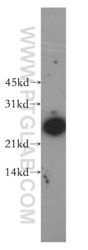
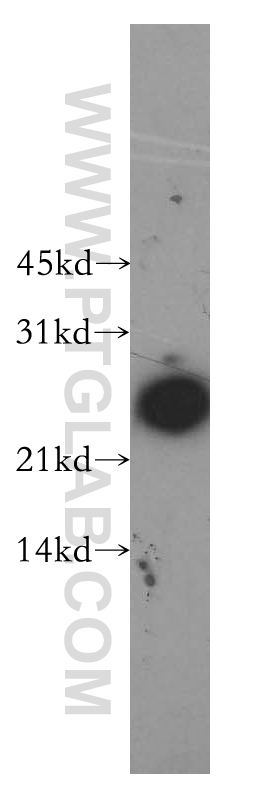
- HeLa cells were subjected to SDS PAGE followed by western blot with 13512-1-AP(SNRPB2 antibody) at dilution of 1:500
- Sample type
- cell line
Supportive validation
- Submitted by
- Proteintech Group (provider)
- Main image
- Experimental details
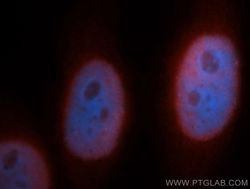
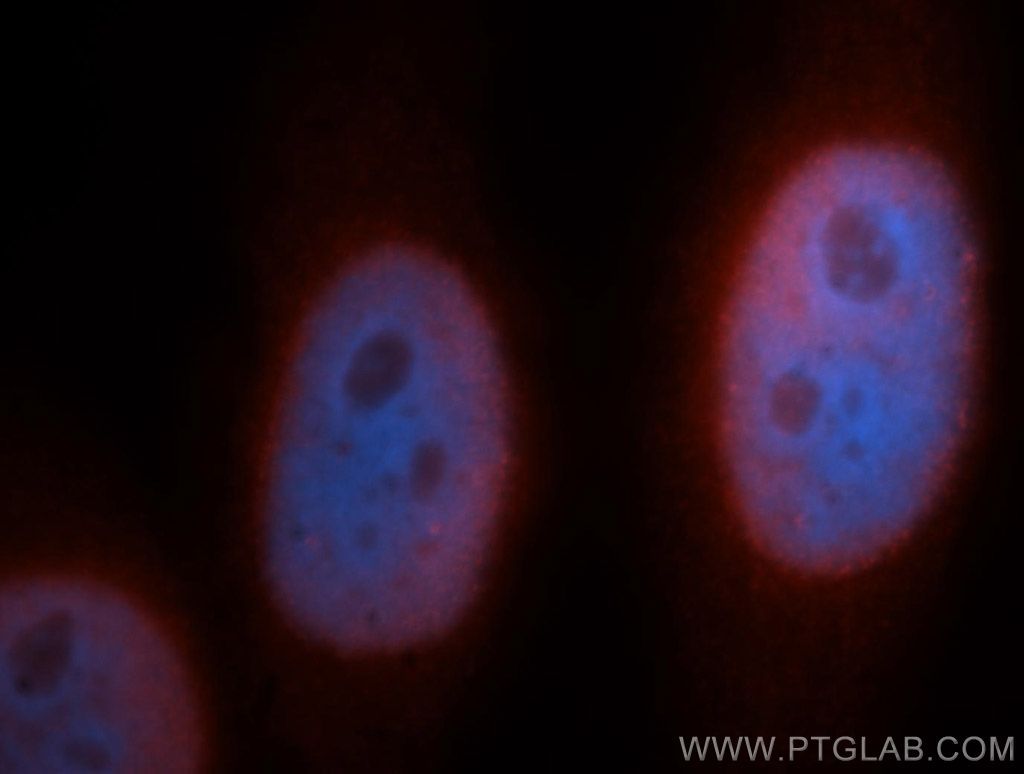
- Immunofluorescent analysis of Hela cells, using SNRPB2 antibody 13512-1-AP at 1:50 dilution and Rhodamine-labeled goat anti-rabbit IgG (red). Blue pseudocolor = DAPI (fluorescent DNA dye).
- Sample type
- cell line
Supportive validation
- Submitted by
- Proteintech Group (provider)
- Main image
- Experimental details
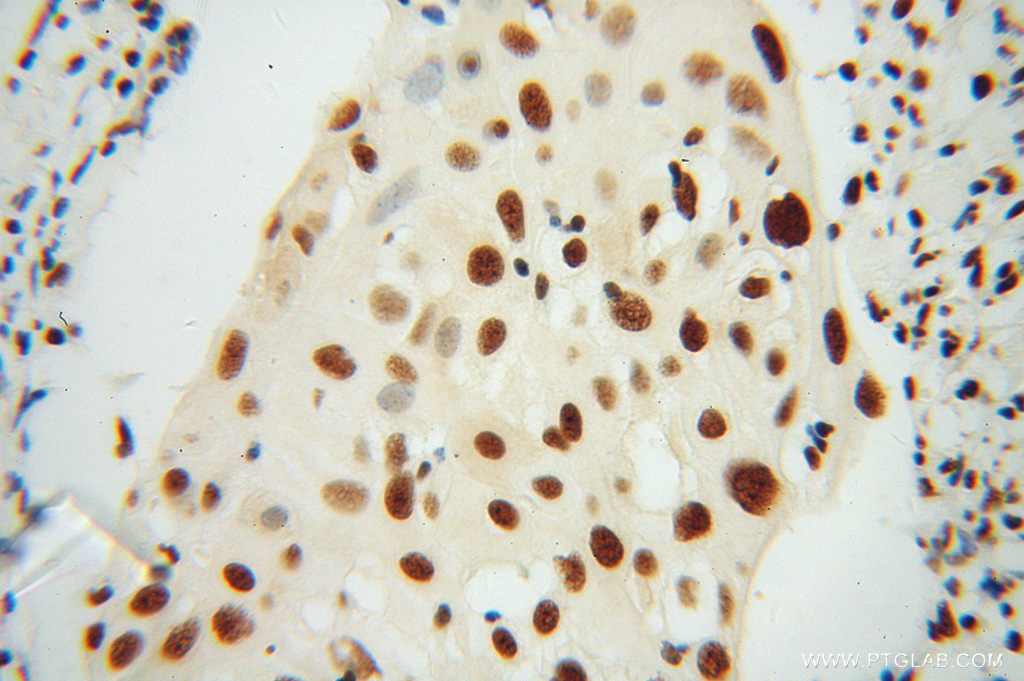
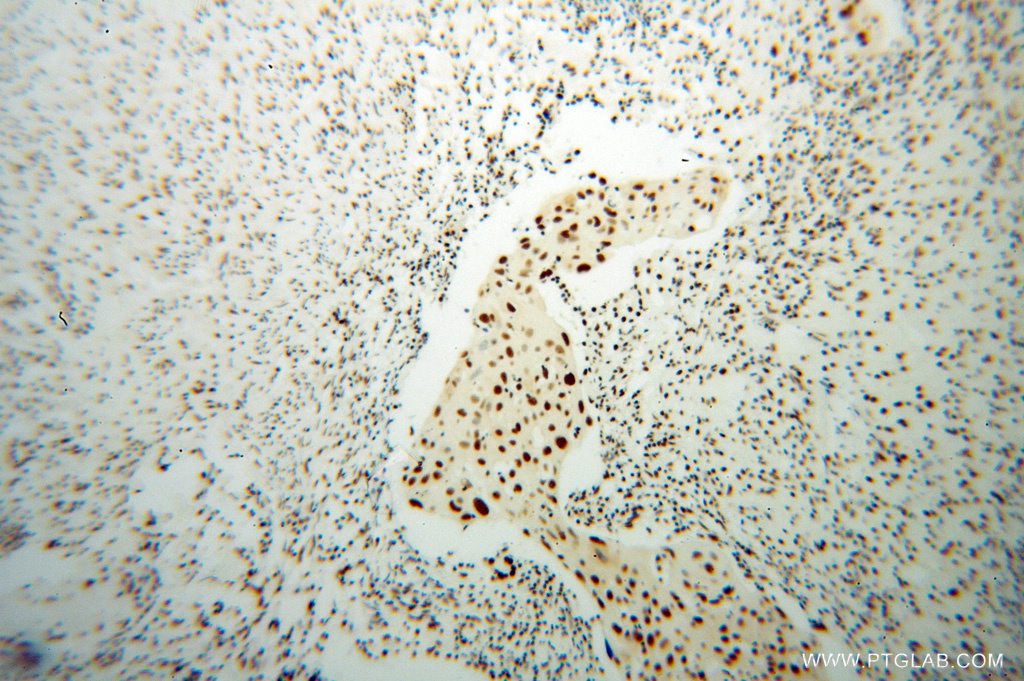
- Immunohistochemical of paraffin-embedded human cervical cancer using 13512-1-AP(SNRPB2 antibody) at dilution of 1:100 (under 10x lens)
- Sample type
- tissue
- Submitted by
- Proteintech Group (provider)
- Main image
- Experimental details
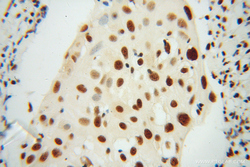
- Immunohistochemical of paraffin-embedded human cervical cancer using 13512-1-AP(SNRPB2 antibody) at dilution of 1:100 (under 40x lens)
- Sample type
- tissue