Explore
 Validate
 Learn
Learn Western blot
 ELISA
ELISAAntibody data
- Antibody Data
- Antigen structure
- References [8]
- Comments [0]
- Validations
- Western blot [1]
Submit
Validation data
Reference
Comment
Report error
- Product number
- 11132-1-AP - Provider product page

- Provider
- Proteintech Group
- Proper citation
- Proteintech Cat#11132-1-AP, RRID:AB_11182503
- Product name
- Dysbindin antibody
- Antibody type
- Polyclonal
- Description
- Dysbindin antibody (Cat. #11132-1-AP) is a rabbit polyclonal antibody that shows reactivity with human, mouse, rat and has been validated for the following applications: IHC, WB,ELISA.
- Reactivity
- Human, Mouse, Rat
- Host
- Rabbit
- Conjugate
- Unconjugated
- Isotype
- IgG
- Vial size
- 20ul, 150ul
Submitted references Loss of dysbindin-1 in excitatory neurons in mice impacts NMDAR-dependent behaviors, neuronal morphology and synaptic transmission in the ventral hippocampus.
TRIM24-DTNBP1-ATP7A mediated astrocyte cuproptosis in cognition and memory dysfunction caused by Y(2)O(3) NPs.
Dopaminergic signalling and behavioural alterations by Comt-Dtnbp1 genetic interaction and their clinical relevance.
Protein Kinase B/Akt1 Phosphorylates Dysbindin-1A at Serine 10 to Regulate Neuronal Development.
Mice with dopaminergic neuron-specific deletion of DTNBP-1 gene show blunted nucleus accumbens dopamine release and associated behaviors.
Deletion of Dtnbp1 in mice impairs threat memory consolidation and is associated with enhanced inhibitory drive in the amygdala.
Gene-edited MLE-15 Cells as a Model for the Hermansky-Pudlak Syndromes.
BLOC-1 is required for selective membrane protein trafficking from endosomes to primary cilia.
Bhardwaj SK, Nath M, Wong TP, Srivastava LK
Scientific reports 2024 Jul 2;14(1):15239
Scientific reports 2024 Jul 2;14(1):15239
TRIM24-DTNBP1-ATP7A mediated astrocyte cuproptosis in cognition and memory dysfunction caused by Y(2)O(3) NPs.
Chen Z, Liu J, Zheng M, Mo M, Hu X, Liu C, Pathak JL, Wang L, Chen L
The Science of the total environment 2024 Dec 1;954:176353
The Science of the total environment 2024 Dec 1;954:176353
Dopaminergic signalling and behavioural alterations by Comt-Dtnbp1 genetic interaction and their clinical relevance.
Managò F, Scheggia D, Pontillo M, Mereu M, Mastrogiacomo R, Udayan G, Valentini P, Tata MC, Weinberger DR, Weickert CS, Pompa PP, De Luca MA, Vicari S, Papaleo F
British journal of pharmacology 2023 Oct;180(19):2514-2531
British journal of pharmacology 2023 Oct;180(19):2514-2531
Protein Kinase B/Akt1 Phosphorylates Dysbindin-1A at Serine 10 to Regulate Neuronal Development.
Fei E, Chen P, Zhang Q, Zhong Y, Zhou T
Neuroscience 2022 May 10;490:66-78
Neuroscience 2022 May 10;490:66-78
Mice with dopaminergic neuron-specific deletion of DTNBP-1 gene show blunted nucleus accumbens dopamine release and associated behaviors.
Bhardwaj SK, Cui Q, Moquin L, Gratton A, Giros B, Srivastava LK
Neuropharmacology 2021 Feb 15;184:108440
Neuropharmacology 2021 Feb 15;184:108440
Deletion of Dtnbp1 in mice impairs threat memory consolidation and is associated with enhanced inhibitory drive in the amygdala.
Huang CCY, Muszynski KJ, Bolshakov VY, Balu DT
Translational psychiatry 2019 Apr 9;9(1):132
Translational psychiatry 2019 Apr 9;9(1):132
Gene-edited MLE-15 Cells as a Model for the Hermansky-Pudlak Syndromes.
Kook S, Qi A, Wang P, Meng S, Gulleman P, Young LR, Guttentag SH
American journal of respiratory cell and molecular biology 2018 May;58(5):566-574
American journal of respiratory cell and molecular biology 2018 May;58(5):566-574
BLOC-1 is required for selective membrane protein trafficking from endosomes to primary cilia.
Monis WJ, Faundez V, Pazour GJ
The Journal of cell biology 2017 Jul 3;216(7):2131-2150
The Journal of cell biology 2017 Jul 3;216(7):2131-2150
No comments: Submit comment
Supportive validation
- Submitted by
- Proteintech Group (provider)
- Main image
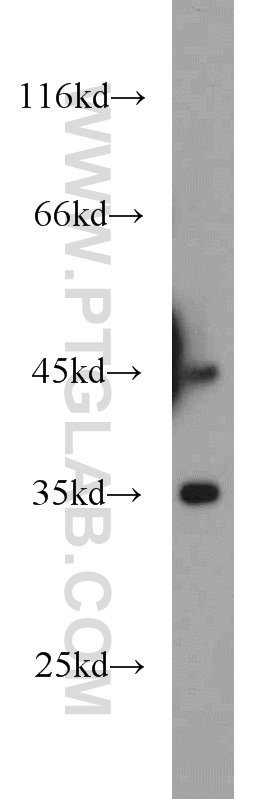
- Experimental details
- The DTNBP1 antibody from Proteintech is a rabbit polyclonal antibody to a recombinant protein of human DTNBP1. This antibody recognizes human, mouse, rat antigen. The DTNBP1 antibody has been validated for the following applications: ELISA, WB analysis.