Explore
 Validate
 Learn
Learn Western blot
 ELISA
ELISAAntibody data
- Antibody Data
- Antigen structure
- References [10]
- Comments [0]
- Validations
- Western blot [1]
- Immunohistochemistry [1]
Submit
Validation data
Reference
Comment
Report error
- Product number
- 12667-2-AP - Provider product page

- Provider
- Proteintech Group
- Proper citation
- Proteintech Cat#12667-2-AP, RRID:AB_2119204
- Product name
- HSPA13 antibody
- Antibody type
- Polyclonal
- Description
- KD/KO validated HSPA13 antibody (Cat. #12667-2-AP) is a rabbit polyclonal antibody that shows reactivity with human, mouse, rat and has been validated for the following applications: IHC, IP, WB, ELISA.
- Reactivity
- Human, Mouse, Rat
- Host
- Rabbit
- Conjugate
- Unconjugated
- Isotype
- IgG
- Vial size
- 20ul, 150ul
Submitted references Identification of molecular markers and exploration of the oncogenic role of exomeres in hepatocellular carcinoma.
Hspa13 Deficiency Impaired Marginal Zone B Cells Regulatory Function and Contributed to Lupus Pathogenesis.
Knockdown of HSPA13 Inhibits TGFβ1-Induced Epithelial-Mesenchymal Transition of RPE by Suppressing the PI3K/Akt Signaling Pathway.
Human Seminal Extracellular Vesicles Enhance Endometrial Receptivity Through Leukemia Inhibitory Factor.
Heat shock protein HSPA13 promotes hepatocellular carcinoma progression by stabilizing TANK.
PRM-based quantitative proteomics analysis of altered HSP abundance in villi and decidua of patients with early missed abortion.
Reassessment of the Proteomic Composition and Function of Extracellular Vesicles in the Seminal Plasma.
HSPA13 facilitates NF-κB-mediated transcription and attenuates cell death responses in TNFα signaling.
Hspa13 Promotes Plasma Cell Production and Antibody Secretion.
Overexpression of the Hspa13 (Stch) gene reduces prion disease incubation time in mice.
Yeung CLS, Lai CJ, Cui L, Korani L, Ng TH, Zhang X, Chen Z, Ma RR, Ng KM, Yam JWP
Cell reports 2025 Nov 25;44(11):116460
Cell reports 2025 Nov 25;44(11):116460
Hspa13 Deficiency Impaired Marginal Zone B Cells Regulatory Function and Contributed to Lupus Pathogenesis.
Xing C, Cui H, Li G, Liu X, Liu K, Wen Q, Huang X, Wang R, Song L
Advanced science (Weinheim, Baden-Wurttemberg, Germany) 2025 Feb;12(8):e2413144
Advanced science (Weinheim, Baden-Wurttemberg, Germany) 2025 Feb;12(8):e2413144
Knockdown of HSPA13 Inhibits TGFβ1-Induced Epithelial-Mesenchymal Transition of RPE by Suppressing the PI3K/Akt Signaling Pathway.
Gao F, Li M, Zhu L, Li J, Xu J, Jia S, Ou Q, Jin C, Tian H, Wang J, Xu J, Xu W, Xu GT, Lu L
Investigative ophthalmology & visual science 2024 Sep 3;65(11):1
Investigative ophthalmology & visual science 2024 Sep 3;65(11):1
Human Seminal Extracellular Vesicles Enhance Endometrial Receptivity Through Leukemia Inhibitory Factor.
Wang H, Lin Y, Chen R, Zhu Y, Wang H, Li S, Yu L, Zhang K, Liu Y, Jing T, Sun F
Endocrinology 2024 Mar 29;165(5)
Endocrinology 2024 Mar 29;165(5)
Heat shock protein HSPA13 promotes hepatocellular carcinoma progression by stabilizing TANK.
Cen X, Lu Y, Lu J, Luo C, Zhan P, Cheng Y, Yang F, Xie C, Yin Z, Wang F
Cell death discovery 2023 Dec 8;9(1):443
Cell death discovery 2023 Dec 8;9(1):443
PRM-based quantitative proteomics analysis of altered HSP abundance in villi and decidua of patients with early missed abortion.
Chen XF, Chen XQ, Luo HL, Xia LN, Huang SH, Chen Q
Proteome science 2023 Aug 16;21(1):12
Proteome science 2023 Aug 16;21(1):12
Reassessment of the Proteomic Composition and Function of Extracellular Vesicles in the Seminal Plasma.
Wang H, Zhu Y, Tang C, Zhou Z, Wang Z, Li Z, Zheng X, Chen S, Zhou Y, Liang A, Li Y, Lin Y, Sun F
Endocrinology 2022 Jan 1;163(1)
Endocrinology 2022 Jan 1;163(1)
HSPA13 facilitates NF-κB-mediated transcription and attenuates cell death responses in TNFα signaling.
Gao C, Deng J, Zhang H, Li X, Gu S, Zheng M, Tang M, Zhu Y, Lin X, Jin J, Zhang L, Huang J, Zou J, Xia ZP, Xu PL, Shen L, Zhao B, Feng XH
Science advances 2021 Oct 8;7(41):eabh1756
Science advances 2021 Oct 8;7(41):eabh1756
Hspa13 Promotes Plasma Cell Production and Antibody Secretion.
He Y, Xu R, Zhai B, Fang Y, Hou C, Xing C, Xiao H, Chen G, Wang X, Ma N, Han G, Wang R
Frontiers in immunology 2020;11:913
Frontiers in immunology 2020;11:913
Overexpression of the Hspa13 (Stch) gene reduces prion disease incubation time in mice.
Grizenkova J, Akhtar S, Hummerich H, Tomlinson A, Asante EA, Wenborn A, Fizet J, Poulter M, Wiseman FK, Fisher EM, Tybulewicz VL, Brandner S, Collinge J, Lloyd SE
Proceedings of the National Academy of Sciences of the United States of America 2012 Aug 21;109(34):13722-7
Proceedings of the National Academy of Sciences of the United States of America 2012 Aug 21;109(34):13722-7
No comments: Submit comment
Supportive validation
- Submitted by
- Proteintech Group (provider)
- Main image
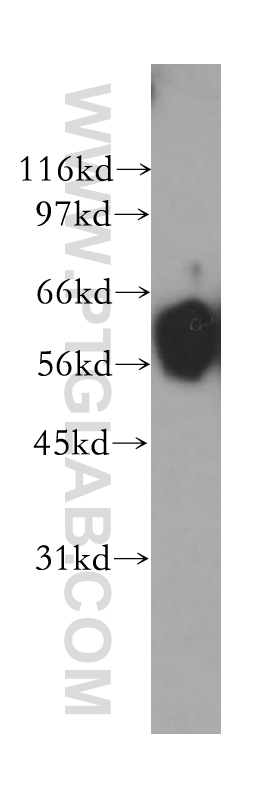
- Experimental details
- human brain tissue were subjected to SDS PAGE followed by western blot with 12667-2-AP(HSPA13 antibody) at dilution of 1:500
- Sample type
- tissue
Supportive validation
- Submitted by
- Proteintech Group (provider)
- Main image
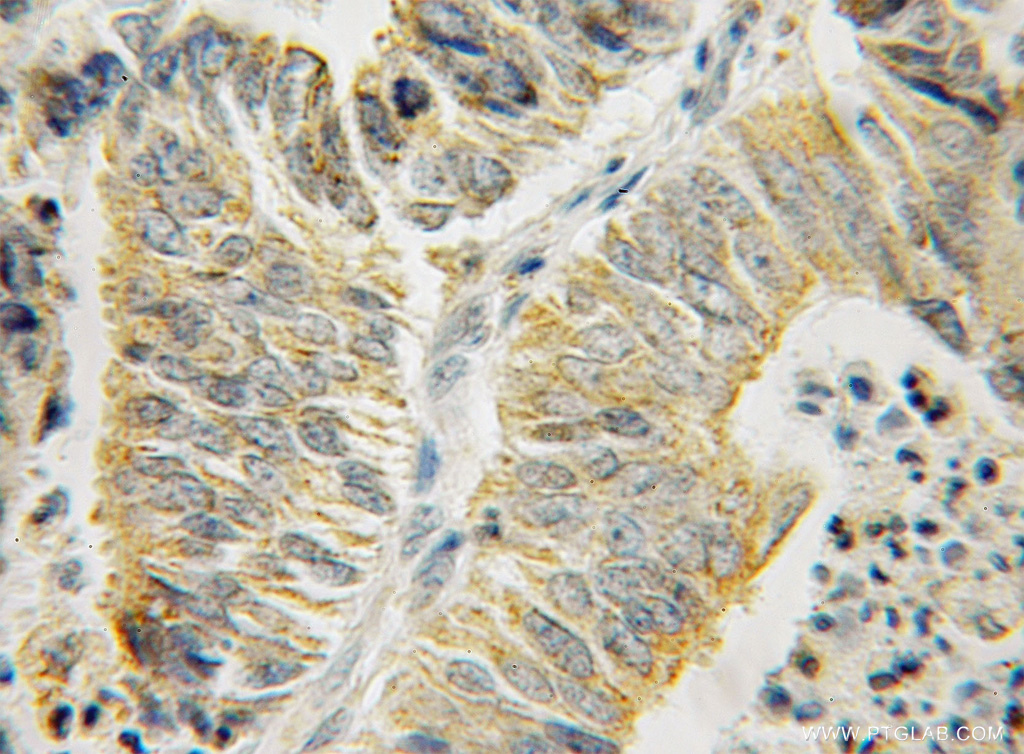
- Experimental details
- The HSPA13 antibody from Proteintech is a rabbit polyclonal antibody to a recombinant protein of human HSPA13. This antibody recognizes human, mouse, rat antigen. The HSPA13 antibody has been validated for the following applications: ELISA, WB, IHC analysis.