Explore
 Validate
 Learn
Learn Western blot
 ELISA
ELISAAntibody data
- Antibody Data
- Antigen structure
- References [11]
- Comments [0]
- Validations
- Western blot [1]
Submit
Validation data
Reference
Comment
Report error
- Product number
- 20873-1-AP - Provider product page

- Provider
- Proteintech Group
- Proper citation
- Proteintech Cat#20873-1-AP, RRID:AB_10858619
- Product name
- VMAT2 antibody
- Antibody type
- Polyclonal
- Description
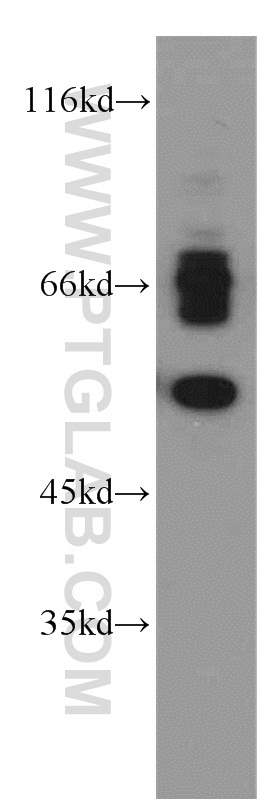
- KD/KO validated VMAT2 antibody (Cat. #20873-1-AP) is a rabbit polyclonal antibody that shows reactivity with human and has been validated for the following applications: WB, ELISA.
- Reactivity
- Human
- Host
- Rabbit
- Conjugate
- Unconjugated
- Isotype
- IgG
- Vial size
- 20ul, 150ul
Submitted references Single-Cell Profiling Identifies Reward Behavior-Related Neurons and Alterations in the Ventral Tegmental Area Based on Arvcf-Knockout Mouse Model.
The selenocysteine-containing protein SELENOT maintains dopamine signaling in the midbrain to protect mice from hyperactivity disorder.
Behavioral and histological analyses of the mouse Bassoon p.P3882A mutation corresponding to the human BSN p.P3866A mutation.
Effects of latroeggtoxin-VI on dopamine and α-synuclein in PC12 cells and the implications for Parkinson's disease.
Pathological characteristics of axons and alterations of proteomic and lipidomic profiles in midbrain dopaminergic neurodegeneration induced by WDR45-deficiency.
Deregulation of mTORC1-TFEB axis in human iPSC model of GBA1-associated Parkinson's disease.
A Matrigel-based 3D construct of SH-SY5Y cells models the α-synuclein pathologies of Parkinson's disease.
Reversing a model of Parkinson's disease with in situ converted nigral neurons.
Differentiation of adult human retinal pigment epithelial cells into dopaminergic-like cells in vitro and in the recipient monkey brain.
Zonisamide Enhances Motor Effects of Levodopa, Not of Apomorphine, in a Rat Model of Parkinson's Disease.
Identification of TMEM230 mutations in familial Parkinson's disease.
Zhang M, Zhang B, Wang Y, Chang Q, He J, Yang Z, Li MD
Research (Washington, D.C.) 2025;8:1030
Research (Washington, D.C.) 2025;8:1030
The selenocysteine-containing protein SELENOT maintains dopamine signaling in the midbrain to protect mice from hyperactivity disorder.
Guo Q, Li ZF, Hu DY, Li PJ, Wu KN, Fan HH, Deng J, Wu HM, Zhang X, Zhu JH
The EMBO journal 2025 May;44(10):2906-2927
The EMBO journal 2025 May;44(10):2906-2927
Behavioral and histological analyses of the mouse Bassoon p.P3882A mutation corresponding to the human BSN p.P3866A mutation.
Tanaka D, Yaguchi H, Yoshizaki K, Kudo A, Mori F, Nomura T, Pan J, Miki Y, Takahashi H, Hara T, Wakabayashi K, Yabe I
Frontiers in neuroscience 2024;18:1414145
Frontiers in neuroscience 2024;18:1414145
Effects of latroeggtoxin-VI on dopamine and α-synuclein in PC12 cells and the implications for Parkinson's disease.
Yu D, Wang H, Zhai Y, Lei Z, Sun M, Chen S, Yin P, Wang X
Biological research 2024 Mar 16;57(1):9
Biological research 2024 Mar 16;57(1):9
Pathological characteristics of axons and alterations of proteomic and lipidomic profiles in midbrain dopaminergic neurodegeneration induced by WDR45-deficiency.
Wang P, Shao Y, Al-Nusaif M, Zhang J, Yang H, Yang Y, Kim K, Li S, Liu C, Cai H, Le W
Molecular neurodegeneration 2024 Aug 26;19(1):62
Molecular neurodegeneration 2024 Aug 26;19(1):62
Deregulation of mTORC1-TFEB axis in human iPSC model of GBA1-associated Parkinson's disease.
Mubariz F, Saadin A, Lingenfelter N, Sarkar C, Banerjee A, Lipinski MM, Awad O
Frontiers in neuroscience 2023;17:1152503
Frontiers in neuroscience 2023;17:1152503
A Matrigel-based 3D construct of SH-SY5Y cells models the α-synuclein pathologies of Parkinson's disease.
Li ZF, Cui L, Jin MM, Hu DY, Hou XG, Liu SS, Zhang X, Zhu JH
Disease models & mechanisms 2022 Mar 1;15(3)
Disease models & mechanisms 2022 Mar 1;15(3)
Reversing a model of Parkinson's disease with in situ converted nigral neurons.
Qian H, Kang X, Hu J, Zhang D, Liang Z, Meng F, Zhang X, Xue Y, Maimon R, Dowdy SF, Devaraj NK, Zhou Z, Mobley WC, Cleveland DW, Fu XD
Nature 2020 Jun;582(7813):550-556
Nature 2020 Jun;582(7813):550-556
Differentiation of adult human retinal pigment epithelial cells into dopaminergic-like cells in vitro and in the recipient monkey brain.
Li S, Zhang H, Wang A, Liu Y, Liu H, Yue F, Abulaiti X, Zhang C, Li L
Molecular medicine (Cambridge, Mass.) 2019 Mar 29;25(1):9
Molecular medicine (Cambridge, Mass.) 2019 Mar 29;25(1):9
Zonisamide Enhances Motor Effects of Levodopa, Not of Apomorphine, in a Rat Model of Parkinson's Disease.
Nishijima H, Miki Y, Ueno S, Tomiyama M
Parkinson's disease 2018;2018:8626783
Parkinson's disease 2018;2018:8626783
Identification of TMEM230 mutations in familial Parkinson's disease.
Deng HX, Shi Y, Yang Y, Ahmeti KB, Miller N, Huang C, Cheng L, Zhai H, Deng S, Nuytemans K, Corbett NJ, Kim MJ, Deng H, Tang B, Yang Z, Xu Y, Chan P, Huang B, Gao XP, Song Z, Liu Z, Fecto F, Siddique N, Foroud T, Jankovic J, Ghetti B, Nicholson DA, Krainc D, Melen O, Vance JM, Pericak-Vance MA, Ma YC, Rajput AH, Siddique T
Nature genetics 2016 Jul;48(7):733-9
Nature genetics 2016 Jul;48(7):733-9
No comments: Submit comment
Supportive validation
- Submitted by
- Proteintech Group (provider)
- Main image
- Experimental details
- The VMAT2 antibody from Proteintech is a rabbit polyclonal antibody to a fusion protein of human VMAT2. This antibody recognizes human antigen. The VMAT2 antibody has been validated for the following applications: ELISA, WB analysis.