Explore
 Validate
 Learn
Learn13546-1-AP
antibody from Proteintech Group
Targeting: ST3GAL4
CGS23, FLJ11867, NANTA3, SAT3, SIAT4, SIAT4C, STZ
 Western blot
 ELISA
ELISAAntibody data
- Antibody Data
- Antigen structure
- References [10]
- Comments [0]
- Validations
- Western blot [1]
- Immunohistochemistry [2]
Submit
Validation data
Reference
Comment
Report error
- Product number
- 13546-1-AP - Provider product page

- Provider
- Proteintech Group
- Proper citation
- Proteintech Cat#13546-1-AP, RRID:AB_10597402
- Product name
- ST3GAL4 antibody
- Antibody type
- Polyclonal
- Description
- ST3GAL4 antibody (Cat. #13546-1-AP) is a rabbit polyclonal antibody that shows reactivity with human, mouse, rat and has been validated for the following applications: IHC, WB,ELISA.
- Reactivity
- Human, Mouse, Rat
- Host
- Rabbit
- Conjugate
- Unconjugated
- Isotype
- IgG
- Vial size
- 20ul, 150ul
Submitted references Deficient extravillous trophoblast invasion caused by impaired sialylation-Siglec-7 interaction contributes to recurrent pregnancy loss.
A Glycoproteome Data Mining Strategy for Characterizing Structural Features of Altered Glycans with Thymic Involution.
scRNA-seq and scATAC-seq reveal that Sertoli cell mediates spermatogenesis disorders through stage-specific communications in non-obstructive azoospermia.
Sialyltransferase ST3GAL4 directs a dual mechanism to promote pancreatic ductal adenocarcinoma progression by regulating endoplasmic reticulum stress and mitochondrial homeostasis.
ST3GAL4 promotes tumorigenesis in breast cancer by enhancing aerobic glycolysis.
RANK(+)TLR2(+) myeloid subpopulation converts autoimmune to joint destruction in rheumatoid arthritis.
Sialylation-dependent interaction between PD-L1 and CD169 promotes monocyte adhesion to endothelial cells.
Five hypoxia and immunity related genes as potential biomarkers for the prognosis of osteosarcoma.
ST3Gal IV Mediates the Growth and Proliferation of Cervical Cancer Cells In Vitro and In Vivo Via the Notch/p21/CDKs Pathway.
The sialyltransferase ST3Gal3 facilitates the receptivity of the uterine endometrium in vitro and in vivo.
Zhang L, Feng Y, Wu P, Chen L, Jiang N, Ma X, Ma Q, Lu HJ, Xiao X, Ma F
Cell death & disease 2026 Mar 2;17(1)
Cell death & disease 2026 Mar 2;17(1)
A Glycoproteome Data Mining Strategy for Characterizing Structural Features of Altered Glycans with Thymic Involution.
Zhang Z, Wu Y, Hou K, Zhang Y, Chen L, Yang M, Jin Z, Xu Y, Zhang Y, Cai Y, Zhao J, Sun S
Advanced science (Weinheim, Baden-Wurttemberg, Germany) 2025 Oct;12(38):e02013
Advanced science (Weinheim, Baden-Wurttemberg, Germany) 2025 Oct;12(38):e02013
scRNA-seq and scATAC-seq reveal that Sertoli cell mediates spermatogenesis disorders through stage-specific communications in non-obstructive azoospermia.
Wang S, Wang H, Jin B, Yan H, Zheng Q, Zhao D
eLife 2025 May 15;13
eLife 2025 May 15;13
Sialyltransferase ST3GAL4 directs a dual mechanism to promote pancreatic ductal adenocarcinoma progression by regulating endoplasmic reticulum stress and mitochondrial homeostasis.
Zeng J, Liu Y, Dong C, Chong S, Liu Y, Bian Z, Chen X, Fan S
Biochimica et biophysica acta. Molecular basis of disease 2025 Aug;1871(6):167900
Biochimica et biophysica acta. Molecular basis of disease 2025 Aug;1871(6):167900
ST3GAL4 promotes tumorigenesis in breast cancer by enhancing aerobic glycolysis.
Chen X, Su W, Chen J, Ouyang P, Gong J
Human cell 2024 Oct 18;38(1):1
Human cell 2024 Oct 18;38(1):1
RANK(+)TLR2(+) myeloid subpopulation converts autoimmune to joint destruction in rheumatoid arthritis.
Zhang W, Noller K, Crane J, Wan M, Wu X, Cahan P, Cao X
eLife 2023 May 19;12
eLife 2023 May 19;12
Sialylation-dependent interaction between PD-L1 and CD169 promotes monocyte adhesion to endothelial cells.
Cai K, Chen Q, Shi D, Huang S, Wang C, Ai Z, Jiang J
Glycobiology 2023 Apr 19;33(3):215-224
Glycobiology 2023 Apr 19;33(3):215-224
Five hypoxia and immunity related genes as potential biomarkers for the prognosis of osteosarcoma.
Liu D, Hu Z, Jiang J, Zhang J, Hu C, Huang J, Wei Q
Scientific reports 2022 Jan 31;12(1):1617
Scientific reports 2022 Jan 31;12(1):1617
ST3Gal IV Mediates the Growth and Proliferation of Cervical Cancer Cells In Vitro and In Vivo Via the Notch/p21/CDKs Pathway.
Wu Y, Chen X, Dong W, Xu Z, Jian Y, Xu C, Zhang L, Wei A, Yu X, Wang S, Wang Y, Liu G, Sun X, Wang S
Frontiers in oncology 2020;10:540332
Frontiers in oncology 2020;10:540332
The sialyltransferase ST3Gal3 facilitates the receptivity of the uterine endometrium in vitro and in vivo.
Yu M, Wang H, Liu J, Qin H, Liu S, Yan Q
FEBS letters 2018 Nov;592(22):3696-3707
FEBS letters 2018 Nov;592(22):3696-3707
No comments: Submit comment
Supportive validation
- Submitted by
- Proteintech Group (provider)
- Main image
- Experimental details
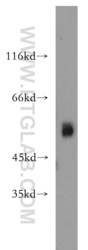
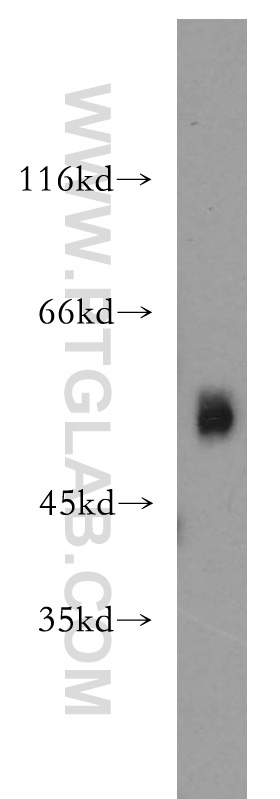
- HeLa cells were subjected to SDS PAGE followed by western blot with 13546-1-AP(ST3GAL4 antibody) at dilution of 1:300
- Sample type
- cell line
Supportive validation
- Submitted by
- Proteintech Group (provider)
- Main image
- Experimental details
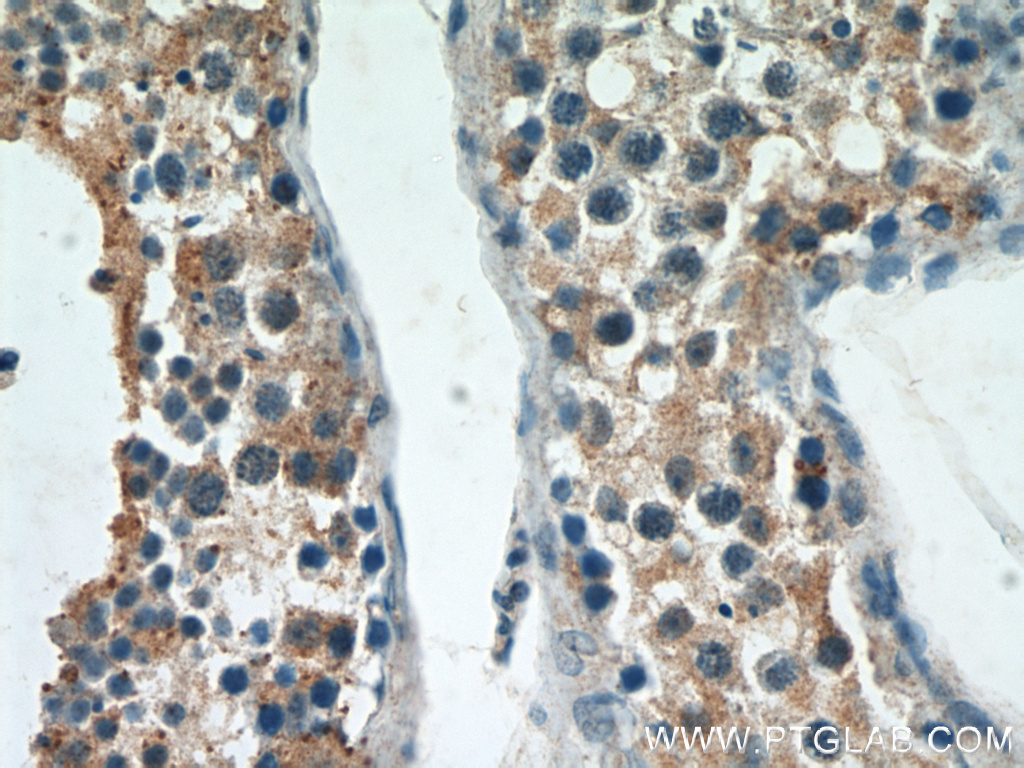
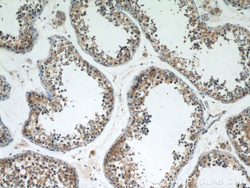
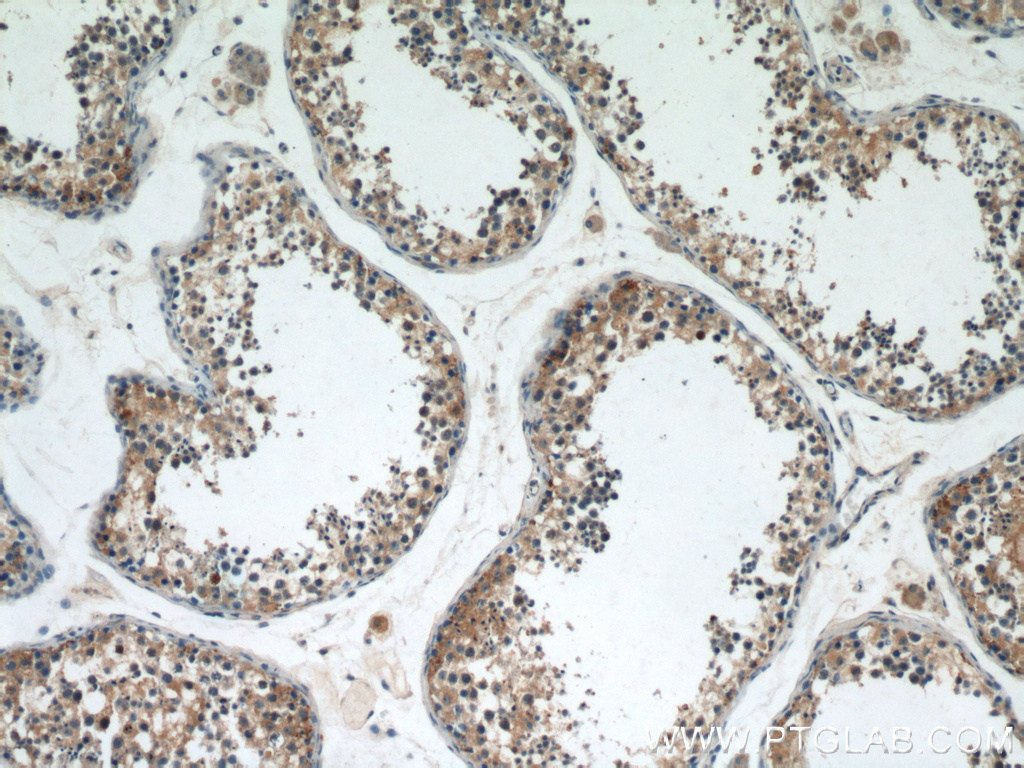
- Immunohistochemical of paraffin-embedded human testis using 13546-1-AP(ST3GAL4 antibody) at dilution of 1:50 (under 10x lens)
- Sample type
- tissue
- Submitted by
- Proteintech Group (provider)
- Main image
- Experimental details
- The ST3GAL4 antibody from Proteintech is a rabbit polyclonal antibody to a recombinant protein of human ST3GAL4. This antibody recognizes human, mouse, rat antigen. The ST3GAL4 antibody has been validated for the following applications: ELISA, WB, IHC analysis.