Explore
 Validate
 Learn
Learn Western blot
 Immunohistochemistry
Antibody data
- Antibody Data
- Antigen structure
- References [6]
- Comments [0]
- Validations
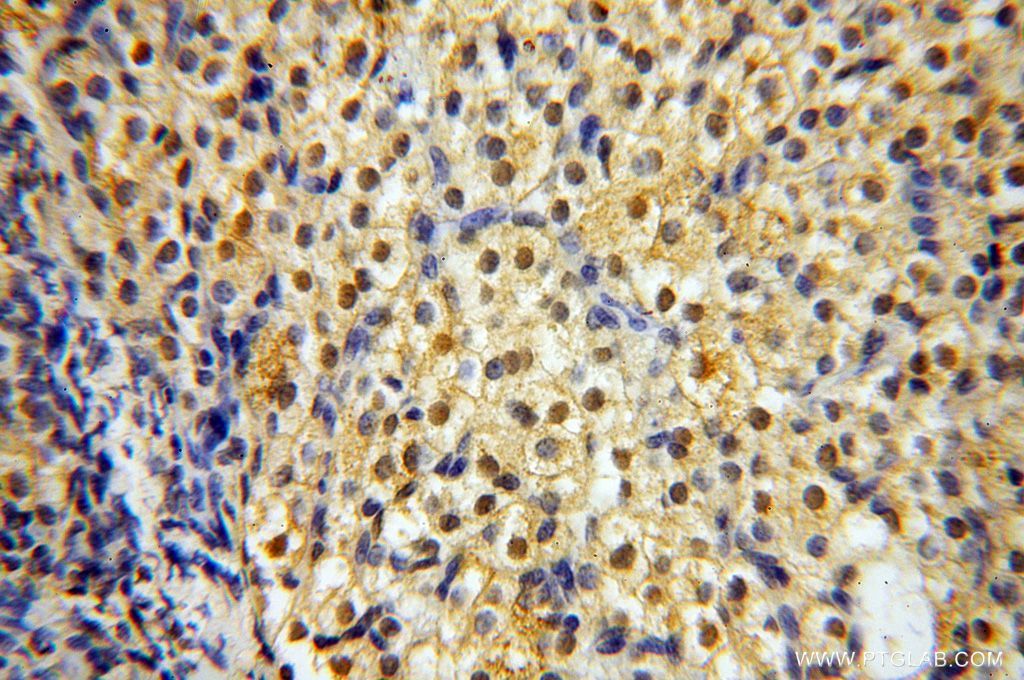
- Immunohistochemistry [2]
Submit
Validation data
Reference
Comment
Report error
- Product number
- 14717-1-AP - Provider product page

- Provider
- Proteintech Group
- Proper citation
- Proteintech Cat#14717-1-AP, RRID:AB_2081548
- Product name
- CNBP antibody
- Antibody type
- Polyclonal
- Description
- KD/KO validated CNBP antibody (Cat. #14717-1-AP) is a rabbit polyclonal antibody that shows reactivity with human, mouse and has been validated for the following applications: IHC, WB,ELISA.
- Reactivity
- Human, Mouse
- Host
- Rabbit
- Conjugate
- Unconjugated
- Isotype
- IgG
- Vial size
- 20ul, 150ul
Submitted references A new candidate tumor suppressor tRF-Ser inhibits gastric cancer progression by regulating the CNBP/HSPA8 axis.
Discovery of Gut-Restricted PRMT5 Inhibitors to Intercept Colorectal Cancer in Patients with Genetic Loss of Tumor Suppressor Adenomatous Polyposis Coli.
Proteostasis regulated by testis-specific ribosomal protein RPL39L maintains mouse spermatogenesis.
Phosphoglucomutase 1 inhibits hepatocellular carcinoma progression by regulating glucose trafficking.
Cellular nucleic acid-binding protein is vital to testis development and spermatogenesis in mice.
Quantitative Proteomics Reveals the Essential Roles of Stromal Interaction Molecule 1 (STIM1) in the Testicular Cord Formation in Mouse Testis.
Jiao J, Wang G, Liu J, Xiao K, Gao Z, Dong D, Shan K, Cui H, Shang L, Li L, Zhang C
Cell death & disease 2026 Mar 25;17(1)
Cell death & disease 2026 Mar 25;17(1)
Discovery of Gut-Restricted PRMT5 Inhibitors to Intercept Colorectal Cancer in Patients with Genetic Loss of Tumor Suppressor Adenomatous Polyposis Coli.
Hulpia F, Schepens W, Lepri S, Nicolaï J, Jiang Z, Boj SF, Bush TL, Carvalho MA, Chen F, Chu G, Clancy KW, Etwebi Z, Everaerts M, Fan Y, Fernandez Candelaria FO, Francis A, Hixon MS, Jardi F, Jin S, Larin EM, Last S, Leenaerts JE, Li S, Liddane AG, Lutter FH, Lv D, Mattson B, Milligan CM, Patrick AN, Patwardhan GA, Perez-Benito L, Pieters S, Renders E, Retzbach E, Smith-Monroy C, Silva J, Silva M, Sterckx H, Ten Hag G, Thäte C, Van Brandt S, Verissimo CS, Verniest G, Vesely E, Vetrano I, Vinken P, Wang Y, Wong V, Yao X, Yang J, Zijlmans R, Bachman KE, Pocalyko D, Jimenez JM, Gaffney D, Thuring JW
Journal of medicinal chemistry 2025 Nov 27;68(22):23825-23866
Journal of medicinal chemistry 2025 Nov 27;68(22):23825-23866
Proteostasis regulated by testis-specific ribosomal protein RPL39L maintains mouse spermatogenesis.
Zou Q, Yang L, Shi R, Qi Y, Zhang X, Qi H
iScience 2021 Dec 17;24(12):103396
iScience 2021 Dec 17;24(12):103396
Phosphoglucomutase 1 inhibits hepatocellular carcinoma progression by regulating glucose trafficking.
Jin GZ, Zhang Y, Cong WM, Wu X, Wang X, Wu S, Wang S, Zhou W, Yuan S, Gao H, Yu G, Yang W
PLoS biology 2018 Oct;16(10):e2006483
PLoS biology 2018 Oct;16(10):e2006483
Cellular nucleic acid-binding protein is vital to testis development and spermatogenesis in mice.
Zheng B, Yu J, Guo Y, Gao T, Shen C, Zhang X, Li H, Huang X
Reproduction (Cambridge, England) 2018 Jul;156(1):59-69
Reproduction (Cambridge, England) 2018 Jul;156(1):59-69
Quantitative Proteomics Reveals the Essential Roles of Stromal Interaction Molecule 1 (STIM1) in the Testicular Cord Formation in Mouse Testis.
Zheng B, Zhao D, Zhang P, Shen C, Guo Y, Zhou T, Guo X, Zhou Z, Sha J
Molecular & cellular proteomics : MCP 2015 Oct;14(10):2682-91
Molecular & cellular proteomics : MCP 2015 Oct;14(10):2682-91
No comments: Submit comment
Supportive validation
- Submitted by
- Proteintech Group (provider)
- Main image
- Experimental details
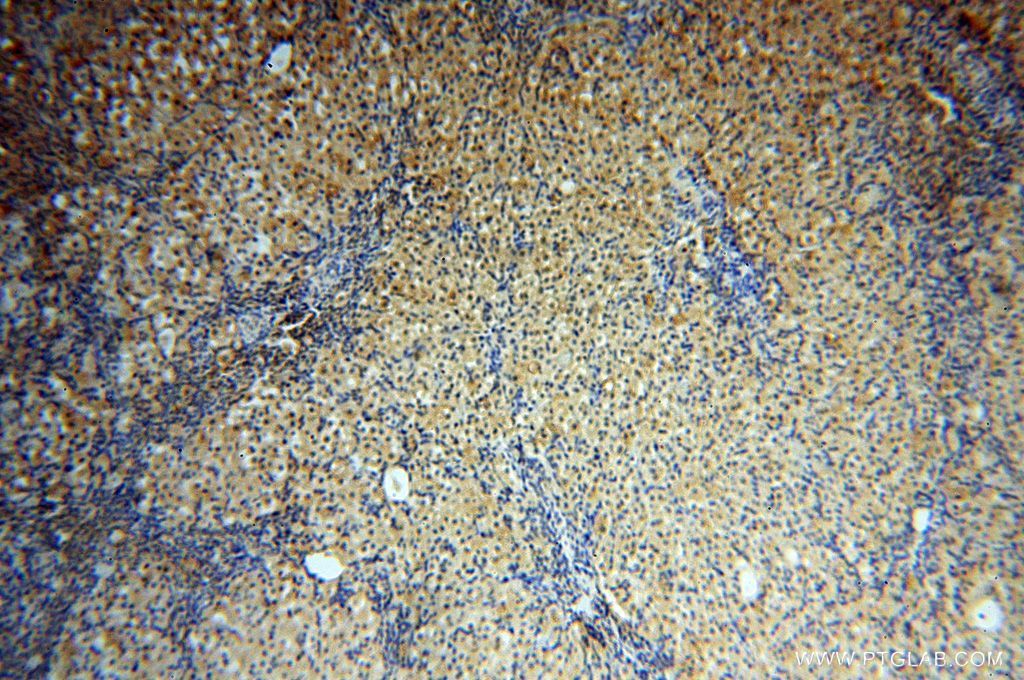
- Immunohistochemical of paraffin-embedded human ovary using 14717-1-AP(CNBP antibody) at dilution of 1:50 (under 10x lens)
- Sample type
- tissue
- Submitted by
- Proteintech Group (provider)
- Main image
- Experimental details
- The CNBP antibody from Proteintech is a rabbit polyclonal antibody to a recombinant protein of human CNBP. This antibody recognizes human, mouse antigen. The CNBP antibody has been validated for the following applications: ELISA, IHC analysis.