Explore
 Validate
 Learn
Learn Flow cytometry
Antibody data
- Antibody Data
- Antigen structure
- References [7]
- Comments [0]
- Validations
- Flow cytometry [1]
Submit
Validation data
Reference
Comment
Report error
- Product number
- 12-0098-41 - Provider product page

- Provider
- Invitrogen Antibodies
- Product name
- Anti-CD9 Monoclonal Antibody (eBioSN4 (SN4 C3-3A2)), PE, eBioscience™
- Antibody type
- Monoclonal
- Antigen
- Other
- Description
- Description: The eBioSN4 monoclonal antibody reacts with human CD9. CD9 is a 24 kDa member of the tetraspanin family, whose members are characterized by the presence of 4 hydrophobic transmembrane domains. CD9 is expressed in platelets, eosinophils, basophils, pre-B cells, activated T cells and neural cell lines. Furthermore, CD9 expression has been associated with a malignant phenotype, including expression on 90% of non T cell acute lymphoblastic leukemia cells and on 50% of chronic lymphocytic and acute myeloblastic leukemias. In platelets, CD9 is expressed in alpha-granules and through association with the integrin alphaIIb/betaIII plays a role in platelet aggregation, as demonstrated by the use of anti-human CD9 antibodies. CD9 has also been shown to induce the aggregation of pre-B cell lines, and the adhesion and migration of pre-B cells and Schwann cells. Additionally, it has been demonstrated that CD9 is able to provide a co-stimulatory signal for T cells independently of CD28, in the absence of antigen-presenting cells. Binding of the eBioSN4 monoclonal antibody partially cross-blocks binding of another anti-human CD9 monoclonal antibody, MM2/57. Applications Reported: This eBioSN4 (SN4 C3-3A2) antibody has been reported for use in flow cytometric analysis. Applications Tested: This eBioSN4 (SN4 C3-3A2) antibody has been pre-titrated and tested by flow cytometric analysis of normal human platelets. This can be used at 5 µL (0.06 µg) per test. A test is defined as the amount (µg) of antibody that will stain a cell sample in a final volume of 100 µL. Cell number should be determined empirically but can range from 10^5 to 10^8 cells/test. Excitation: 488-561 nm; Emission: 578 nm; Laser: Blue Laser, Green Laser, Yellow-Green Laser. Filtration: 0.2 µm post-manufacturing filtered.
- Reactivity
- Human
- Host
- Mouse
- Conjugate
- Yellow dye
- Isotype
- IgG
- Antibody clone number
- eBioSN4 (SN4 C3-3A2)
- Vial size
- 25 Tests
- Concentration
- 5 µL/Test
- Storage
- 4° C, store in dark, DO NOT FREEZE!
Submitted references MLL leukemia induction by t(9;11) chromosomal translocation in human hematopoietic stem cells using genome editing.
Eomesodermin and T-bet mark developmentally distinct human natural killer cells.
Guanine-Rich Sequences Are a Dominant Feature of Exosomal microRNAs across the Mammalian Species and Cell Types.
Human islets contain four distinct subtypes of β cells.
A pilot study of omalizumab in eosinophilic esophagitis.
Microvesicles derived from human umbilical cord Wharton's jelly mesenchymal stem cells attenuate bladder tumor cell growth in vitro and in vivo.
Establishment of ascitic tumor of human pre-B acute lymphoblastic leukemia in nonconditioned nude mice.
Schneidawind C, Jeong J, Schneidawind D, Kim IS, Duque-Afonso J, Wong SHK, Iwasaki M, Breese EH, Zehnder JL, Porteus M, Cleary ML
Blood advances 2018 Apr 24;2(8):832-845
Blood advances 2018 Apr 24;2(8):832-845
Eomesodermin and T-bet mark developmentally distinct human natural killer cells.
Collins A, Rothman N, Liu K, Reiner SL
JCI insight 2017 Mar 9;2(5):e90063
JCI insight 2017 Mar 9;2(5):e90063
Guanine-Rich Sequences Are a Dominant Feature of Exosomal microRNAs across the Mammalian Species and Cell Types.
Momose F, Seo N, Akahori Y, Sawada S, Harada N, Ogura T, Akiyoshi K, Shiku H
PloS one 2016;11(4):e0154134
PloS one 2016;11(4):e0154134
Human islets contain four distinct subtypes of β cells.
Dorrell C, Schug J, Canaday PS, Russ HA, Tarlow BD, Grompe MT, Horton T, Hebrok M, Streeter PR, Kaestner KH, Grompe M
Nature communications 2016 Jul 11;7:11756
Nature communications 2016 Jul 11;7:11756
A pilot study of omalizumab in eosinophilic esophagitis.
Loizou D, Enav B, Komlodi-Pasztor E, Hider P, Kim-Chang J, Noonan L, Taber T, Kaushal S, Limgala R, Brown M, Gupta R, Balba N, Goker-Alpan O, Khojah A, Alpan O
PloS one 2015;10(3):e0113483
PloS one 2015;10(3):e0113483
Microvesicles derived from human umbilical cord Wharton's jelly mesenchymal stem cells attenuate bladder tumor cell growth in vitro and in vivo.
Wu S, Ju GQ, Du T, Zhu YJ, Liu GH
PloS one 2013;8(4):e61366
PloS one 2013;8(4):e61366
Establishment of ascitic tumor of human pre-B acute lymphoblastic leukemia in nonconditioned nude mice.
Luo Y, Hara H, Haruta Y, Seon BK
Cancer research 1989 Feb 1;49(3):706-10
Cancer research 1989 Feb 1;49(3):706-10
No comments: Submit comment
Supportive validation
- Submitted by
- Invitrogen Antibodies (provider)
- Main image
- Experimental details
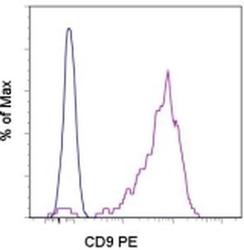
- Staining of normal human peripheral blood cells with Mouse IgG1 kappa Isotype Control PE (Product # 12-4714-81) (blue histogram) or Anti-Human CD9 PE (purple histogram). Cells in the monocyte gate were used for analysis.
- Conjugate
- Yellow dye