Explore
 Validate
 Learn
Learn Western blot
 ELISA
ELISAAntibody data
- Antibody Data
- Antigen structure
- References [9]
- Comments [0]
- Validations
- Western blot [1]
Submit
Validation data
Reference
Comment
Report error
- Product number
- 15956-1-AP - Provider product page

- Provider
- Proteintech Group
- Proper citation
- Proteintech Cat#15956-1-AP, RRID:AB_2237367
- Product name
- PLK2 antibody
- Antibody type
- Polyclonal
- Description
- KD/KO validated PLK2 antibody (Cat. #15956-1-AP) is a rabbit polyclonal antibody that shows reactivity with human, mouse, rat and has been validated for the following applications: IP, WB,ELISA.
- Reactivity
- Human, Mouse, Rat
- Host
- Rabbit
- Conjugate
- Unconjugated
- Isotype
- IgG
- Vial size
- 20ul, 150ul
Submitted references Deciphering single-cell landscape unravels cell-type-specific functional roles of RNA m(6)A modification in atherosclerosis.
Decreased PLK2 promotes atrial fibrillation in diabetic mice through Nrf2/HO-1 pathway.
Chronic low-level exposure to Pb, Hg, and Cd mixture triggers brain premature aging in rat.
Identification and validation of SUN modification-related anti-PD-1 immunotherapy-resistance signatures to predict prognosis and immune microenvironment status in glioblastoma.
Microcystin-LR Exposure Damages Neurons by Inducing α-Syn Aggregation via MAPK4/GATA2/SNCA and PP2A/GRKs Pathways.
PLK2 inhibited oxidative stress and ameliorated hepatic ischemia-reperfusion injury through phosphorylating GSK3β.
Tazarotene-induced gene 1 interacts with Polo-like kinase 2 and inhibits cell proliferation in HCT116 colorectal cancer cells.
PLK2 protects retinal ganglion cells from oxidative stress by potentiating Nrf2 signaling via GSK-3β.
MicroRNA-27b up-regulated by human papillomavirus 16 E7 promotes proliferation and suppresses apoptosis by targeting polo-like kinase2 in cervical cancer.
Ping X, Liang X, Xing W, Wang S, Gong F, Cheng Y, Duan S, Lv X, Li X, Zhang T, Chen C, Zhang Y, Yuan C, Liu S, Liu G, Sun B
Theranostics 2025;15(10):4785-4807
Theranostics 2025;15(10):4785-4807
Decreased PLK2 promotes atrial fibrillation in diabetic mice through Nrf2/HO-1 pathway.
Liu HH, Yang F, Zhang L, Zhang XL, Zhao N, Zhang ZY, Zhou JB, Wei TP, Qian LL, Ding LG, Wang RX
Acta diabetologica 2025 Sep;62(9):1479-1492
Acta diabetologica 2025 Sep;62(9):1479-1492
Chronic low-level exposure to Pb, Hg, and Cd mixture triggers brain premature aging in rat.
Xie J, Ouyang L, Li J, Yang S, Li Q, Li Y, Yan L, Fu Y, Li Q, Xia Y, Chen X, Fu Z, Sun W, Du G, Zhou F, Feng C, Fan G
Toxicology 2025 Sep;516:154196
Toxicology 2025 Sep;516:154196
Identification and validation of SUN modification-related anti-PD-1 immunotherapy-resistance signatures to predict prognosis and immune microenvironment status in glioblastoma.
Zhang H, Gao M, Gao Z, Yao L, Sun H, Wang H, Zhang R, Zhan S
BMC cancer 2025 Nov 29;26(1):7
BMC cancer 2025 Nov 29;26(1):7
Microcystin-LR Exposure Damages Neurons by Inducing α-Syn Aggregation via MAPK4/GATA2/SNCA and PP2A/GRKs Pathways.
Yan M, Wu H, Wu T, Wang Y, Su C, Li D, Han X
Molecular neurobiology 2025 May;62(5):6195-6211
Molecular neurobiology 2025 May;62(5):6195-6211
PLK2 inhibited oxidative stress and ameliorated hepatic ischemia-reperfusion injury through phosphorylating GSK3β.
Ge W, Wang Z, Zhong X, Chen Y, Tang X, Zheng S, Xu X, Wang K
Journal of gastroenterology and hepatology 2025 Jan;40(1):304-314
Journal of gastroenterology and hepatology 2025 Jan;40(1):304-314
Tazarotene-induced gene 1 interacts with Polo-like kinase 2 and inhibits cell proliferation in HCT116 colorectal cancer cells.
Wang CH, Lu TJ, Wang LK, Wu CC, Chen ML, Kuo CY, Shyu RY, Tsai FM
Cell biology international 2021 Nov;45(11):2347-2356
Cell biology international 2021 Nov;45(11):2347-2356
PLK2 protects retinal ganglion cells from oxidative stress by potentiating Nrf2 signaling via GSK-3β.
Fan Y, Wang J, He N, Feng H
Journal of biochemical and molecular toxicology 2021 Aug;35(8):e22815
Journal of biochemical and molecular toxicology 2021 Aug;35(8):e22815
MicroRNA-27b up-regulated by human papillomavirus 16 E7 promotes proliferation and suppresses apoptosis by targeting polo-like kinase2 in cervical cancer.
Liu F, Zhang S, Zhao Z, Mao X, Huang J, Wu Z, Zheng L, Wang Q
Oncotarget 2016 Apr 12;7(15):19666-79
Oncotarget 2016 Apr 12;7(15):19666-79
No comments: Submit comment
Supportive validation
- Submitted by
- Proteintech Group (provider)
- Main image
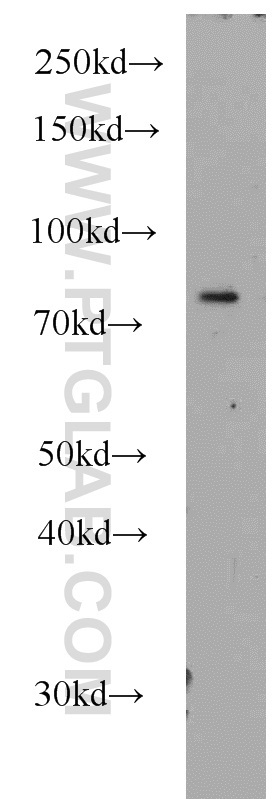
- Experimental details
- The PLK2 antibody from Proteintech is a rabbit polyclonal antibody to a recombinant protein of human PLK2. This antibody recognizes human,mouse,rat antigen. The PLK2 antibody has been validated for the following applications: ELISA, WB analysis.