Explore
 Validate
 Learn
Learn Western blot
 ELISA
ELISAAntibody data
- Antibody Data
- Antigen structure
- References [11]
- Comments [0]
- Validations
- Western blot [1]
Submit
Validation data
Reference
Comment
Report error
- Product number
- 60333-1-Ig - Provider product page

- Provider
- Proteintech Group
- Product name
- TMEM106B antibody
- Antibody type
- Monoclonal
- Description
- KD/KO validated TMEM106B antibody (Cat. #60333-1-Ig) is a mouse monoclonal antibody that shows reactivity with human and has been validated for the following applications: IHC, WB,ELISA.
- Reactivity
- Human
- Host
- Mouse
- Conjugate
- Unconjugated
- Isotype
- IgG
- Antibody clone number
- 5D1F8
- Vial size
- 20ul, 150ul
Submitted references Estradiol facilitates urate excretion by reducing GLUT9 expression via ERβ/TMEM106B/PI3K/AKT1 pathway in renal tubular epithelial cells.
TMEM106B Supports Viral Entry and Syncytia Formation Mediated by the Spike Proteins From Omicron BA.2.86 and JN.1.
Increased TMEM106B levels lead to lysosomal dysfunction which affects synaptic signaling and neuronal health.
TESC acts as a prognostic factor and promotes epithelial-mesenchymal transition progression in esophageal squamous carcinoma.
Tracing TMEM106B fibril deposition in aging and Parkinson's disease with dementia brains.
Lysosomal membrane protein TMEM106B modulates hematopoietic stem and progenitor cell proliferation and differentiation by regulating LAMP2A stability.
The identification of high-performing antibodies for transmembrane protein 106B (TMEM106B) for use in Western blot, immunoprecipitation, and immunofluorescence.
C-terminal TMEM106B fragments in human brain correlate with disease-associated TMEM106B haplotypes.
Accumulation of TMEM106B C-terminal fragments in neurodegenerative disease and aging.
Loss of TMEM106B exacerbates C9ALS/FTD DPR pathology by disrupting autophagosome maturation.
Homotypic fibrillization of TMEM106B across diverse neurodegenerative diseases.
Liu H, Xiao Z, Yue S, Liu Y, Ouyang X, Long K, Liu N, Wang X, Min Y
The international journal of biochemistry & cell biology 2026 Jun-Jul;195-196:106940
The international journal of biochemistry & cell biology 2026 Jun-Jul;195-196:106940
TMEM106B Supports Viral Entry and Syncytia Formation Mediated by the Spike Proteins From Omicron BA.2.86 and JN.1.
Wang Y, Sun H, Liu Y, Song Y, Wang W, Li G, Zhang J, Zhang Y, Chen D, Zhao X
Journal of medical virology 2025 Jul;97(7):e70439
Journal of medical virology 2025 Jul;97(7):e70439
Increased TMEM106B levels lead to lysosomal dysfunction which affects synaptic signaling and neuronal health.
Perneel J, Lastra Osua M, Alidadiani S, Peeters N, De Witte L, Heeman B, Manzella S, De Rycke R, Brooks M, Perkerson RB, Calus E, De Coster W, Neumann M, Mackenzie IRA, Van Dam D, Asselbergh B, Ellender T, Zhou X, Rademakers R
Molecular neurodegeneration 2025 Apr 23;20(1):45
Molecular neurodegeneration 2025 Apr 23;20(1):45
TESC acts as a prognostic factor and promotes epithelial-mesenchymal transition progression in esophageal squamous carcinoma.
Dong Y, Fan B, Li M, Zhang J, Xie S, Di S, Jia Q, Gong T
Pathology, research and practice 2024 Jan;253:154964
Pathology, research and practice 2024 Jan;253:154964
Tracing TMEM106B fibril deposition in aging and Parkinson's disease with dementia brains.
Zhao W, Fan Y, Zhao Q, Fan Z, Zhao J, Yu W, Li W, Li D, Liu C, Wang J
Life medicine 2024 Feb;3(1):lnae011
Life medicine 2024 Feb;3(1):lnae011
Lysosomal membrane protein TMEM106B modulates hematopoietic stem and progenitor cell proliferation and differentiation by regulating LAMP2A stability.
Guo D, Xiong H, Yang Z, Zhang R, Shi P, Yao Y, Liu M, Xu C, Wang QK
FASEB journal : official publication of the Federation of American Societies for Experimental Biology 2024 Aug 15;38(15):e23870
FASEB journal : official publication of the Federation of American Societies for Experimental Biology 2024 Aug 15;38(15):e23870
The identification of high-performing antibodies for transmembrane protein 106B (TMEM106B) for use in Western blot, immunoprecipitation, and immunofluorescence.
Ayoubi R, Fotouhi M, Southern K, Bhajiawala R, Fanti R, Prinos P, McPherson PS, Laflamme C, NeuroSGC/YCharOS/EDDU collaborative group, ABIF Consortium
F1000Research 2023;12:308
F1000Research 2023;12:308
C-terminal TMEM106B fragments in human brain correlate with disease-associated TMEM106B haplotypes.
T Vicente C, Perneel J, Wynants S, Heeman B, Van den Broeck M, Baker M, Cheung S, Faura J, Mackenzie IRA, Rademakers R
Brain : a journal of neurology 2023 Oct 3;146(10):4055-4064
Brain : a journal of neurology 2023 Oct 3;146(10):4055-4064
Accumulation of TMEM106B C-terminal fragments in neurodegenerative disease and aging.
Perneel J, Neumann M, Heeman B, Cheung S, Van den Broeck M, Wynants S, Baker M, Vicente CT, Faura J, Rademakers R, Mackenzie IRA
Acta neuropathologica 2023 Mar;145(3):285-302
Acta neuropathologica 2023 Mar;145(3):285-302
Loss of TMEM106B exacerbates C9ALS/FTD DPR pathology by disrupting autophagosome maturation.
Bauer CS, Webster CP, Shaw AC, Kok JR, Castelli LM, Lin YH, Smith EF, Illanes-Álvarez F, Higginbottom A, Shaw PJ, Azzouz M, Ferraiuolo L, Hautbergue GM, Grierson AJ, De Vos KJ
Frontiers in cellular neuroscience 2022;16:1061559
Frontiers in cellular neuroscience 2022;16:1061559
Homotypic fibrillization of TMEM106B across diverse neurodegenerative diseases.
Chang A, Xiang X, Wang J, Lee C, Arakhamia T, Simjanoska M, Wang C, Carlomagno Y, Zhang G, Dhingra S, Thierry M, Perneel J, Heeman B, Forgrave LM, DeTure M, DeMarco ML, Cook CN, Rademakers R, Dickson DW, Petrucelli L, Stowell MHB, Mackenzie IRA, Fitzpatrick AWP
Cell 2022 Apr 14;185(8):1346-1355.e15
Cell 2022 Apr 14;185(8):1346-1355.e15
No comments: Submit comment
Supportive validation
- Submitted by
- Proteintech Group (provider)
- Main image
- Experimental details
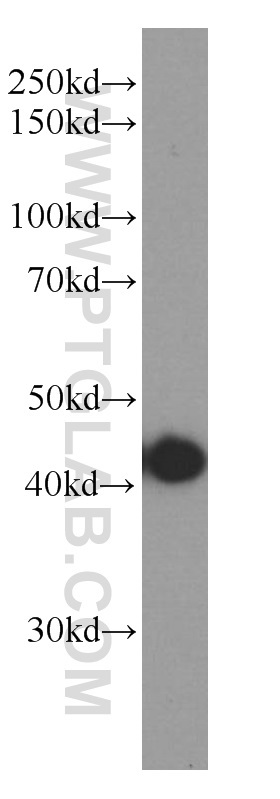
- U-251 cells were subjected to SDS PAGE followed by western blot with 60333-1-Ig( TMEM106B Antibody) at dilution of 1:1000
- Validation comment
- WB