Explore
 Validate
 Learn
Learn Western blot
 ELISA
ELISAAntibody data
- Antibody Data
- Antigen structure
- References [9]
- Comments [0]
- Validations
- Western blot [1]
- Immunoprecipitation [1]
- Immunohistochemistry [2]
Submit
Validation data
Reference
Comment
Report error
- Product number
- 16999-1-AP - Provider product page

- Provider
- Proteintech Group
- Proper citation
- Proteintech Cat#16999-1-AP, RRID:AB_2214070
- Product name
- UFSP2 antibody
- Antibody type
- Polyclonal
- Description
- UFSP2 antibody (Cat. #16999-1-AP) is a rabbit polyclonal antibody that shows reactivity with human, mouse, rat and has been validated for the following applications: IF, IHC, IP, WB,ELISA.
- Reactivity
- Human, Mouse, Rat
- Host
- Rabbit
- Conjugate
- Unconjugated
- Isotype
- IgG
- Vial size
- 20ul, 150ul
Submitted references Loss of UFL1 confers enzalutamide resistance of prostate tumors by regulating METTL16-mediated m6A modification of EEF1A1 mRNA.
The UFL1-AKT positive feedback loop promotes breast cancer progression by enhancing lipid synthesis.
Targeting the UFL1-AKT cascade suppresses triple-negative breast cancer progression.
Loss of Ufsp1 does not cause major changes at the neuromuscular junction.
Akt-phosphorylated UFL1 UFMylates ArpC4 to promote metastasis.
The ufmylation cascade controls COPII recruitment, anterograde transport, and sorting of nascent GPCRs at ER.
UFMylation of HRD1 regulates endoplasmic reticulum homeostasis.
Ufmylation of UFBP1 Is Dispensable for Endoplasmic Reticulum Stress Response, Embryonic Development, and Cardiac and Intestinal Homeostasis.
A pathogenic UFSP2 variant in an autosomal recessive form of pediatric neurodevelopmental anomalies and epilepsy.
Wu X, Gao H, Zhuang Q, Li F, Feng X, Shao N, Zhang W, Zhang Y, Zhang X
International journal of biological sciences 2026;22(3):1306-1321
International journal of biological sciences 2026;22(3):1306-1321
The UFL1-AKT positive feedback loop promotes breast cancer progression by enhancing lipid synthesis.
Meng F, Du Y, Liang J, Li H, Wang J, Tang K, Kong R, Sun H, Yin T, Qin J, Yang X, Shan C, Liu M, Yang G, Zhang J, Wang Y, Zhou J, Chen Y
Nature communications 2026 Jan 20;17(1):614
Nature communications 2026 Jan 20;17(1):614
Targeting the UFL1-AKT cascade suppresses triple-negative breast cancer progression.
Yang X, Wen Y, Ma X, Qin S, Liu Y, Chen J, Zhang H, Goding CR, Cui R, Liu T
Nature communications 2026 Jan 20;17(1):613
Nature communications 2026 Jan 20;17(1):613
Loss of Ufsp1 does not cause major changes at the neuromuscular junction.
Calvo C, Smith C, Song T, Montecino-Morales F, Sadayappan S, Millay DP, Kim M
PloS one 2025;20(8):e0328690
PloS one 2025;20(8):e0328690
Akt-phosphorylated UFL1 UFMylates ArpC4 to promote metastasis.
Zhao K, Hu H, Fang D, Xie M, Chen J, Zhang S, Tang S, Wu M, Guo X, Yu N, Yao B, Jiang W, Wang C, Mei Y
Nature structural & molecular biology 2025 Aug;32(8):1528-1541
Nature structural & molecular biology 2025 Aug;32(8):1528-1541
The ufmylation cascade controls COPII recruitment, anterograde transport, and sorting of nascent GPCRs at ER.
Xu X, Huang W, Bryant CN, Dong Z, Li H, Wu G
Science advances 2024 Jun 21;10(25):eadm9216
Science advances 2024 Jun 21;10(25):eadm9216
UFMylation of HRD1 regulates endoplasmic reticulum homeostasis.
Luo H, Jiao QB, Shen CB, Gong WY, Yuan JH, Liu YY, Chen Z, Liu J, Xu XL, Cong YS, Zhang XW
FASEB journal : official publication of the Federation of American Societies for Experimental Biology 2023 Nov;37(11):e23221
FASEB journal : official publication of the Federation of American Societies for Experimental Biology 2023 Nov;37(11):e23221
Ufmylation of UFBP1 Is Dispensable for Endoplasmic Reticulum Stress Response, Embryonic Development, and Cardiac and Intestinal Homeostasis.
Tandra V, Anderson T, Ayala JD, Weintraub NL, Singh N, Li H, Li J
Cells 2023 Jul 25;12(15)
Cells 2023 Jul 25;12(15)
A pathogenic UFSP2 variant in an autosomal recessive form of pediatric neurodevelopmental anomalies and epilepsy.
Ni M, Afroze B, Xing C, Pan C, Shao Y, Cai L, Cantarel BL, Pei J, Grishin NV, Hewson S, Knight D, Mahida S, Michel D, Tarnopolsky M, Poduri A, Rotenberg A, Sondheimer N, DeBerardinis RJ
Genetics in medicine : official journal of the American College of Medical Genetics 2021 May;23(5):900-908
Genetics in medicine : official journal of the American College of Medical Genetics 2021 May;23(5):900-908
No comments: Submit comment
Supportive validation
- Submitted by
- Proteintech Group (provider)
- Main image
- Experimental details
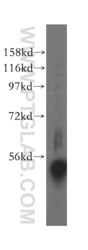
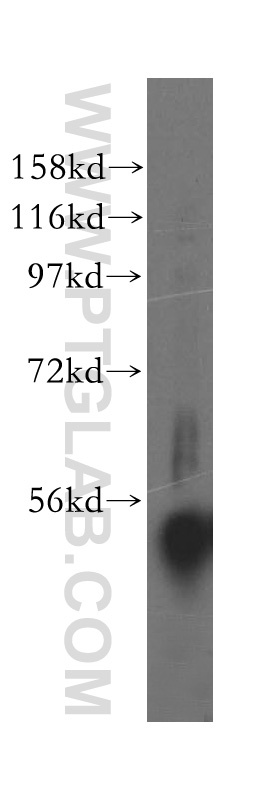
- mouse pancreas tissue were subjected to SDS PAGE followed by western blot with 16999-1-AP(UFSP2 antibody) at dilution of 1:400
- Sample type
- tissue
Supportive validation
- Submitted by
- Proteintech Group (provider)
- Main image
- Experimental details
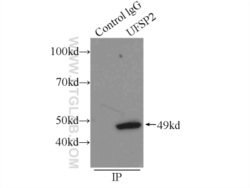
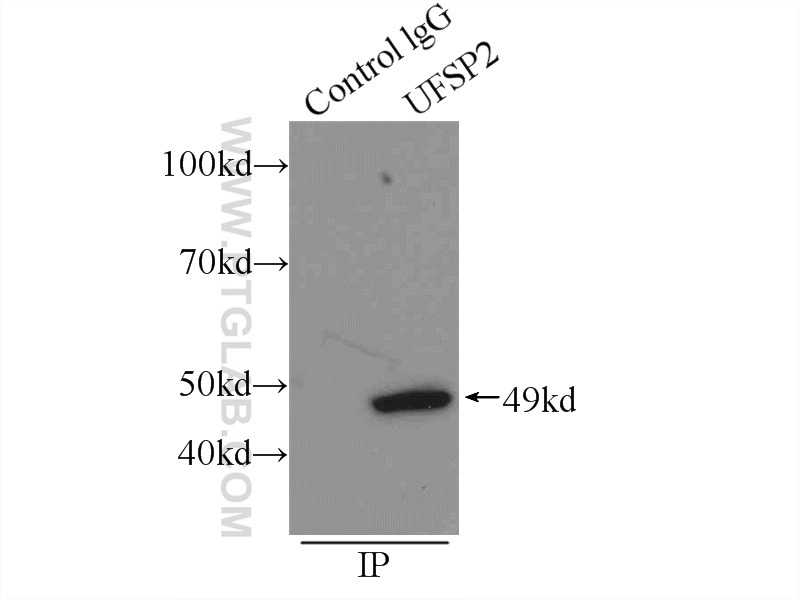
- IP Result of anti-UFSP2 (IP:16999-1-AP, 3ug; Detection:16999-1-AP 1:1000) with HepG2 cells lysate 1700ug.
- Sample type
- cell line
Supportive validation
- Submitted by
- Proteintech Group (provider)
- Main image
- Experimental details
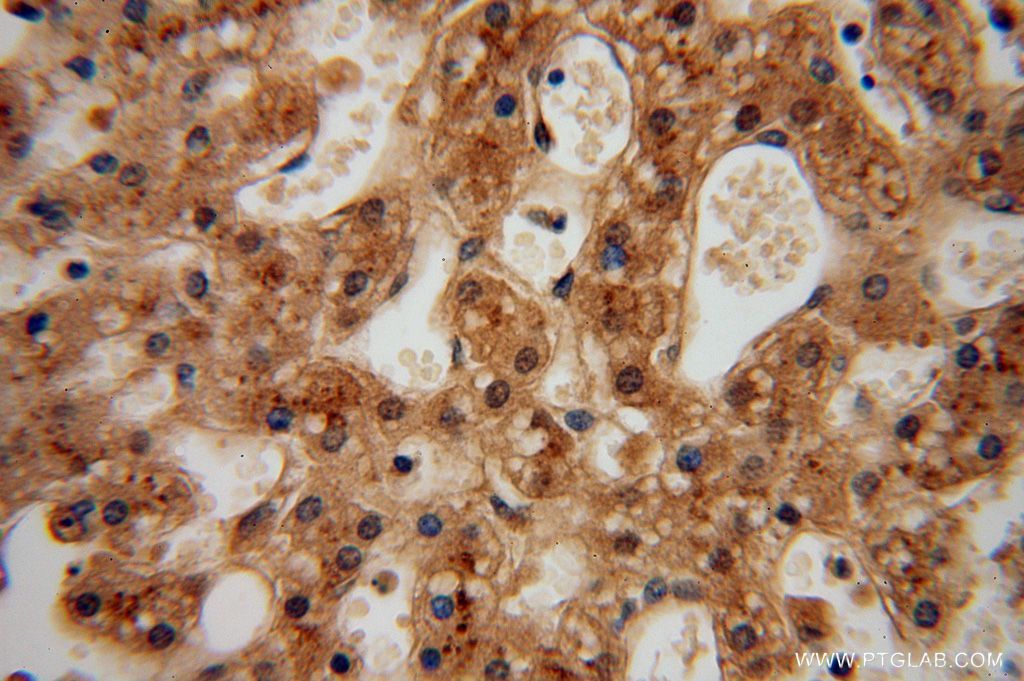
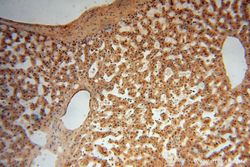
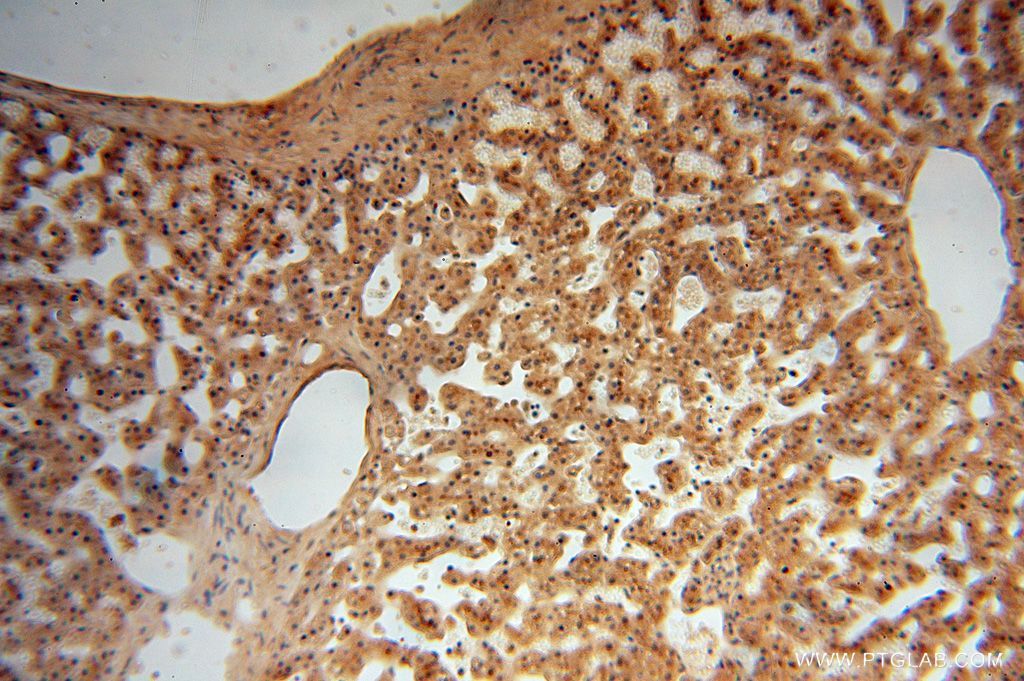
- Immunohistochemical of paraffin-embedded human liver using 16999-1-AP(UFSP2 antibody) at dilution of 1:100 (under 10x lens)
- Sample type
- tissue
- Submitted by
- Proteintech Group (provider)
- Main image
- Experimental details
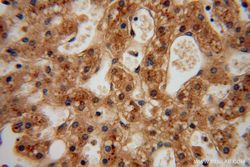
- The UFSP2 antibody from Proteintech is a rabbit polyclonal antibody to a recombinant protein of human UFSP2. This antibody recognizes human,mouse,rat antigen. The UFSP2 antibody has been validated for the following applications: ELISA, WB, IHC, IP analysis.