Explore
 Validate
 Learn
Learn Western blot
 ELISA
ELISAAntibody data
- Antibody Data
- Antigen structure
- References [10]
- Comments [0]
- Validations
- Western blot [1]
- Immunohistochemistry [2]
Submit
Validation data
Reference
Comment
Report error
- Product number
- 17002-1-AP - Provider product page

- Provider
- Proteintech Group
- Proper citation
- Proteintech Cat#17002-1-AP, RRID:AB_2240206
- Product name
- TBC1D23 antibody
- Antibody type
- Polyclonal
- Description
- TBC1D23 antibody (Cat. #17002-1-AP) is a rabbit polyclonal antibody that shows reactivity with human, mouse, rat and has been validated for the following applications: IF, IHC, IP, WB,ELISA.
- Reactivity
- Human, Mouse, Rat
- Host
- Rabbit
- Conjugate
- Unconjugated
- Isotype
- IgG
- Vial size
- 20ul, 150ul
Submitted references The functional landscape of alternative splicing in hematopoietic lineage commitment.
Divergent proteome tolerance against gain and loss of chromosome arms.
Trans-Golgi network tethering factors regulate TBK1 trafficking and promote the STING-IFN-I pathway.
A CRISPR/Cas9 screen reveals proteins at the endosome-Golgi interface that modulate cellular anti-sense oligonucleotide activity.
TBC1D23 mediates Golgi-specific LKB1 signaling.
The WDR11 complex is a receptor for acidic-cluster-containing cargo proteins.
TBC1 domain family member 23 interacts with Ras-related protein Rab-11A to promote poor prognosis of non-small-cell lung cancer via β1-integrin.
Homozygous Mutations in TBC1D23 Lead to a Non-degenerative Form of Pontocerebellar Hypoplasia.
Homozygous Truncating Variants in TBC1D23 Cause Pontocerebellar Hypoplasia and Alter Cortical Development.
Identification of frequently mutated genes with relevance to nonsense mediated mRNA decay in the high microsatellite instability cancers.
Hu X, Wang J, Chen L, Yang Q, Tardaguila M, Mao B, Niu S, Xu Z, Wang G, Zhang D, Zhang Y, Zhou Z, Luo J, He Z, Liu D, Tang C, Soranzo N, Lin JW, Jia D, Chen L
Nature communications 2026 Jan 27;17(1)
Nature communications 2026 Jan 27;17(1)
Divergent proteome tolerance against gain and loss of chromosome arms.
Di Y, Li W, Castellano JJ, Jin W, Modi JN, Salovska B, Khosroabadi D, Hu W, Taylor AM, Liu Y
Molecular cell 2025 Nov 20;85(22):4268-4278.e6
Molecular cell 2025 Nov 20;85(22):4268-4278.e6
Trans-Golgi network tethering factors regulate TBK1 trafficking and promote the STING-IFN-I pathway.
Wang J, Niu S, Hu X, Li T, Liu S, Tu Y, Shang Z, Zhao L, Xu P, Lin J, Chen L, Billadeau DD, Jia D
Cell discovery 2025 Mar 18;11(1):23
Cell discovery 2025 Mar 18;11(1):23
A CRISPR/Cas9 screen reveals proteins at the endosome-Golgi interface that modulate cellular anti-sense oligonucleotide activity.
Malong L, Roskosch J, Hager C, Fortin JP, Schmucki R, Callow MG, Weile C, Romeo V, Patsch C, Martin S, Costa M, Modrusan Z, Villaseñor R, Koller E, Haley B, Spang A, Roudnicky F
Nature communications 2025 Jun 30;16(1):5378
Nature communications 2025 Jun 30;16(1):5378
TBC1D23 mediates Golgi-specific LKB1 signaling.
Tu Y, Yang Q, Tang M, Gao L, Wang Y, Wang J, Liu Z, Li X, Mao L, Jia RZ, Wang Y, Tang TS, Xu P, Liu Y, Dai L, Jia D
Nature communications 2024 Feb 27;15(1):1785
Nature communications 2024 Feb 27;15(1):1785
The WDR11 complex is a receptor for acidic-cluster-containing cargo proteins.
Deng H, Jia G, Li P, Tang Y, Zhao L, Yang Q, Zhao J, Wang J, Tu Y, Yong X, Zhang S, Mo X, Billadeau DD, Su Z, Jia D
Cell 2024 Aug 8;187(16):4272-4288.e20
Cell 2024 Aug 8;187(16):4272-4288.e20
TBC1 domain family member 23 interacts with Ras-related protein Rab-11A to promote poor prognosis of non-small-cell lung cancer via β1-integrin.
Zhang Y, Su H, Wudu M, Ren H, Xu Y, Zhang Q, Jiang J, Wang Q, Jiang X, Zhang B, Liu Z, Zou Z, Qiu X
Journal of cellular and molecular medicine 2021 Sep;25(18):8821-8835
Journal of cellular and molecular medicine 2021 Sep;25(18):8821-8835
Homozygous Mutations in TBC1D23 Lead to a Non-degenerative Form of Pontocerebellar Hypoplasia.
Marin-Valencia I, Gerondopoulos A, Zaki MS, Ben-Omran T, Almureikhi M, Demir E, Guemez-Gamboa A, Gregor A, Issa MY, Appelhof B, Roosing S, Musaev D, Rosti B, Wirth S, Stanley V, Baas F, Barr FA, Gleeson JG
American journal of human genetics 2017 Sep 7;101(3):441-450
American journal of human genetics 2017 Sep 7;101(3):441-450
Homozygous Truncating Variants in TBC1D23 Cause Pontocerebellar Hypoplasia and Alter Cortical Development.
Ivanova EL, Mau-Them FT, Riazuddin S, Kahrizi K, Laugel V, Schaefer E, de Saint Martin A, Runge K, Iqbal Z, Spitz MA, Laura M, Drouot N, Gérard B, Deleuze JF, de Brouwer APM, Razzaq A, Dollfus H, Assir MZ, Nitchké P, Hinckelmann MV, Ropers H, Riazuddin S, Najmabadi H, van Bokhoven H, Chelly J
American journal of human genetics 2017 Sep 7;101(3):428-440
American journal of human genetics 2017 Sep 7;101(3):428-440
Identification of frequently mutated genes with relevance to nonsense mediated mRNA decay in the high microsatellite instability cancers.
Shin N, You KT, Lee H, Kim WK, Song M, Choi HJ, Rhee H, Nam SW, Kim H
International journal of cancer 2011 Jun 15;128(12):2872-80
International journal of cancer 2011 Jun 15;128(12):2872-80
No comments: Submit comment
Supportive validation
- Submitted by
- Proteintech Group (provider)
- Main image
- Experimental details
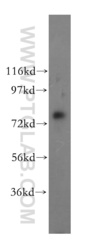
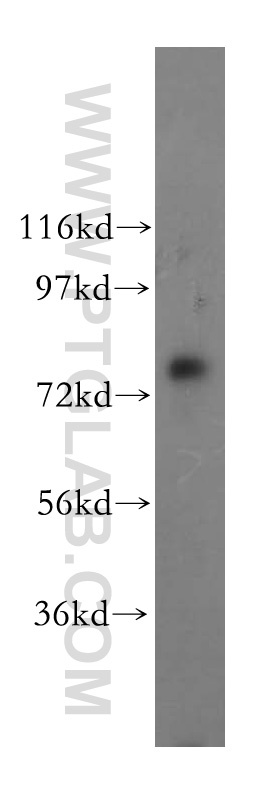
- HepG2 cells were subjected to SDS PAGE followed by western blot with 17002-1-AP(TBC1D23 antibody) at dilution of 1:500
- Sample type
- cell line
Supportive validation
- Submitted by
- Proteintech Group (provider)
- Main image
- Experimental details
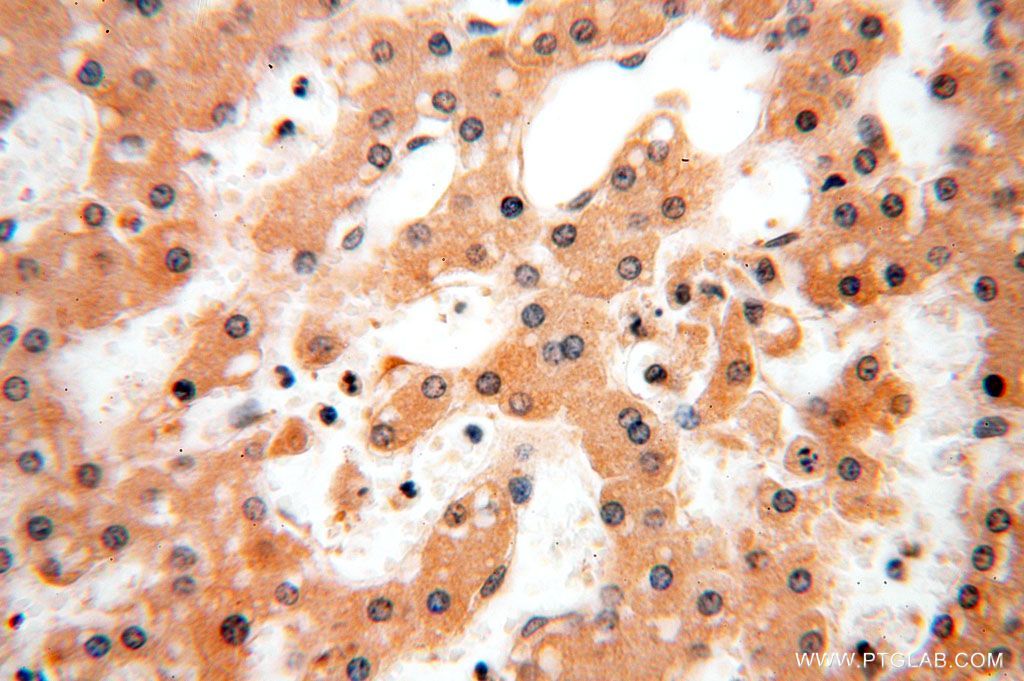
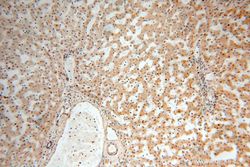
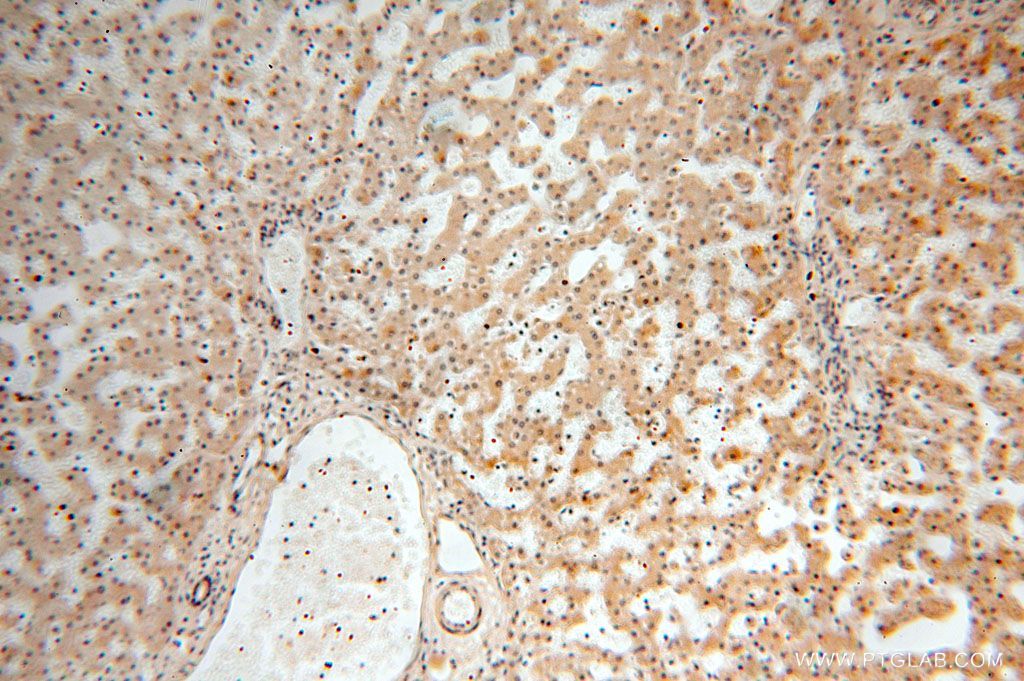
- Immunohistochemical of paraffin-embedded human liver using 17002-1-AP(TBC1D23 antibody) at dilution of 1:100 (under 10x lens)
- Sample type
- tissue
- Submitted by
- Proteintech Group (provider)
- Main image
- Experimental details
- The TBC1D23 antibody from Proteintech is a rabbit polyclonal antibody to a recombinant protein of human TBC1D23. This antibody recognizes human, mouse, rat antigen. The TBC1D23 antibody has been validated for the following applications: ELISA, WB, IHC analysis.