Explore
 Validate
 Learn
Learn Western blot
 ELISA
ELISAAntibody data
- Antibody Data
- Antigen structure
- References [13]
- Comments [0]
- Validations
- Western blot [1]
Submit
Validation data
Reference
Comment
Report error
- Product number
- 55149-1-AP - Provider product page

- Provider
- Proteintech Group
- Proper citation
- Proteintech Cat#55149-1-AP, RRID:AB_10858796
- Product name
- PARP2 antibody
- Antibody type
- Polyclonal
- Description
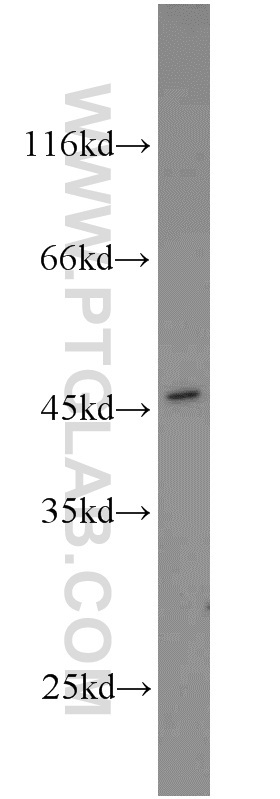
- PARP2 antibody (Cat. #55149-1-AP) is a rabbit polyclonal antibody that shows reactivity with human, mouse and has been validated for the following applications: IF, IHC, WB,ELISA.
- Reactivity
- Human, Mouse
- Host
- Rabbit
- Conjugate
- Unconjugated
- Isotype
- IgG
- Vial size
- 20ul, 150ul
Submitted references Stabilization of AFF1 by PARylation ensures transcriptional restart after DNA damage.
Multi-cohort analysis and experimental study on the function of squalene epoxidase as a ferroptosis inhibitor in HCC.
Duplexed CeTEAM drug biosensors reveal determinants of PARP inhibitor selectivity in cells.
PARP1 Promotes Heart Regeneration and Cardiomyocyte Proliferation.
A Novel Prognostic Model of Hepatocellular Carcinoma per Two NAD+ Metabolic Synthesis-Associated Genes.
Leveraging a rationally designed veliparib-based anilide eliciting anti-leukemic effects for the design of pH-responsive polymer nanoformulation.
Control of NAD(+) homeostasis by autophagic flux modulates mitochondrial and cardiac function.
Coupling cellular drug-target engagement to downstream pharmacology with CeTEAM.
Minimizing DNA trapping while maintaining activity inhibition via selective PARP1 degrader.
Enhancing therapeutic efficacy in homologous recombination-proficient pancreatic cancer via the combination of PARP1-PROTAC and a BRD4 inhibitor.
Poly(ADP-Ribose) Polymerase-1 Lacking Enzymatic Activity Is Not Compatible with Mouse Development.
Selective degradation of PARP2 by PROTACs via recruiting DCAF16 for triple-negative breast cancer.
CPSF4 regulates circRNA formation and microRNA mediated gene silencing in hepatocellular carcinoma.
Zhu F, Fu H, Zhu W, Li C, Yang M, Feng Z, Shao Y, Li Z, Guo Y, Huang M, Zhang Y, He Y, Lu Y, Wu Z, Zhou Q, Jiao H, Huang J, Zhang L, Xue Y, Lu H
Nature chemical biology 2026 May;22(5):702-715
Nature chemical biology 2026 May;22(5):702-715
Multi-cohort analysis and experimental study on the function of squalene epoxidase as a ferroptosis inhibitor in HCC.
Yang X, Wu Y, Zhang Q, Zhou Y, Chang S, Zhang C, Liu D
BMC cancer 2025 Dec 13;26(1):81
BMC cancer 2025 Dec 13;26(1):81
Duplexed CeTEAM drug biosensors reveal determinants of PARP inhibitor selectivity in cells.
Pires MJ, Alam S, Lovric A, Fabbrizi E, Rotili D, Altun M, Valerie NCK
The Journal of biological chemistry 2025 Apr;301(4):108361
The Journal of biological chemistry 2025 Apr;301(4):108361
PARP1 Promotes Heart Regeneration and Cardiomyocyte Proliferation.
Shu J, Yan S, Ju C, Chen L, Liang M, Wang C, Huang K
International journal of biological sciences 2024;20(5):1602-1616
International journal of biological sciences 2024;20(5):1602-1616
A Novel Prognostic Model of Hepatocellular Carcinoma per Two NAD+ Metabolic Synthesis-Associated Genes.
Dai L, Lu S, Mao L, Zhong M, Feng G, He S, Yuan G
International journal of molecular sciences 2024 Sep 26;25(19)
International journal of molecular sciences 2024 Sep 26;25(19)
Leveraging a rationally designed veliparib-based anilide eliciting anti-leukemic effects for the design of pH-responsive polymer nanoformulation.
Thakur A, Chu YH, Rao NV, Mathew J, Grewal AS, Prabakaran P, Guru S, Liou JP, Pan CH, Nepali K
European journal of medicinal chemistry 2024 Jul 5;273:116507
European journal of medicinal chemistry 2024 Jul 5;273:116507
Control of NAD(+) homeostasis by autophagic flux modulates mitochondrial and cardiac function.
Zhang Q, Li Z, Li Q, Trammell SA, Schmidt MS, Pires KM, Cai J, Zhang Y, Kenny H, Boudina S, Brenner C, Abel ED
The EMBO journal 2024 Feb;43(3):362-390
The EMBO journal 2024 Feb;43(3):362-390
Coupling cellular drug-target engagement to downstream pharmacology with CeTEAM.
Valerie NCK, Sanjiv K, Mortusewicz O, Zhang SM, Alam S, Pires MJ, Stigsdotter H, Rasti A, Langelier MF, Rehling D, Throup A, Purewal-Sidhu O, Desroses M, Onireti J, Wakchaure P, Almlöf I, Boström J, Bevc L, Benzi G, Stenmark P, Pascal JM, Helleday T, Page BDG, Altun M
Nature communications 2024 Dec 6;15(1):10347
Nature communications 2024 Dec 6;15(1):10347
Minimizing DNA trapping while maintaining activity inhibition via selective PARP1 degrader.
Chen L, Zou Y, Sun R, Huang M, Zhu X, Tang X, Yang X, Li D, Fan G, Wang Y
Cell death & disease 2024 Dec 18;15(12):898
Cell death & disease 2024 Dec 18;15(12):898
Enhancing therapeutic efficacy in homologous recombination-proficient pancreatic cancer via the combination of PARP1-PROTAC and a BRD4 inhibitor.
Pu C, Liu Y, Lan S, Fan H, Liu L, Liu J, Guo Y
Bioorganic & medicinal chemistry 2024 Dec 1;115:117970
Bioorganic & medicinal chemistry 2024 Dec 1;115:117970
Poly(ADP-Ribose) Polymerase-1 Lacking Enzymatic Activity Is Not Compatible with Mouse Development.
Kamaletdinova T, Zong W, Urbánek P, Wang S, Sannai M, Grigaravičius P, Sun W, Fanaei-Kahrani Z, Mangerich A, Hottiger MO, Li T, Wang ZQ
Cells 2023 Aug 16;12(16)
Cells 2023 Aug 16;12(16)
Selective degradation of PARP2 by PROTACs via recruiting DCAF16 for triple-negative breast cancer.
Pu C, Tong Y, Liu Y, Lan S, Wang S, Yan G, Zhang H, Luo D, Ma X, Yu S, Huang Q, Deng R, Li R
European journal of medicinal chemistry 2022 Jun 5;236:114321
European journal of medicinal chemistry 2022 Jun 5;236:114321
CPSF4 regulates circRNA formation and microRNA mediated gene silencing in hepatocellular carcinoma.
Wang X, Dong J, Li X, Cheng Z, Zhu Q
Oncogene 2021 Jun;40(25):4338-4351
Oncogene 2021 Jun;40(25):4338-4351
No comments: Submit comment
Supportive validation
- Submitted by
- Proteintech Group (provider)
- Main image
- Experimental details
- The PARP2 antibody from Proteintech is a rabbit polyclonal antibody to a peptide of human PARP2. This antibody recognizes human, mouse antigen. The PARP2 antibody has been validated for the following applications: ELISA, WB analysis.