Explore
 Validate
 Learn
Learn Western blot
 Immunocytochemistry
Antibody data
- Antibody Data
- Antigen structure
- References [11]
- Comments [0]
- Validations
- Immunocytochemistry [1]
Submit
Validation data
Reference
Comment
Report error
- Product number
- HPA039441 - Provider product page

- Provider
- Atlas Antibodies
- Proper citation
- Atlas Antibodies Cat#HPA039441, RRID:AB_10671042
- Product name
- Anti-SMCHD1
- Antibody type
- Polyclonal
- Description
- Polyclonal Antibody against Human SMCHD1, Gene description: structural maintenance of chromosomes flexible hinge domain containing 1, Alternative Gene Names: KIAA0650, Validated applications: IHC, WB, ICC, Uniprot ID: A6NHR9, Storage: Store at +4°C for short term storage. Long time storage is recommended at -20°C.
- Reactivity
- Human
- Host
- Rabbit
- Conjugate
- Unconjugated
- Isotype
- IgG
- Vial size
- 100 µl
- Concentration
- 0.1 mg/ml
- Storage
- Store at +4°C for short term storage. Long time storage is recommended at -20°C.
- Handling
- The antibody solution should be gently mixed before use.
Submitted references In skeletal muscle and neural crest cells, SMCHD1 regulates biological pathways relevant for Bosma syndrome and facioscapulohumeral dystrophy phenotype
Replication dynamics identifies the folding principles of the inactive X chromosome
SMCHD1 has separable roles in chromatin architecture and gene silencing that could be targeted in disease
HOX epimutations driven by maternal SMCHD1/LRIF1 haploinsufficiency trigger homeotic transformations in genetically wildtype offspring
PRC1 collaborates with SMCHD1 to fold the X-chromosome and spread Xist RNA between chromosome compartments
Identification of SMCHD1 domains for nuclear localization, homo-dimerization, and protein cleavage
FSHD2- and BAMS-associated mutations confer opposing effects on SMCHD1 function
SMCHD1 Merges Chromosome Compartments and Assists Formation of Super-Structures on the Inactive X
De novo mutations in SMCHD1 cause Bosma arhinia microphthalmia syndrome and abrogate nasal development
Segregation between SMCHD1 mutation, D4Z4 hypomethylation and Facio-Scapulo-Humeral Dystrophy: a case report
Digenic inheritance of an SMCHD1 mutation and an FSHD-permissive D4Z4 allele causes facioscapulohumeral muscular dystrophy type 2
Laberthonnière C, Delourme M, Chevalier R, Dion C, Ganne B, Hirst D, Caron L, Perrin P, Adélaïde J, Chaffanet M, Xue S, Nguyen K, Reversade B, Déjardin J, Baudot A, Robin J, Magdinier F
Nucleic Acids Research 2023;51(14):7269-7287
Nucleic Acids Research 2023;51(14):7269-7287
Replication dynamics identifies the folding principles of the inactive X chromosome
Poonperm R, Ichihara S, Miura H, Tanigawa A, Nagao K, Obuse C, Sado T, Hiratani I
Nature Structural & Molecular Biology 2023;30(8):1224-1237
Nature Structural & Molecular Biology 2023;30(8):1224-1237
SMCHD1 has separable roles in chromatin architecture and gene silencing that could be targeted in disease
Tapia del Fierro A, den Hamer B, Benetti N, Jansz N, Chen K, Beck T, Vanyai H, Gurzau A, Daxinger L, Xue S, Ly T, Wanigasuriya I, Iminitoff M, Breslin K, Oey H, Krom Y, van der Hoorn D, Bouwman L, Johanson T, Ritchie M, Gouil Q, Reversade B, Prin F, Mohun T, van der Maarel S, McGlinn E, Murphy J, Keniry A, de Greef J, Blewitt M
Nature Communications 2023;14(1)
Nature Communications 2023;14(1)
HOX epimutations driven by maternal SMCHD1/LRIF1 haploinsufficiency trigger homeotic transformations in genetically wildtype offspring
Xue S, Ly T, Vijayakar R, Chen J, Ng J, Mathuru A, Magdinier F, Reversade B
Nature Communications 2022;13(1)
Nature Communications 2022;13(1)
PRC1 collaborates with SMCHD1 to fold the X-chromosome and spread Xist RNA between chromosome compartments
Wang C, Colognori D, Sunwoo H, Wang D, Lee J
Nature Communications 2019;10(1)
Nature Communications 2019;10(1)
Identification of SMCHD1 domains for nuclear localization, homo-dimerization, and protein cleavage
Hiramuki Y, Tapscott S
Skeletal Muscle 2018;8(1)
Skeletal Muscle 2018;8(1)
FSHD2- and BAMS-associated mutations confer opposing effects on SMCHD1 function
Gurzau A, Chen K, Xue S, Dai W, Lucet I, Ly T, Reversade B, Blewitt M, Murphy J
Journal of Biological Chemistry 2018;293(25):9841-9853
Journal of Biological Chemistry 2018;293(25):9841-9853
SMCHD1 Merges Chromosome Compartments and Assists Formation of Super-Structures on the Inactive X
Wang C, Jégu T, Chu H, Oh H, Lee J
Cell 2018;174(2):406-421.e25
Cell 2018;174(2):406-421.e25
De novo mutations in SMCHD1 cause Bosma arhinia microphthalmia syndrome and abrogate nasal development
Gordon C, Xue S, Yigit G, Filali H, Chen K, Rosin N, Yoshiura K, Oufadem M, Beck T, McGowan R, Magee A, Altmüller J, Dion C, Thiele H, Gurzau A, Nürnberg P, Meschede D, Mühlbauer W, Okamoto N, Varghese V, Irving R, Sigaudy S, Williams D, Ahmed S, Bonnard C, Kong M, Ratbi I, Fejjal N, Fikri M, Elalaoui S, Reigstad H, Bole-Feysot C, Nitschké P, Ragge N, Lévy N, Tunçbilek G, Teo A, Cunningham M, Sefiani A, Kayserili H, Murphy J, Chatdokmaiprai C, Hillmer A, Wattanasirichaigoon D, Lyonnet S, Magdinier F, Javed A, Blewitt M, Amiel J, Wollnik B, Reversade B
Nature Genetics 2017;49(2):249-255
Nature Genetics 2017;49(2):249-255
Segregation between SMCHD1 mutation, D4Z4 hypomethylation and Facio-Scapulo-Humeral Dystrophy: a case report
Gaillard M, Puppo F, Roche S, Dion C, Campana E, Mariot V, Chaix C, Vovan C, Mazaleyrat K, Tasmadjian A, Bernard R, Dumonceaux J, Attarian S, Lévy N, Nguyen K, Magdinier F, Bartoli M
BMC Medical Genetics 2016;17(1)
BMC Medical Genetics 2016;17(1)
Digenic inheritance of an SMCHD1 mutation and an FSHD-permissive D4Z4 allele causes facioscapulohumeral muscular dystrophy type 2
Lemmers R, Tawil R, Petek L, Balog J, Block G, Santen G, Amell A, van der Vliet P, Almomani R, Straasheijm K, Krom Y, Klooster R, Sun Y, den Dunnen J, Helmer Q, Donlin-Smith C, Padberg G, van Engelen B, de Greef J, Aartsma-Rus A, Frants R, de Visser M, Desnuelle C, Sacconi S, Filippova G, Bakker B, Bamshad M, Tapscott S, Miller D, van der Maarel S
Nature Genetics 2012;44(12):1370-1374
Nature Genetics 2012;44(12):1370-1374
No comments: Submit comment
Supportive validation
- Submitted by
- Atlas Antibodies (provider)
- Main image
- Experimental details
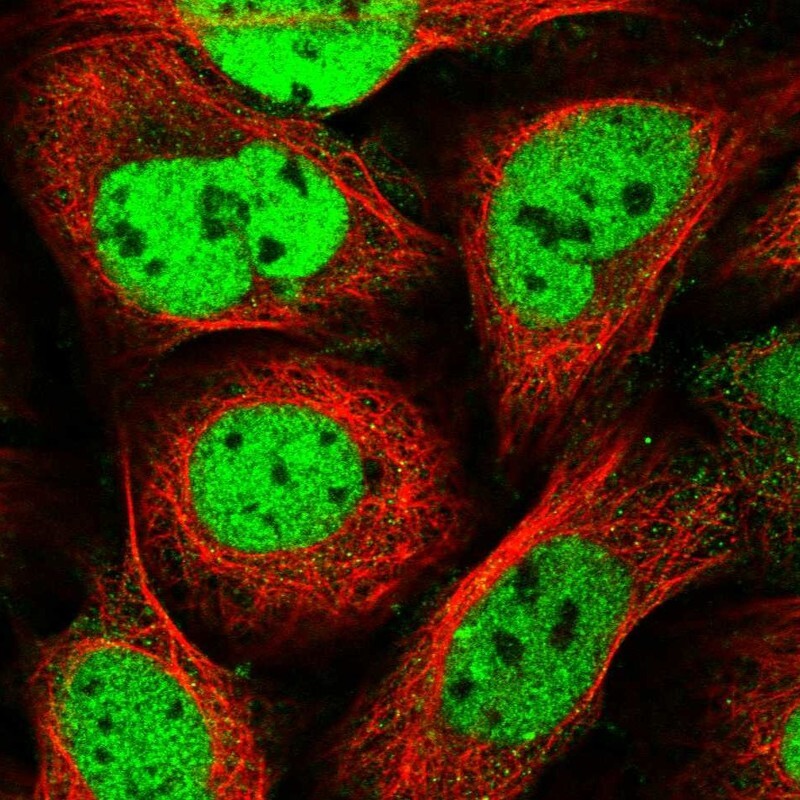
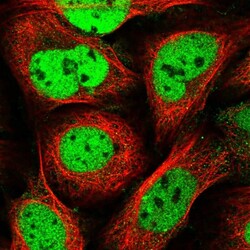
- Immunofluorescent staining of human cell line U-2 OS shows localization to nucleoplasm.
- Sample type
- Human