Explore
 Validate
 Learn
Learn Western blot
 Immunocytochemistry
 Immunohistochemistry
Antibody data
- Antibody Data
- Antigen structure
- References [8]
- Comments [0]
- Validations
- Immunocytochemistry [2]
- Other assay [4]
Submit
Validation data
Reference
Comment
Report error
- Product number
- 14-9777-80 - Provider product page

- Provider
- Invitrogen Antibodies
- Product name
- Vinculin Monoclonal Antibody (7F9), eBioscience™
- Antibody type
- Monoclonal
- Antigen
- Other
- Description
- Description: The monoclonal antibody 7F9 (VIIF9) recognizes human, mouse, rat, and avian vinculin and its alternatively spliced isoform, metavinculin. Vinculin is a cytoskeletal protein associated with cell-cell and cell-matrix junctions. Vinculin is involved in the anchoring of F-actin to the membrane and the regulation of E-cadherin expression. Vinculin binds to talin, paxillin, and alpha-actinin. Disregulation of vinculin alters cell adhesion, migration, and growth, which promotes cancer invasion and metastasis. Applications Reported: This 7F9 antibody has been reported for use in western blotting, immunohistochemical staining of frozen tissue sections and formalin-fixed paraffin embedded tissue sections, immunocytochemistry, and microscopy. Applications Tested: This 7F9 antibody has been tested by immunocytochemistry on methanol-fixed or formaldehyde-fixed and permeabilized cells and can be used at less than or equal to 5 µg/mL. This antibody has been tested by immunohistochemistry of formalin-fixed paraffin embedded tissue using low pH antigen retrieval buffer and can be used at less than or equal to 5 µg/mL. The antibody has been tested by western blot on reduced and non-reduced cell lysates and can be used at less than or equal to 5 µg/mL. It is recommended that the antibody be carefully titrated for optimal performance in the assay of interest. Purity: Greater than 90%, as determined by SDS-PAGE. Aggregation: Less than 10%, as determined by HPLC. Filtration: 0.2 µm post-manufacturing filtered.
- Reactivity
- Human, Mouse, Rat
- Host
- Mouse
- Isotype
- IgG
- Antibody clone number
- 7F9
- Vial size
- 25 μg
- Concentration
- 0.5 mg/mL
- Storage
- 4°C
Submitted references Fetal Programming by Methyl Donor Deficiency Produces Pathological Remodeling of the Ascending Aorta.
Miro1-mediated mitochondrial positioning supports subcellular redox status.
Inhibiting IRE1α-endonuclease activity decreases tumor burden in a mouse model for hepatocellular carcinoma.
Substrate properties modulate cell membrane roughness by way of actin filaments.
Comparative Haploid Genetic Screens Reveal Divergent Pathways in the Biogenesis and Trafficking of Glycophosphatidylinositol-Anchored Proteins.
Vinculin regulates cell-surface E-cadherin expression by binding to beta-catenin.
Further characterisation of the talin-binding site in the cytoskeletal protein vinculin.
Vinculin, an intracellular protein localized at specialized sites where microfilament bundles terminate at cell membranes.
Balint B, Hergalant S, Camadro JM, Blaise S, Vanalderwiert L, Lignières L, Guéant-Rodriguez RM, Guéant JL
Arteriosclerosis, thrombosis, and vascular biology 2021 Jun;41(6):1928-1941
Arteriosclerosis, thrombosis, and vascular biology 2021 Jun;41(6):1928-1941
Miro1-mediated mitochondrial positioning supports subcellular redox status.
Alshaabi H, Shannon N, Gravelle R, Milczarek S, Messier T, Cunniff B
Redox biology 2021 Jan;38:101818
Redox biology 2021 Jan;38:101818
Inhibiting IRE1α-endonuclease activity decreases tumor burden in a mouse model for hepatocellular carcinoma.
Pavlović N, Calitz C, Thanapirom K, Mazza G, Rombouts K, Gerwins P, Heindryckx F
eLife 2020 Oct 26;9
eLife 2020 Oct 26;9
Substrate properties modulate cell membrane roughness by way of actin filaments.
Chang CH, Lee HH, Lee CH
Scientific reports 2017 Aug 22;7(1):9068
Scientific reports 2017 Aug 22;7(1):9068
Comparative Haploid Genetic Screens Reveal Divergent Pathways in the Biogenesis and Trafficking of Glycophosphatidylinositol-Anchored Proteins.
Davis EM, Kim J, Menasche BL, Sheppard J, Liu X, Tan AC, Shen J
Cell reports 2015 Jun 23;11(11):1727-36
Cell reports 2015 Jun 23;11(11):1727-36
Vinculin regulates cell-surface E-cadherin expression by binding to beta-catenin.
Peng X, Cuff LE, Lawton CD, DeMali KA
Journal of cell science 2010 Feb 15;123(Pt 4):567-77
Journal of cell science 2010 Feb 15;123(Pt 4):567-77
Further characterisation of the talin-binding site in the cytoskeletal protein vinculin.
Gilmore AP, Jackson P, Waites GT, Critchley DR
Journal of cell science 1992 Nov;103 ( Pt 3):719-31
Journal of cell science 1992 Nov;103 ( Pt 3):719-31
Vinculin, an intracellular protein localized at specialized sites where microfilament bundles terminate at cell membranes.
Geiger B, Tokuyasu KT, Dutton AH, Singer SJ
Proceedings of the National Academy of Sciences of the United States of America 1980 Jul;77(7):4127-31
Proceedings of the National Academy of Sciences of the United States of America 1980 Jul;77(7):4127-31
No comments: Submit comment
Supportive validation
- Submitted by
- Invitrogen Antibodies (provider)
- Main image
- Experimental details
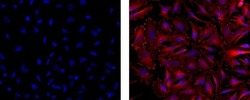
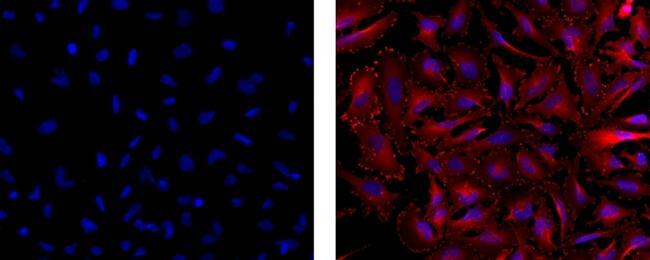
- Immunocytochemistry of formaldehyde-fixed, permeabilized HeLa cells stained with 5 µg/mL of Mouse IgG1 K Isotype Control Purified (Product # 14-4714-82) (left) or 5 µg/mL of Anti-Vinculin Purified (right), followed by F (ab')2 Anti-Mouse IgG eFluor® 570.Nuclei are stained with DAPI.
- Submitted by
- Invitrogen Antibodies (provider)
- Main image
- Experimental details
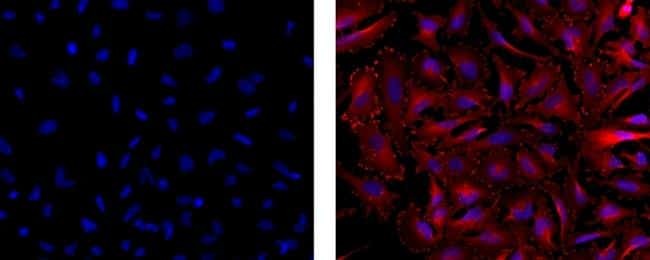
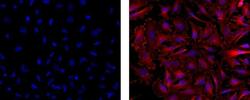
- Immunocytochemistry of formaldehyde-fixed, permeabilized HeLa cells stained with 5 µg/mL of Mouse IgG1 K Isotype Control Purified (Product # 14-4714-82) (left) or 5 µg/mL of Anti-Vinculin Purified (right), followed by F (ab')2 Anti-Mouse IgG eFluor® 570.Nuclei are stained with DAPI.
Supportive validation
- Submitted by
- Invitrogen Antibodies (provider)
- Main image
- Experimental details
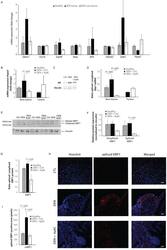
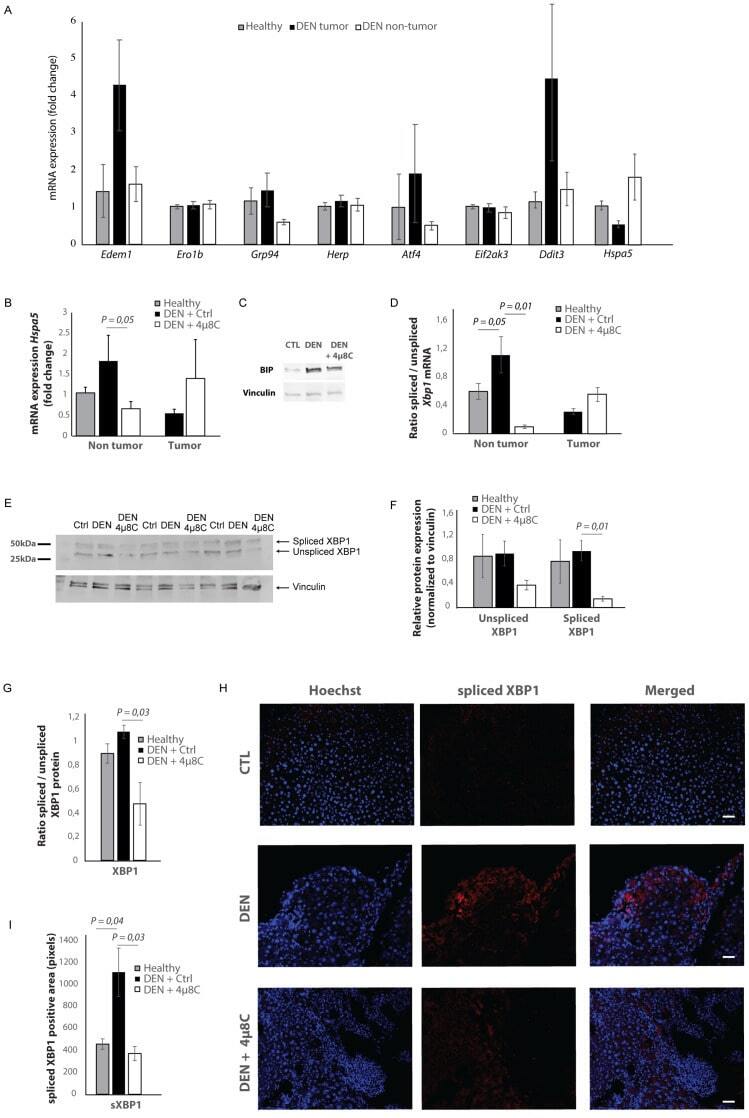
- Figure 2. Increased expression of ER-stress markers in mice with HCC. ( A ) mRNA expression of ER-stress markers Edem1, Ero1b, Grp94, Herp, Atf4, Eif2ak3, Ddit3 , and Hspa5 in liver tissue from healthy mice; and tumor tissue and surrounding non-tumoral tissue from mice with DEN-induced HCC. ( B ) Hspa5- mRNA and ( C ) protein expression of BIP in murine liver tissue. ( D ) Ratio of spliced to unspliced XBP1 in liver tissue from healthy mice; and tumor tissue and surrounding non-tumoral tissue from mice with DEN-induced HCC, treated with 4mu8C. ( E ) Representative western blot image of spliced and unspliced XBP1 protein and vinculin in healthy liver, DEN-induced HCC and DEN-induced HCC treated with 4mu8C. ( F ) quantification of spliced and unspliced XBP1, normalized to total vinculin levels. ( G ) Ratio of spliced to unspliced XBP1 protein levels. ( H ) Representative images and ( I ) quantification of liver tissue sections stained with antibodies against spliced XBP1. p-Values were calculated via the Student''s T-test with five biological replicates per group. Scale bars = 120 mum. Figure 2-figure supplement 1. Activation of the unfolded protein response is mainly located in the stroma of mice with HCC. Liver tissue from mice with DEN-induced HCC, stained with alphaSMA-antibodies and co-stained with antibodies against ( A ) spliced XBP1, ( B ) total XBP1, ( C ) IRE1alpha ( D ) phopho-IRE1alpha, and ( E ) BIP. Scale bars = 50 mum. Figure 2-figure supplement 2. Expression of
- Submitted by
- Invitrogen Antibodies (provider)
- Main image
- Experimental details
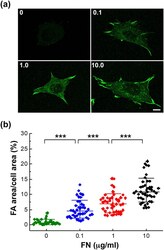
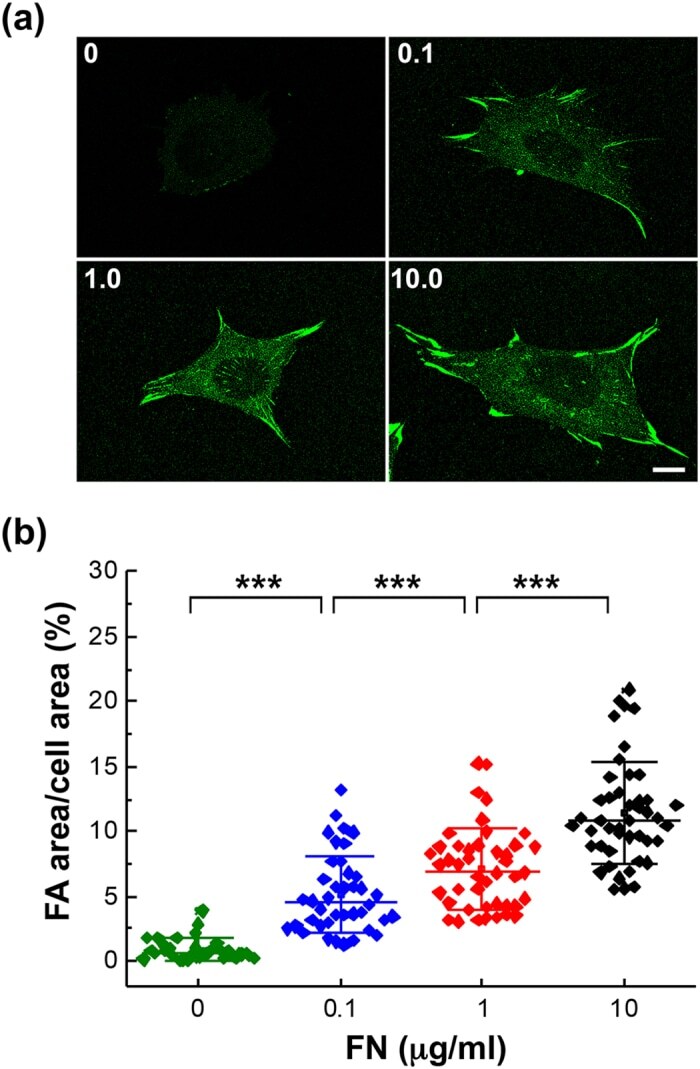
- Figure 2 FA area is positively correlated with the FN concentration on substrate surface. ( a ) MEFs were seeded on the polymer coverslip-bottom mu-dishes coated with ploy-L-lysine followed by 0 to 10 mug/ml FN. After 6 hours, the cells were fixed and stained with anti-vinculin antibody for FA area determination. Scale bar, 10 mum. ( b ) The variation of FA areas in cells responding to various concentrations of FN. Data are expressed as the percentage of the total FA area of each cell relative to the cell area. Values represent mean +- standard deviation ( n = 45 in each condition.). *** P < 0.005 (Student's t-test).
- Submitted by
- Invitrogen Antibodies (provider)
- Main image
- Experimental details
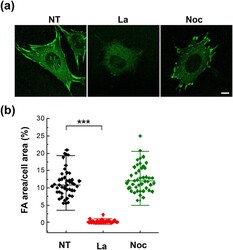
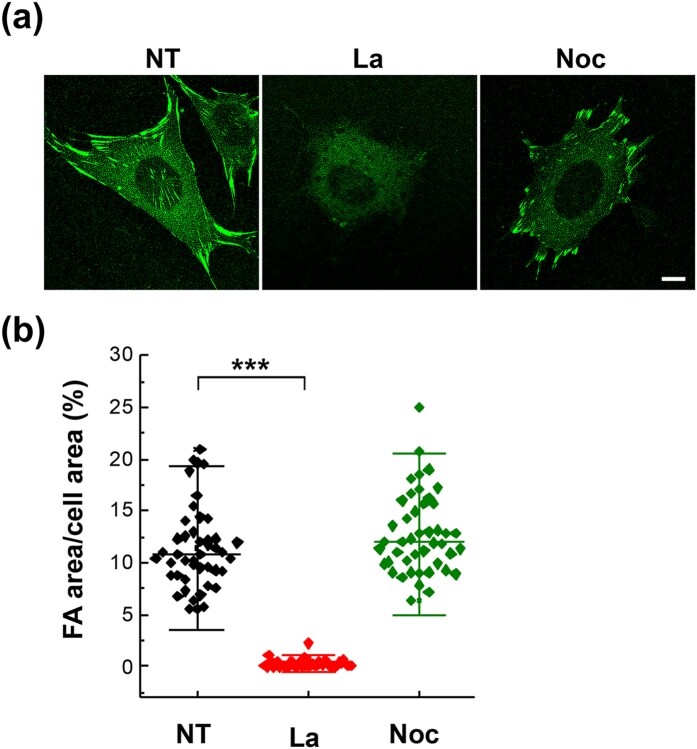
- Figure 4 Actin polymerization is required for FA maturation. ( a ) MEFs were seeded on the 10 mug/ml FN-coated polymer coverslip-bottom mu-dishes and treated with latrunculin (La; 1.0 muM) or nocodazole (Noc; 10 muM) for 30 min followed by immunostaining with anti-vinculin antibody for FA area determination. NT, no treatment. Scale bar, 10 mum. ( b ) The variation of FA areas under various treatments. Data are expressed as the percentage of the total FA area of each cell relative to the cell area. Values represent mean +- standard deviation ( n = 45). *** P < 0.005 (Student's t-test).
- Submitted by
- Invitrogen Antibodies (provider)
- Main image
- Experimental details
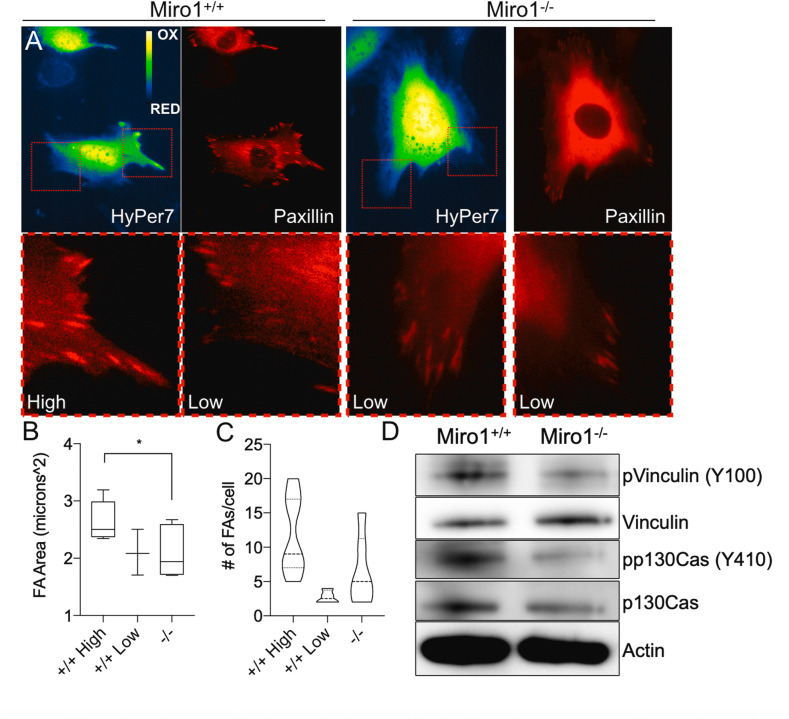
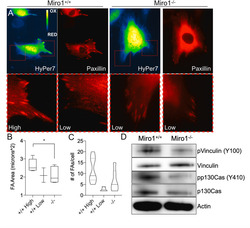
- Fig. 7 Paxillin containing focal adhesion size and abundance correlates with local H 2 O 2 levels. (A) Miro1 +/+ and Miro1 -/- MEFs expressing mCherry-Paxillin and HyPer7. Red-box inserts show mCherry-Paxillin features below at areas of high and low HyPer7 oxidation levels in Miro1 +/+ MEFs and areas of low HyPer7 oxidation in Miro1 -/- MEFs. (B) Quantification of focal adhesion (FA) area (mCherry-Paxillin) at sites of high and low HyPer7 oxidation levels in Miro1 +/+ MEFs and sites of low HyPer7 oxidation in Miro1 -/- MEFs (n = average from 3-5 cells/group, *p < 0.05). (C) Quantification of the number of FAs (mCherry-Paxillin) per cell at sites of high and low HyPer7 oxidation levels in Miro1 +/+ MEFs and sitess of low HyPer7 oxidation in Miro1 -/- MEFs (n = average from 3-5 cells/group). (D) Western blot of reduced phospho-Vinculin (Y100) and phospho-p130Cas (Y410) phosphorylation status in Miro1 -/- MEFs. (For interpretation of the references to colour in this figure legend, the reader is referred to the Web version of this article.) Fig. 7