 Explore
 Validate
 Learn
Learn Western blot
 ELISA
ELISAAntibody data
- Antibody Data
- Antigen structure
- References [11]
- Comments [0]
- Validations
- Western blot [1]
- Immunohistochemistry [2]
Submit
Validation data
Reference
Comment
Report error
- Product number
- 16282-1-AP - Provider product page

- Provider
- Proteintech Group
- Proper citation
- Proteintech Cat#16282-1-AP, RRID:AB_2110243
- Product name
- GNPNAT1 antibody
- Antibody type
- Polyclonal
- Description
- KD/KO validated GNPNAT1 antibody (Cat. #16282-1-AP) is a rabbit polyclonal antibody that shows reactivity with human, mouse, rat and has been validated for the following applications: IHC, IP, WB,ELISA.
- Reactivity
- Human, Mouse, Rat
- Host
- Rabbit
- Conjugate
- Unconjugated
- Isotype
- IgG
- Vial size
- 20ul, 150ul
Submitted references Injectable thermosensitive hydrogel-encapsulated paclitaxel liposomes enriched with miR-455-3p antagomir for dormancy therapy of salivary adenoid cystic carcinoma.
Targeting PGM3 abolishes SREBP-1 activation-hexosamine synthesis feedback regulation to effectively suppress brain tumor growth.
The Hexosamine Biosynthetic Pathway alters the cytoskeleton to modulate cell proliferation and migration in metastatic prostate cancer.
GNPNAT1 is a potential biomarker correlated with immune infiltration and immunotherapy outcome in breast cancer.
Risk stratification based on DNA damage-repair-related signature reflects the microenvironmental feature, metabolic status and therapeutic response of breast cancer.
Mannose antagonizes GSDME-mediated pyroptosis through AMPK activated by metabolite GlcNAc-6P.
ER Stress-Perturbed Intracellular Protein O-GlcNAcylation Aggravates Podocyte Injury in Diabetes Nephropathy.
GNPNAT1 Predicts Poor Prognosis and Cancer Development in Non-Small Cell Lung Cancer.
Upregulation of GNPNAT1 Predicts Poor Prognosis and Correlates With Immune Infiltration in Lung Adenocarcinoma.
Identification of a Novel Hemizygous SQSTM1 Nonsense Mutation in Atypical Behavioral Variant Frontotemporal Dementia.
Inhibition of the hexosamine biosynthetic pathway promotes castration-resistant prostate cancer.
Li M, Zhang X, Zhang LH, Wang JR, Fan HY, Dou ZC, Liang XH, Tang YL
Journal of materials chemistry. B 2025 Jul 23;13(29):8749-8766
Journal of materials chemistry. B 2025 Jul 23;13(29):8749-8766
Targeting PGM3 abolishes SREBP-1 activation-hexosamine synthesis feedback regulation to effectively suppress brain tumor growth.
Su H, Zhong Y, He L, Geng F, Yin X, Kou Y, Chiang CY, Mo X, Fan Y, Liu Y, Wang Q, Magaki S, Cloughesy TF, Lefai E, Yong WH, Chakravarti A, Zhang X, Guo D
Science advances 2025 Apr 18;11(16):eadq0334
Science advances 2025 Apr 18;11(16):eadq0334
The Hexosamine Biosynthetic Pathway alters the cytoskeleton to modulate cell proliferation and migration in metastatic prostate cancer.
Shakya R, Suraneni P, Zaslavsky A, Rahi A, Magdongon CB, Gajjela R, Mattamana BB, Varma D
bioRxiv : the preprint server for biology 2024 Oct 14;
bioRxiv : the preprint server for biology 2024 Oct 14;
GNPNAT1 is a potential biomarker correlated with immune infiltration and immunotherapy outcome in breast cancer.
Yuan R, Zhang Y, Wang Y, Chen H, Zhang R, Hu Z, Chai C, Chen T
Frontiers in immunology 2023;14:1152678
Frontiers in immunology 2023;14:1152678
Risk stratification based on DNA damage-repair-related signature reflects the microenvironmental feature, metabolic status and therapeutic response of breast cancer.
Li C, Yu S, Chen J, Hou Q, Wang S, Qian C, Yin S
Frontiers in immunology 2023;14:1127982
Frontiers in immunology 2023;14:1127982
Mannose antagonizes GSDME-mediated pyroptosis through AMPK activated by metabolite GlcNAc-6P.
Ai YL, Wang WJ, Liu FJ, Fang W, Chen HZ, Wu LZ, Hong X, Zhu Y, Zhang CX, Liu LY, Hong WB, Zhou B, Chen QT, Wu Q
Cell research 2023 Dec;33(12):904-922
Cell research 2023 Dec;33(12):904-922
ER Stress-Perturbed Intracellular Protein O-GlcNAcylation Aggravates Podocyte Injury in Diabetes Nephropathy.
Song S, Hu T, Shi X, Jin Y, Liu S, Li X, Zou W, Wang C
International journal of molecular sciences 2023 Dec 18;24(24)
International journal of molecular sciences 2023 Dec 18;24(24)
GNPNAT1 Predicts Poor Prognosis and Cancer Development in Non-Small Cell Lung Cancer.
Feng Y, Li N, Ren Y
Cancer management and research 2022;14:2419-2428
Cancer management and research 2022;14:2419-2428
Upregulation of GNPNAT1 Predicts Poor Prognosis and Correlates With Immune Infiltration in Lung Adenocarcinoma.
Liu W, Jiang K, Wang J, Mei T, Zhao M, Huang D
Frontiers in molecular biosciences 2021;8:605754
Frontiers in molecular biosciences 2021;8:605754
Identification of a Novel Hemizygous SQSTM1 Nonsense Mutation in Atypical Behavioral Variant Frontotemporal Dementia.
Sun L, Rong Z, Li W, Zheng H, Xiao S, Li X
Frontiers in aging neuroscience 2018;10:26
Frontiers in aging neuroscience 2018;10:26
Inhibition of the hexosamine biosynthetic pathway promotes castration-resistant prostate cancer.
Kaushik AK, Shojaie A, Panzitt K, Sonavane R, Venghatakrishnan H, Manikkam M, Zaslavsky A, Putluri V, Vasu VT, Zhang Y, Khan AS, Lloyd S, Szafran AT, Dasgupta S, Bader DA, Stossi F, Li H, Samanta S, Cao X, Tsouko E, Huang S, Frigo DE, Chan L, Edwards DP, Kaipparettu BA, Mitsiades N, Weigel NL, Mancini M, McGuire SE, Mehra R, Ittmann MM, Chinnaiyan AM, Putluri N, Palapattu GS, Michailidis G, Sreekumar A
Nature communications 2016 May 19;7:11612
Nature communications 2016 May 19;7:11612
No comments: Submit comment
Supportive validation
- Submitted by
- Proteintech Group (provider)
- Main image
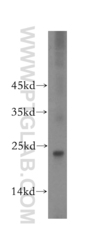
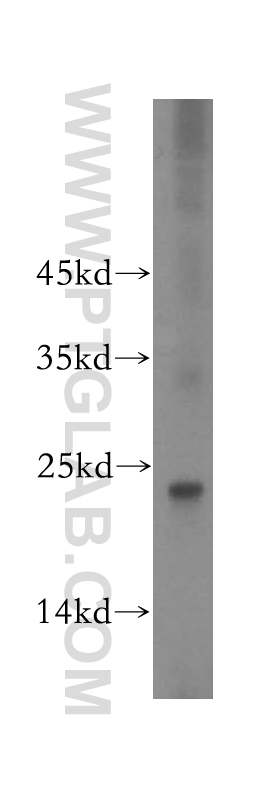
- Experimental details
- mouse large intestine tissue were subjected to SDS PAGE followed by western blot with 16282-1-AP(GNPNAT1 antibody) at dilution of 1:300
- Sample type
- tissue
Supportive validation
- Submitted by
- Proteintech Group (provider)
- Main image
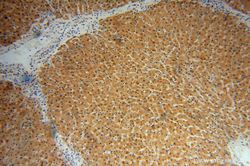
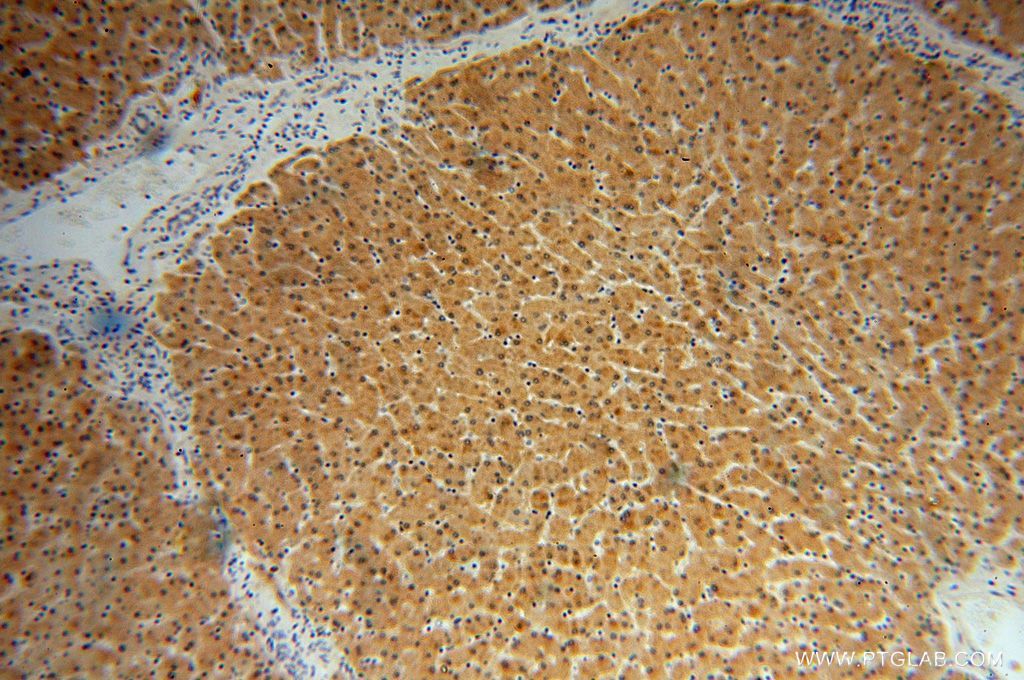
- Experimental details
- Immunohistochemical of paraffin-embedded human liver using 16282-1-AP(GNPNAT1 antibody) at dilution of 1:100 (under 10x lens)
- Sample type
- tissue
- Submitted by
- Proteintech Group (provider)
- Main image
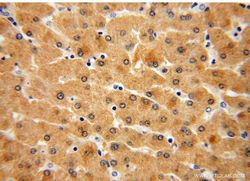
- Experimental details
- The GNPNAT1 antibody from Proteintech is a rabbit polyclonal antibody to a recombinant protein of human GNPNAT1. This antibody recognizes human, mouse, rat antigen. The GNPNAT1 antibody has been validated for the following applications: ELISA, WB, IHC analysis.
