Explore
 Validate
 Learn
Learn Western blot
 ELISA
ELISAAntibody data
- Antibody Data
- Antigen structure
- References [24]
- Comments [0]
- Validations
- Western blot [1]
Submit
Validation data
Reference
Comment
Report error
- Product number
- 10426-1-AP - Provider product page

- Provider
- Proteintech Group
- Proper citation
- Proteintech Cat#10426-1-AP, RRID:AB_2141660
- Product name
- MAX antibody
- Antibody type
- Polyclonal
- Description
- MAX antibody (Cat. #10426-1-AP) is a rabbit polyclonal antibody that shows reactivity with human and has been validated for the following applications: IF, IP, WB,ELISA.
- Reactivity
- Human
- Host
- Rabbit
- Conjugate
- Unconjugated
- Isotype
- IgG
- Vial size
- 20ul, 150ul
Submitted references MYC binding to nascent RNA suppresses innate immune signaling by R-loop-derived RNA-DNA hybrids.
Targeting TCF21-TCF3 heterodimer in tumor-associated pericytes attenuates hematogenous metastasis by restoring pericyte gatekeeper function.
Counteracting FOX proteins epigenetically control the herpesvirus lytic-latent balance.
Endogenous protein tagging coupled with a CRISPR screening approach identifies UBE3C as a potential MYC oncogene regulator.
Salvianolic acid B and Senkyunolide I synergistically alleviate cardiac hypertrophy and regulate MAP3K1 signaling.
Cell-based high-throughput screening using a target-NanoLuc fusion construct to identify molecular glue degraders of c-Myc oncoprotein.
NKD1 enhances colon cancer progression by inhibiting the autophagic degradation of MYC.
Single-cell and spatial transcriptomic analyses reveal heterogeneity characteristics and specific cell subtype regulators in growth hormone-secreting pituitary adenomas.
AKR1B10 dictates c-Myc stability to suppress colorectal cancer metastasis via PP2A nitration.
MAX inactivation deregulates the MYC network and induces neuroendocrine neoplasia in multiple tissues.
MAX inactivation deregulates the MYC network and induces neuroendocrine neoplasia in multiple tissues.
The MYCN oncoprotein is an RNA-binding accessory factor of the nuclear exosome targeting complex.
A program of successive gene expression in mouse one-cell embryos.
Unreprogrammed H3K9me3 prevents minor zygotic genome activation and lineage commitment in SCNT embryos.
MAX deficiency impairs human endometrial decidualization through down-regulating OSR2 in women with recurrent spontaneous abortion.
Novel dual-targeting c-Myc inhibitor D347-2761 represses myeloma growth via blocking c-Myc/Max heterodimerization and disturbing its stability.
Integrated analysis of mRNA-seq and miRNA-seq reveals the potential roles of Egr1, Rxra and Max in kidney stone disease.
PCGF6 controls neuroectoderm specification of human pluripotent stem cells by activating SOX2 expression.
A MYC inhibitor selectively alters the MYC and MAX cistromes and modulates the epigenomic landscape to regulate target gene expression.
Loss of MGA repression mediated by an atypical polycomb complex promotes tumor progression and invasiveness.
NAD(+) supplement potentiates tumor-killing function by rescuing defective TUB-mediated NAMPT transcription in tumor-infiltrated T cells.
Role for carbohydrate response element-binding protein (ChREBP) in high glucose-mediated repression of long noncoding RNA Tug1.
MAX Functions as a Tumor Suppressor and Rewires Metabolism in Small Cell Lung Cancer.
Myc/Max dependent intronic long antisense noncoding RNA, EVA1A-AS, suppresses the expression of Myc/Max dependent anti-proliferating gene EVA1A in a U2 dependent manner.
Uhl L, Aziba A, Löbbert S, Russell T, Krenz B, Montesinos F, Kannan T, Valanju OR, Schülein-Völk C, de Martines T, Bolz M, Fleischhauer D, Cossa G, Endres T, Solvie D, Gallant P, Rosenwald A, Maric HM, Papadopoulos D, Vos SM, Eilers M
Cell 2026 Mar 5;189(5):1371-1388.e29
Cell 2026 Mar 5;189(5):1371-1388.e29
Targeting TCF21-TCF3 heterodimer in tumor-associated pericytes attenuates hematogenous metastasis by restoring pericyte gatekeeper function.
Yin W, Yao H, Li X, Pan W, Zhang Y, Wang C, Deng L, Lin C, Zhang ZM, Pan J, Han S, Tang Z, Zhao Z, Zhu C, Li S, Huang M, Chen M, Xue Y, Zhang J, Ye W, Zhang D
Cell reports. Medicine 2026 Jan 20;7(1):102569
Cell reports. Medicine 2026 Jan 20;7(1):102569
Counteracting FOX proteins epigenetically control the herpesvirus lytic-latent balance.
Xiang Y, Yang X, Zhang J, Hou F, Deng Y, Fu H, Oh HS, Wang Q, Chen S, Sun Z, Das B, Yeo YY, Pesola JM, Sen P, Jiang S, Knipe DM, Coen DM, Pan D
Nature communications 2026 Feb 2;17(1)
Nature communications 2026 Feb 2;17(1)
Endogenous protein tagging coupled with a CRISPR screening approach identifies UBE3C as a potential MYC oncogene regulator.
Seibert M, Kurrle N, Kaleab S, Wempe F, von Metzler I, Serve H, Schnütgen F
Scientific reports 2026 Apr 11;16(1)
Scientific reports 2026 Apr 11;16(1)
Salvianolic acid B and Senkyunolide I synergistically alleviate cardiac hypertrophy and regulate MAP3K1 signaling.
Liu C, Guo R, Zhou Y, Zhu M, Shao L, Wang Y, Zhao L
Chinese medicine 2025 Sep 28;20(1):148
Chinese medicine 2025 Sep 28;20(1):148
Cell-based high-throughput screening using a target-NanoLuc fusion construct to identify molecular glue degraders of c-Myc oncoprotein.
Xu M, Qiu J, Tan L, Xu J, Wang Y, Kong W, Liao H, Chen A, Chen X, Zhang J, Chiu CKC, Zhang M, Tian Y, Li C, Ma B, Wang L, Fu J, Choi SH, Hill J, Shen W
RSC chemical biology 2025 Oct 29;6(11):1759-1771
RSC chemical biology 2025 Oct 29;6(11):1759-1771
NKD1 enhances colon cancer progression by inhibiting the autophagic degradation of MYC.
Lu W, Tang J, Wang Y, Gu X, Zhang H, Liu Y, Xiao Y, Zhu Q, Deng J, Shen Y, Jiang A, Xu Y, Jin J, Hou Y, Liu Q
Cell death & disease 2025 Jul 17;16(1):532
Cell death & disease 2025 Jul 17;16(1):532
Single-cell and spatial transcriptomic analyses reveal heterogeneity characteristics and specific cell subtype regulators in growth hormone-secreting pituitary adenomas.
Zhang Y, Wang L, Yi X, Ma X, Wu H, Zhang M, Yang Z, Ma L, Mi Z, Zhi W, Fu C, Liu P, Yang Z
International journal of surgery (London, England) 2025 Feb 1;111(2):2072-2088
International journal of surgery (London, England) 2025 Feb 1;111(2):2072-2088
AKR1B10 dictates c-Myc stability to suppress colorectal cancer metastasis via PP2A nitration.
Wu X, Huang S, Gao J, Huang S, Chen L, Zhao Z, Pu R, Ma X, Liu X, He W, Song M
Science advances 2025 Aug 22;11(34):eadv6937
Science advances 2025 Aug 22;11(34):eadv6937
MAX inactivation deregulates the MYC network and induces neuroendocrine neoplasia in multiple tissues.
Freie B, Ibrahim AH, Carroll PA, Bronson RT, Augert A, MacPherson D, Eisenman RN
Science advances 2025 Apr 25;11(17):eadt3177
Science advances 2025 Apr 25;11(17):eadt3177
MAX inactivation deregulates the MYC network and induces neuroendocrine neoplasia in multiple tissues.
Freie B, Ibrahim AH, Carroll PA, Bronson RT, Augert A, MacPherson D, Eisenman RN
bioRxiv : the preprint server for biology 2024 Sep 24;
bioRxiv : the preprint server for biology 2024 Sep 24;
The MYCN oncoprotein is an RNA-binding accessory factor of the nuclear exosome targeting complex.
Papadopoulos D, Ha SA, Fleischhauer D, Uhl L, Russell TJ, Mikicic I, Schneider K, Brem A, Valanju OR, Cossa G, Gallant P, Schuelein-Voelk C, Maric HM, Beli P, Büchel G, Vos SM, Eilers M
Molecular cell 2024 Jun 6;84(11):2070-2086.e20
Molecular cell 2024 Jun 6;84(11):2070-2086.e20
A program of successive gene expression in mouse one-cell embryos.
Asami M, Lam BYH, Hoffmann M, Suzuki T, Lu X, Yoshida N, Ma MK, Rainbow K, Gužvić M, VerMilyea MD, Yeo GSH, Klein CA, Perry ACF
Cell reports 2023 Feb 28;42(2):112023
Cell reports 2023 Feb 28;42(2):112023
Unreprogrammed H3K9me3 prevents minor zygotic genome activation and lineage commitment in SCNT embryos.
Xu R, Zhu Q, Zhao Y, Chen M, Yang L, Shen S, Yang G, Shi Z, Zhang X, Shi Q, Kou X, Zhao Y, Wang H, Jiang C, Li C, Gao S, Liu X
Nature communications 2023 Aug 9;14(1):4807
Nature communications 2023 Aug 9;14(1):4807
MAX deficiency impairs human endometrial decidualization through down-regulating OSR2 in women with recurrent spontaneous abortion.
Ma W, Cao M, Bi S, Du L, Chen J, Wang H, Jiang Y, Wu Y, Liao Y, Kong S, Liu J
Cell and tissue research 2022 May;388(2):453-469
Cell and tissue research 2022 May;388(2):453-469
Novel dual-targeting c-Myc inhibitor D347-2761 represses myeloma growth via blocking c-Myc/Max heterodimerization and disturbing its stability.
Yao R, Zhang M, Zhou J, Liu L, Zhang Y, Gao J, Xu K
Cell communication and signaling : CCS 2022 May 26;20(1):73
Cell communication and signaling : CCS 2022 May 26;20(1):73
Integrated analysis of mRNA-seq and miRNA-seq reveals the potential roles of Egr1, Rxra and Max in kidney stone disease.
Huang L, Shi Y, Hu J, Ding J, Guo Z, Yu B
Urolithiasis 2022 Dec 9;51(1):13
Urolithiasis 2022 Dec 9;51(1):13
PCGF6 controls neuroectoderm specification of human pluripotent stem cells by activating SOX2 expression.
Lan X, Ding S, Zhang T, Yi Y, Li C, Jin W, Chen J, Liang K, Wang H, Jiang W
Nature communications 2022 Aug 6;13(1):4601
Nature communications 2022 Aug 6;13(1):4601
A MYC inhibitor selectively alters the MYC and MAX cistromes and modulates the epigenomic landscape to regulate target gene expression.
Holmes AG, Parker JB, Sagar V, Truica MI, Soni PN, Han H, Schiltz GE, Abdulkadir SA, Chakravarti D
Science advances 2022 Apr 29;8(17):eabh3635
Science advances 2022 Apr 29;8(17):eabh3635
Loss of MGA repression mediated by an atypical polycomb complex promotes tumor progression and invasiveness.
Mathsyaraja H, Catchpole J, Freie B, Eastwood E, Babaeva E, Geuenich M, Cheng PF, Ayers J, Yu M, Wu N, Moorthi S, Poudel KR, Koehne A, Grady W, Houghton AM, Berger AH, Shiio Y, MacPherson D, Eisenman RN
eLife 2021 Jul 8;10
eLife 2021 Jul 8;10
NAD(+) supplement potentiates tumor-killing function by rescuing defective TUB-mediated NAMPT transcription in tumor-infiltrated T cells.
Wang Y, Wang F, Wang L, Qiu S, Yao Y, Yan C, Xiong X, Chen X, Ji Q, Cao J, Gao G, Li D, Zhang L, Guo Z, Wang R, Wang H, Fan G
Cell reports 2021 Aug 10;36(6):109516
Cell reports 2021 Aug 10;36(6):109516
Role for carbohydrate response element-binding protein (ChREBP) in high glucose-mediated repression of long noncoding RNA Tug1.
Long J, Galvan DL, Mise K, Kanwar YS, Li L, Poungavrin N, Overbeek PA, Chang BH, Danesh FR
The Journal of biological chemistry 2020 Nov 20;295(47):15840-15852
The Journal of biological chemistry 2020 Nov 20;295(47):15840-15852
MAX Functions as a Tumor Suppressor and Rewires Metabolism in Small Cell Lung Cancer.
Augert A, Mathsyaraja H, Ibrahim AH, Freie B, Geuenich MJ, Cheng PF, Alibeckoff SP, Wu N, Hiatt JB, Basom R, Gazdar A, Sullivan LB, Eisenman RN, MacPherson D
Cancer cell 2020 Jul 13;38(1):97-114.e7
Cancer cell 2020 Jul 13;38(1):97-114.e7
Myc/Max dependent intronic long antisense noncoding RNA, EVA1A-AS, suppresses the expression of Myc/Max dependent anti-proliferating gene EVA1A in a U2 dependent manner.
Niehus SE, Allister AB, Hoffmann A, Wiehlmann L, Tamura T, Tran DDH
Scientific reports 2019 Nov 21;9(1):17319
Scientific reports 2019 Nov 21;9(1):17319
No comments: Submit comment
Supportive validation
- Submitted by
- Proteintech Group (provider)
- Main image

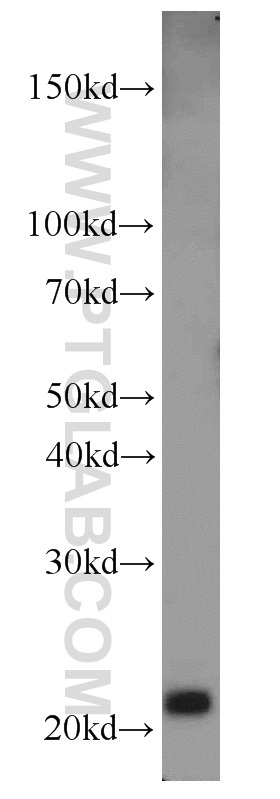
- Experimental details
- The MAX antibody from Proteintech is a rabbit polyclonal antibody to a recombinant protein of human MAX. This antibody recognizes human, mouse, rat antigen. The MAX antibody has been validated for the following applications: ELISA, WB analysis.