Explore
 Validate
 Learn
Learn Western blot
 ELISA
ELISAAntibody data
- Antibody Data
- Antigen structure
- References [14]
- Comments [0]
- Validations
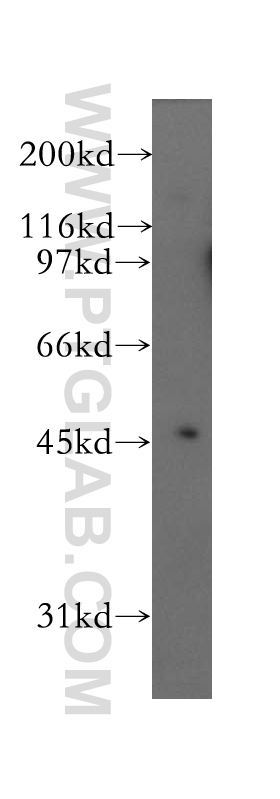
- Western blot [1]
Submit
Validation data
Reference
Comment
Report error
- Product number
- 12503-1-AP - Provider product page

- Provider
- Proteintech Group
- Proper citation
- Proteintech Cat#12503-1-AP, RRID:AB_2234144
- Product name
- Kir4.1 antibody
- Antibody type
- Polyclonal
- Description
- Kir4.1 antibody (Cat. #12503-1-AP) is a rabbit polyclonal antibody that shows reactivity with human, mouse, rat and has been validated for the following applications: IHC, IP, WB,ELISA.
- Reactivity
- Human, Mouse, Rat
- Host
- Rabbit
- Conjugate
- Unconjugated
- Isotype
- IgG
- Vial size
- 20ul, 150ul
Submitted references Elevated Astrocytic NFAT5 of the hippocampus increases epilepsy susceptibility in hypoxic-ischemic mice.
Astrocyte Kir4.1 expression level territorially controls excitatory transmission in the brain.
Retrograde control of sympathetic neuron-satellite glia interactions by target-derived NGF signaling.
Astrocytic neuroligin 3 regulates social memory and synaptic plasticity through adenosine signaling in male mice.
Astrocyte TrkB.T1 deficiency disrupts glutamatergic synaptogenesis and astrocyte-synapse interactions.
Prefrontal cortex astrocytes in major depressive disorder: exploring pathogenic mechanisms and potential therapeutic targets.
Contribution of inwardly rectifying potassium channel 4.1 in orofacial neuropathic pain: Regulation of pannexin 3 via the reactive oxygen species-activated P38 MAPK signal pathway.
Yigan Mingmu Decoction inhibits diabetic macular edema through regulating Kir4.1/AQP4 axis: a study based on network pharmacology.
A novel model of subretinal edema induced by DL-alpha aminoadipic acid.
Glioma epileptiform activity and progression are driven by IGSF3-mediated potassium dysregulation.
Destabilizing COXIV in Müller Glia Increases Retinal Glycolysis and Alters Scotopic Electroretinogram.
Low reliability of anti-KIR4.1(83-120) peptide auto-antibodies in multiple sclerosis patients.
Wnt/β-catenin signaling mediates the seizure-facilitating effect of postischemic reactive astrocytes after pentylenetetrazole-kindling.
Elevated GFAP induces astrocyte dysfunction in caudal brain regions: A potential mechanism for hindbrain involved symptoms in type II Alexander disease.
Jia X, Xu J, Zhang Y, Kong S, Cheng X, Wu N, Han S, Yin J, Liu W, He X, Fan Y, Liu Y, Chen T, Peng B
Epilepsia 2025 Mar;66(3):817-832
Epilepsia 2025 Mar;66(3):817-832
Astrocyte Kir4.1 expression level territorially controls excitatory transmission in the brain.
Tyurikova O, Kopach O, Zheng K, Rathore D, Codadu N, Wu SY, Shen Y, Campbell RE, Wykes RC, Volynski K, Savtchenko LP, Rusakov DA
Cell reports 2025 Feb 25;44(2):115299
Cell reports 2025 Feb 25;44(2):115299
Retrograde control of sympathetic neuron-satellite glia interactions by target-derived NGF signaling.
Kumari R, Boehm E, Pascalau R, Pfeiffer RL, Jones BW, Tampakakis E, Kuruvilla R
Cell reports 2025 Dec 23;44(12):116697
Cell reports 2025 Dec 23;44(12):116697
Astrocytic neuroligin 3 regulates social memory and synaptic plasticity through adenosine signaling in male mice.
Dang R, Liu A, Zhou Y, Li X, Wu M, Cao K, Meng Y, Zhang H, Gan G, Xie W, Jia Z
Nature communications 2024 Oct 5;15(1):8639
Nature communications 2024 Oct 5;15(1):8639
Astrocyte TrkB.T1 deficiency disrupts glutamatergic synaptogenesis and astrocyte-synapse interactions.
Pinkston BTC, Browning JL, Olsen ML
bioRxiv : the preprint server for biology 2024 Oct 22;
bioRxiv : the preprint server for biology 2024 Oct 22;
Prefrontal cortex astrocytes in major depressive disorder: exploring pathogenic mechanisms and potential therapeutic targets.
Pan Y, Xiang L, Zhu T, Wang H, Xu Q, Liao F, He J, Wang Y
Journal of molecular medicine (Berlin, Germany) 2024 Nov;102(11):1355-1369
Journal of molecular medicine (Berlin, Germany) 2024 Nov;102(11):1355-1369
Contribution of inwardly rectifying potassium channel 4.1 in orofacial neuropathic pain: Regulation of pannexin 3 via the reactive oxygen species-activated P38 MAPK signal pathway.
Feng YH, Tang RJ, Zhang YY, Lin J, Liu YJ, Li YK, Li CJ, Zhou C, Liu F, Shen JF
The European journal of neuroscience 2024 Aug;60(4):4569-4585
The European journal of neuroscience 2024 Aug;60(4):4569-4585
Yigan Mingmu Decoction inhibits diabetic macular edema through regulating Kir4.1/AQP4 axis: a study based on network pharmacology.
Huang L, Guo X, Hu Q, Hu Z, Wu P, Jiang J, Liu J, Liu Z, Chen X
American journal of translational research 2023;15(11):6362-6380
American journal of translational research 2023;15(11):6362-6380
A novel model of subretinal edema induced by DL-alpha aminoadipic acid.
Xie Z, Wu X, Cheng R, Huang J, Wang X, Shi Q, Xu B, Paulus YM, Yuan S, Liu Q
Experimental eye research 2023 Mar;228:109388
Experimental eye research 2023 Mar;228:109388
Glioma epileptiform activity and progression are driven by IGSF3-mediated potassium dysregulation.
Curry RN, Aiba I, Meyer J, Lozzi B, Ko Y, McDonald MF, Rosenbaum A, Cervantes A, Huang-Hobbs E, Cocito C, Greenfield JP, Jalali A, Gavvala J, Mohila C, Serin Harmanci A, Noebels J, Rao G, Deneen B
Neuron 2023 Mar 1;111(5):682-695.e9
Neuron 2023 Mar 1;111(5):682-695.e9
Destabilizing COXIV in Müller Glia Increases Retinal Glycolysis and Alters Scotopic Electroretinogram.
Nsiah NY, Inman DM
Cells 2022 Nov 24;11(23)
Cells 2022 Nov 24;11(23)
Low reliability of anti-KIR4.1(83-120) peptide auto-antibodies in multiple sclerosis patients.
Marino M, Frisullo G, Di Sante G, Samengo DM, Provenzano C, Mirabella M, Pani G, Ria F, Bartoccioni E
Multiple sclerosis (Houndmills, Basingstoke, England) 2018 Jun;24(7):910-918
Multiple sclerosis (Houndmills, Basingstoke, England) 2018 Jun;24(7):910-918
Wnt/β-catenin signaling mediates the seizure-facilitating effect of postischemic reactive astrocytes after pentylenetetrazole-kindling.
Yang J, Zhang X, Wu Y, Zhao B, Liu X, Pan Y, Liu Y, Ding Y, Qiu M, Wang YZ, Zhao G
Glia 2016 Jun;64(6):1083-91
Glia 2016 Jun;64(6):1083-91
Elevated GFAP induces astrocyte dysfunction in caudal brain regions: A potential mechanism for hindbrain involved symptoms in type II Alexander disease.
Minkel HR, Anwer TZ, Arps KM, Brenner M, Olsen ML
Glia 2015 Dec;63(12):2285-97
Glia 2015 Dec;63(12):2285-97
No comments: Submit comment
Supportive validation
- Submitted by
- Proteintech Group (provider)
- Main image
- Experimental details
- The Kir4.1 antibody from Proteintech is a rabbit polyclonal antibody to a recombinant protein of human Kir4.1. This antibody recognizes human,mouse,rat antigen. The Kir4.1 antibody has been validated for the following applications: ELISA, WB analysis.