Explore
 Validate
 Learn
Learn Western blot
 Other assay
Antibody data
- Antibody Data
- Antigen structure
- References [2]
- Comments [0]
- Validations
- Other assay [1]
Submit
Validation data
Reference
Comment
Report error
- Product number
- MA5-15159 - Provider product page

- Provider
- Invitrogen Antibodies
- Product name
- Caspase 7 Monoclonal Antibody (S.606.3)
- Antibody type
- Monoclonal
- Antigen
- Recombinant full-length protein
- Description
- It is not recommended to aliquot this antibody. This antibody is not cross-reactive with other caspases.
- Reactivity
- Human
- Host
- Mouse
- Isotype
- IgG
- Antibody clone number
- S.606.3
- Vial size
- 100 μL
- Concentration
- 140 μg/mL
- Storage
- -20°C
Submitted references CAMK1D Triggers Immune Resistance of Human Tumor Cells Refractory to Anti-PD-L1 Treatment.
HtrA4 Protease Promotes Chemotherapeutic-Dependent Cancer Cell Death.
Volpin V, Michels T, Sorrentino A, Menevse AN, Knoll G, Ditz M, Milenkovic VM, Chen CY, Rathinasamy A, Griewank K, Boutros M, Haferkamp S, Berneburg M, Wetzel CH, Seckinger A, Hose D, Goldschmidt H, Ehrenschwender M, Witzens-Harig M, Szoor A, Vereb G, Khandelwal N, Beckhove P
Cancer immunology research 2020 Sep;8(9):1163-1179
Cancer immunology research 2020 Sep;8(9):1163-1179
HtrA4 Protease Promotes Chemotherapeutic-Dependent Cancer Cell Death.
Wenta T, Rychlowski M, Jarzab M, Lipinska B
Cells 2019 Sep 20;8(10)
Cells 2019 Sep 20;8(10)
No comments: Submit comment
Supportive validation
- Submitted by
- Invitrogen Antibodies (provider)
- Main image
- Experimental details
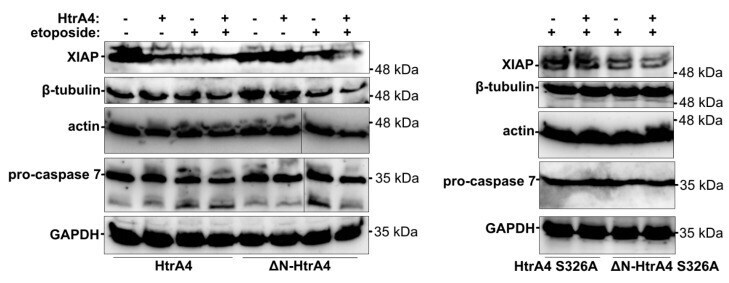
- Figure 9 HtrA4 promotes degradation of XIAP and, less efficiently, of beta-tubulin, actin, and pro-caspase 7. The A549 cells with exogenous HtrA4, DeltaN-HtrA4, or their inactive variants (+) induced by adding doxycycline to the medium were treated with 15 uM etoposide for 48 h. Control cells (-) were incubated with etoposide but without doxycycline. The cells and medium were collected and probed with specific antibodies. Representative blots are presented. Densitometric analyses of the immunoblotting results are shown in Figure S5 .