Explore
 Validate
 Learn
Learn Western blot
 ELISA
ELISAAntibody data
- Antibody Data
- Antigen structure
- References [10]
- Comments [0]
- Validations
- Western blot [1]
Submit
Validation data
Reference
Comment
Report error
- Product number
- 23185-1-AP - Provider product page

- Provider
- Proteintech Group
- Product name
- P4HA3 antibody
- Antibody type
- Polyclonal
- Description
- P4HA3 antibody (Cat. #23185-1-AP) is a rabbit polyclonal antibody that shows reactivity with human, mouse and has been validated for the following applications: IF, WB,ELISA.
- Reactivity
- Human, Mouse
- Host
- Rabbit
- Conjugate
- Unconjugated
- Isotype
- IgG
- Vial size
- 20ul, 150ul
Submitted references Identifying and Targeting Key Driver Genes for Collagen Production within the 11q13/14 Breast Cancer Amplicon.
Protein disulfide isomerase is essential for osteoblast differentiation in mice.
Identification of potential biomarkers and mechanisms for keloid disorder based on comprehensive bioinformatics analysis and machine learning algorithms.
TGF-β1 promotes collagen synthesis in systemic sclerosis via upregulating P4HA3.
Identifying and targeting key driver genes for collagen production within the 11q13/14 breast cancer amplicon.
Collagen synthase P4HA3 as a novel biomarker for colorectal cancer correlates with prognosis and immune infiltration.
Thrombospondin-1 and prolyl 4-hydroxylase subunit alpha 3 as potential biomarkers of salivary gland fibrosis.
Transcriptome sequencing identifies prognostic genes involved in gastric adenocarcinoma.
TGF-β-dependent reprogramming of amino acid metabolism induces epithelial-mesenchymal transition in non-small cell lung cancers.
Ascorbate starvation alters endoplasmic reticulum-resident enzymes in cardiac fibroblasts, priming them for increased procollagen secretion.
Araiza-Olivera D, Prudnikova TY, Uribe-Alvarez C, Cai KQ, Franco-Barraza J, Dones JM, Raines RT, Chernoff J
Molecular cancer research : MCR 2025 May 2;23(5):405-415
Molecular cancer research : MCR 2025 May 2;23(5):405-415
Protein disulfide isomerase is essential for osteoblast differentiation in mice.
Lu Y, Yang A, Zhao Z, Han Y, Wu D, Wu Y
Communications biology 2025 Mar 10;8(1):402
Communications biology 2025 Mar 10;8(1):402
Identification of potential biomarkers and mechanisms for keloid disorder based on comprehensive bioinformatics analysis and machine learning algorithms.
Zheng B, Qiao J, Yu X, Zhou H, Wang A, Zhang X
BMC medical genomics 2025 Jul 1;18(1):108
BMC medical genomics 2025 Jul 1;18(1):108
TGF-β1 promotes collagen synthesis in systemic sclerosis via upregulating P4HA3.
Chen Z, Lin Y, Huang Y, Chen Z, Gong Y, Hou Z, Lin L
Journal of translational autoimmunity 2025 Dec;11:100323
Journal of translational autoimmunity 2025 Dec;11:100323
Identifying and targeting key driver genes for collagen production within the 11q13/14 breast cancer amplicon.
Araiza-Olivera D, Prudnikova TY, Uribe-Alvarez C, Cai KQ, Franco-Barraza J, Dones JM, Raines RT, Chernoff J
bioRxiv : the preprint server for biology 2024 Mar 28;
bioRxiv : the preprint server for biology 2024 Mar 28;
Collagen synthase P4HA3 as a novel biomarker for colorectal cancer correlates with prognosis and immune infiltration.
Guo X, Zhang Y, Peng L, Wang Y, He CW, Li K, Hao K, Li K, Wang Z, Huang H, Miao X
Heliyon 2024 Jun 15;10(11):e31695
Heliyon 2024 Jun 15;10(11):e31695
Thrombospondin-1 and prolyl 4-hydroxylase subunit alpha 3 as potential biomarkers of salivary gland fibrosis.
Zhang Z, Li H, Wang G, Zhao G, Li C, Cao Y
Journal of dental sciences 2023 Jul;18(3):1243-1250
Journal of dental sciences 2023 Jul;18(3):1243-1250
Transcriptome sequencing identifies prognostic genes involved in gastric adenocarcinoma.
Li M, Bai M, Wu Y, Yang S, Zheng L, Sun L, Yu C, Huang Y
Molecular and cellular biochemistry 2023 Dec;478(12):2891-2906
Molecular and cellular biochemistry 2023 Dec;478(12):2891-2906
TGF-β-dependent reprogramming of amino acid metabolism induces epithelial-mesenchymal transition in non-small cell lung cancers.
Nakasuka F, Tabata S, Sakamoto T, Hirayama A, Ebi H, Yamada T, Umetsu K, Ohishi M, Ueno A, Goto H, Sugimoto M, Nishioka Y, Yamada Y, Tomita M, Sasaki AT, Yano S, Soga T
Communications biology 2021 Jun 24;4(1):782
Communications biology 2021 Jun 24;4(1):782
Ascorbate starvation alters endoplasmic reticulum-resident enzymes in cardiac fibroblasts, priming them for increased procollagen secretion.
Cowling RT, Park JI, Sotimehin AE, Greenberg BH
Journal of molecular and cellular cardiology 2017 Dec;113:1-8
Journal of molecular and cellular cardiology 2017 Dec;113:1-8
No comments: Submit comment
Supportive validation
- Submitted by
- Proteintech Group (provider)
- Main image
- Experimental details
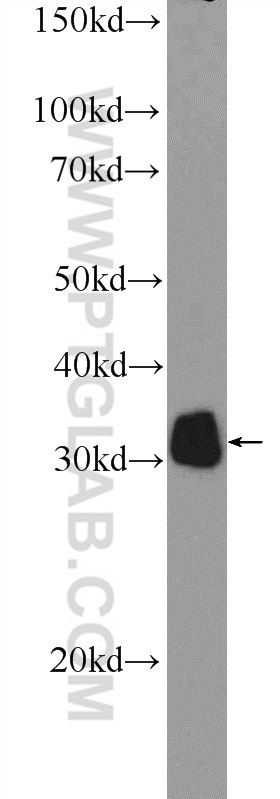
- mouse kidney tissue were subjected to SDS PAGE followed by western blot with 23185-1-AP( P4HA3 Antibody) at dilution of 1:300
- Other comments
- WB