Explore
 Validate
 Learn
Learn Western blot
 Immunoprecipitation
Antibody data
- Antibody Data
- Antigen structure
- References [1]
- Comments [0]
- Validations
- Immunoprecipitation [1]
- Other assay [1]
Submit
Validation data
Reference
Comment
Report error
- Product number
- PA5-29659 - Provider product page

- Provider
- Invitrogen Antibodies
- Product name
- Neutrophil elastase Polyclonal Antibody
- Antibody type
- Polyclonal
- Antigen
- Recombinant full-length protein
- Description
- Recommended positive controls: A549, HepG2. Store product as a concentrated solution. Centrifuge briefly prior to opening the vial.
- Reactivity
- Human
- Host
- Rabbit
- Isotype
- IgG
- Vial size
- 100 μL
- Concentration
- 1 mg/mL
- Storage
- Store at 4°C short term. For long term storage, store at -20°C, avoiding freeze/thaw cycles.
Submitted references A Pilot Study to Investigate the Balance between Proteases and α1-Antitrypsin in Bronchoalveolar Lavage Fluid of Lung Transplant Recipients.
Cagnone M, Piloni D, Ferrarotti I, Di Venere M, Viglio S, Magni S, Bardoni A, Salvini R, Fumagalli M, Iadarola P, Martinello S, Meloni F
High-throughput 2019 Feb 13;8(1)
High-throughput 2019 Feb 13;8(1)
No comments: Submit comment
Supportive validation
- Submitted by
- Invitrogen Antibodies (provider)
- Main image
- Experimental details
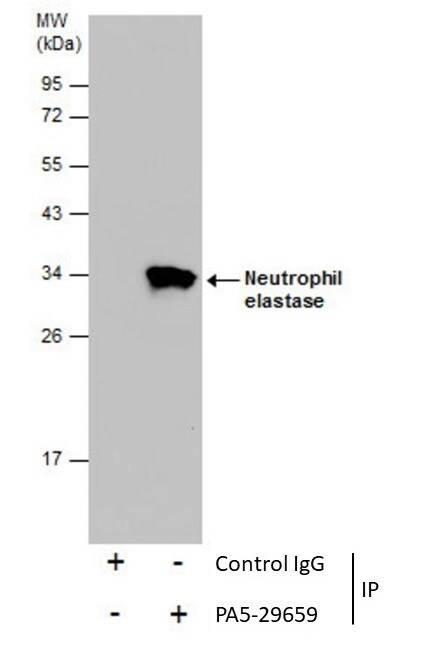
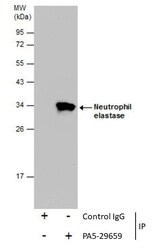
- Immunoprecipitation of Neutrophil elastase was performed in HepG2 whole cell extracts using 5 µg of Neutrophil elastase Polyclonal Antibody (Product # PA5-29659). Samples were transferred to a membrane and probed with Neutrophil elastase Polyclonal Antibody as a primary antibody and an HRP-conjugated anti-Rabbit IgG was used as a secondary antibody.
Supportive validation
- Submitted by
- Invitrogen Antibodies (provider)
- Main image
- Experimental details
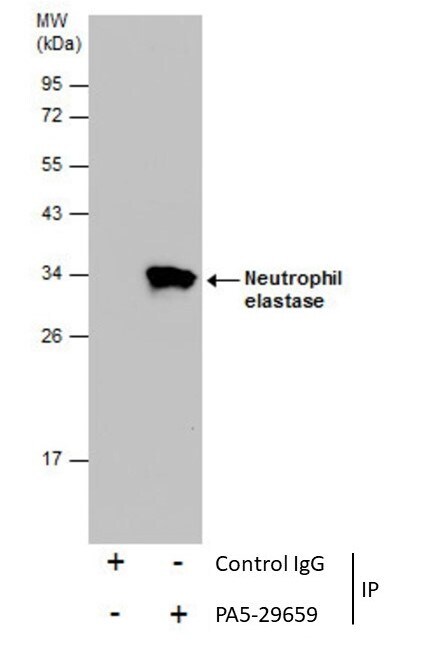
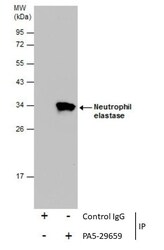
- Immunoprecipitation of Neutrophil elastase was performed in HepG2 whole cell extracts using 5 µg of Neutrophil elastase Polyclonal Antibody (Product # PA5-29659). Samples were transferred to a membrane and probed with Neutrophil elastase Polyclonal Antibody as a primary antibody and an HRP-conjugated anti-Rabbit IgG was used as a secondary antibody.