Explore
 Validate
 Learn
Learn Western blot
 ELISA
ELISA Immunocytochemistry
Antibody data
- Antibody Data
- Antigen structure
- References [5]
- Comments [0]
- Validations
- Immunocytochemistry [2]
Submit
Validation data
Reference
Comment
Report error
- Product number
- ALX-804-448-C100 - Provider product page

- Provider
- Enzo Life Sciences
- Proper citation
- Enzo Life Sciences Cat#ALX-804-448-C100, RRID:AB_2050953
- Product name
- Caspase-8 (mouse) monoclonal antibody (3B10)
- Antibody type
- Monoclonal
- Antigen
- Recombinant full length protein
- Description
- Protein G-affinity purified.
- Reactivity
- Mouse
- Host
- Rat
- Isotype
- IgG
- Antibody clone number
- 3B10
- Vial size
- 100 μg
- Storage
- -20°C
- Handling
- For long term storage, aliquot and freeze at -20¡C. Avoid freeze/thaw cycles.
Submitted references Caspase-8 deficiency in epidermal keratinocytes triggers an inflammatory skin disease.
Membrane-bound Fas ligand only is essential for Fas-induced apoptosis.
Impaired lactation in mice expressing dominant-negative FADD in mammary epithelium.
Stimulation of Toll-like receptor 3 and 4 induces interleukin-1beta maturation by caspase-8.
Modifications and intracellular trafficking of FADD/MORT1 and caspase-8 after stimulation of T lymphocytes.
Kovalenko A, Kim JC, Kang TB, Rajput A, Bogdanov K, Dittrich-Breiholz O, Kracht M, Brenner O, Wallach D
The Journal of experimental medicine 2009 Sep 28;206(10):2161-77
The Journal of experimental medicine 2009 Sep 28;206(10):2161-77
Membrane-bound Fas ligand only is essential for Fas-induced apoptosis.
O' Reilly LA, Tai L, Lee L, Kruse EA, Grabow S, Fairlie WD, Haynes NM, Tarlinton DM, Zhang JG, Belz GT, Smyth MJ, Bouillet P, Robb L, Strasser A
Nature 2009 Oct 1;461(7264):659-63
Nature 2009 Oct 1;461(7264):659-63
Impaired lactation in mice expressing dominant-negative FADD in mammary epithelium.
Shackleton M, O'Reilly LA, Sutherland KD, Bath ML, Ellis S, Strasser A, Visvader JE, Lindeman GJ
Developmental dynamics : an official publication of the American Association of Anatomists 2009 Apr;238(4):1010-6
Developmental dynamics : an official publication of the American Association of Anatomists 2009 Apr;238(4):1010-6
Stimulation of Toll-like receptor 3 and 4 induces interleukin-1beta maturation by caspase-8.
Maelfait J, Vercammen E, Janssens S, Schotte P, Haegman M, Magez S, Beyaert R
The Journal of experimental medicine 2008 Sep 1;205(9):1967-73
The Journal of experimental medicine 2008 Sep 1;205(9):1967-73
Modifications and intracellular trafficking of FADD/MORT1 and caspase-8 after stimulation of T lymphocytes.
O'Reilly LA, Divisekera U, Newton K, Scalzo K, Kataoka T, Puthalakath H, Ito M, Huang DC, Strasser A
Cell death and differentiation 2004 Jul;11(7):724-36
Cell death and differentiation 2004 Jul;11(7):724-36
No comments: Submit comment
Supportive validation
- Submitted by
- Enzo Life Sciences (provider)
- Main image
- Experimental details
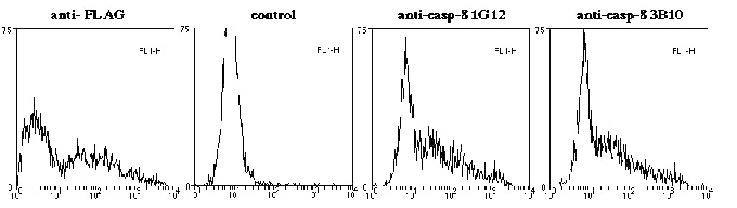
- Flow cytometry of HEK 293T cells transfected with FLAG tagged mutated mouse caspase-8. Method: MAbs 1G12 and 3B10 both detect overexpressed FLAG-epitope-tagged pro-caspase-8 (active-site-mutant) by flow cytometry in permeabilized cells. As a positive control staining with a MAb to FLAG was performed. As a negative control an isotype control was employed.
- Submitted by
- Enzo Life Sciences (provider)
- Main image
- Experimental details
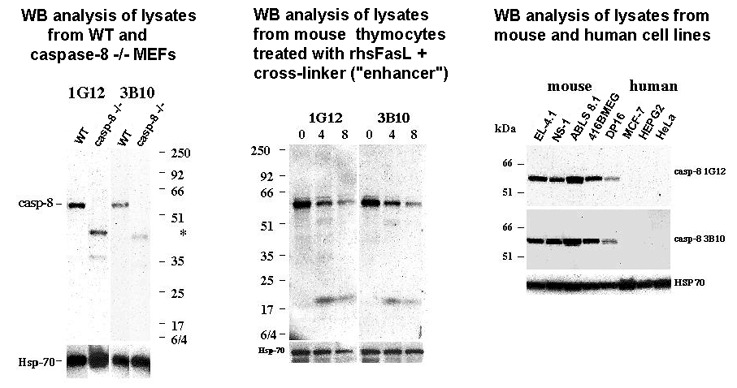
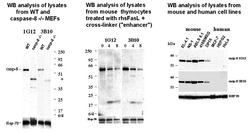
- MAbs 1G12 and 3B10 both detect pro-caspase-8 in MEFs from WT mice, but not in MEFs from caspase-8-/- mice. Several smaller bands detected in the caspase-8-/- MEFs, correspond to truncated forms of caspase-8 made in the caspase-8-/- mice since only exons 1 and 2 of mouse caspase-8 were deleted in these knock-out mice and not the region encoding the p18 subunit.Note: Extra bands marked by * are only seen in lysates from caspase-8-/- MEFs and not in lysates from any WT cell lines or mouse WT tissue. Both MAbs to caspase-8 (mouse) do not recognize human caspase-8, whereas endogenous caspase-8 can be efficiently detected in various mouse cell lines. Upon an apoptotic stimulus e.g. by cross-linked rhsFasL both MAbs to caspase-8 (mouse) do also recognize the cleaved active p18 subunit of mouse caspase-8 in addition to the caspase-8 precursor.