Explore
 Validate
 Learn
Learn Western blot
 ELISA
ELISAAntibody data
- Antibody Data
- Antigen structure
- References [9]
- Comments [0]
- Validations
- Western blot [1]
Submit
Validation data
Reference
Comment
Report error
- Product number
- 11196-1-AP - Provider product page

- Provider
- Proteintech Group
- Proper citation
- Proteintech Cat#11196-1-AP, RRID:AB_2284521
- Product name
- PSMC1 antibody
- Antibody type
- Polyclonal
- Description
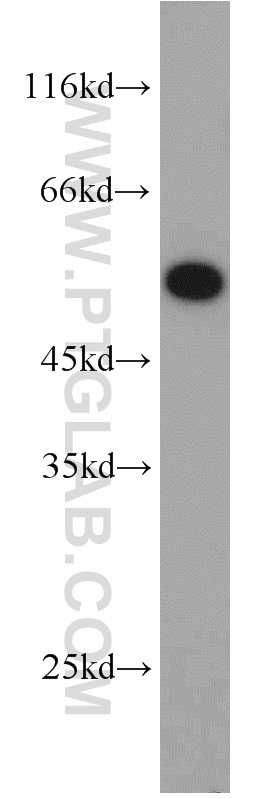
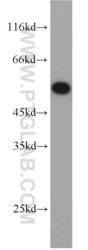
- PSMC1 antibody (Cat. #11196-1-AP) is a rabbit polyclonal antibody that shows reactivity with human, mouse, rat and has been validated for the following applications: WB, ELISA.
- Reactivity
- Human, Mouse, Rat
- Host
- Rabbit
- Conjugate
- Unconjugated
- Isotype
- IgG
- Vial size
- 20ul, 150ul
Submitted references RNF180 suppressed aggressiveness by degrading NOTCH1, TRIM24 and FOXC1, and chemoresistance by degrading ACC1 and ACLY in colorectal cancer.
Curcumin modulates β-catenin stabilization via targeting proteasomal deubiquitinating enzyme USP14(☆).
Using protein turnover assay to explore the drug mechanism of Carfilzomib.
Dihydrolipoamide dehydrogenase (DLD) is a novel molecular target of bortezomib.
Lipid-anchored proteasomes control membrane protein homeostasis.
Inactive USP14 and inactive UCHL5 cause accumulation of distinct ubiquitinated proteins in mammalian cells.
The insulin-degrading enzyme is an allosteric modulator of the 20S proteasome and a potential competitor of the 19S.
The degradation of p53 and its major E3 ligase Mdm2 is differentially dependent on the proteasomal ubiquitin receptor S5a.
Adenoviral expression of TDP-43 and FUS genes and shRNAs for protein degradation pathways in rodent motoneurons in vitro and in vivo.
Li N, Zhang R, Zhao XX, Zhou L, Li YL, Cui ZG, Zheng HC
International immunopharmacology 2025 Nov 14;165:115445
International immunopharmacology 2025 Nov 14;165:115445
Curcumin modulates β-catenin stabilization via targeting proteasomal deubiquitinating enzyme USP14(☆).
Shen M, Chen L, Jiang J, Wang Z, Gong Q, Zhang X, Ke X, Qu Y
Pharmacological research 2025 Jun;216:107745
Pharmacological research 2025 Jun;216:107745
Using protein turnover assay to explore the drug mechanism of Carfilzomib.
Tao Y, Ding X, Jia C, Wang C, Li C
Acta biochimica et biophysica Sinica 2024 Jul 8;57(2):209-222
Acta biochimica et biophysica Sinica 2024 Jul 8;57(2):209-222
Dihydrolipoamide dehydrogenase (DLD) is a novel molecular target of bortezomib.
Feng Y, Luo H, Huang J, Zhang Y, Wen J, Li L, Mi Z, Gao Q, He S, Liu X, Zhai X, Wang X, Zhang L, Niu T, Zheng Y
Cell death & disease 2024 Aug 13;15(8):588
Cell death & disease 2024 Aug 13;15(8):588
Lipid-anchored proteasomes control membrane protein homeostasis.
Zhang R, Pan S, Zheng S, Liao Q, Jiang Z, Wang D, Li X, Hu A, Li X, Zhu Y, Shen X, Lei J, Zhong S, Zhang X, Huang L, Wang X, Huang L, Shen L, Song BL, Zhao JW, Wang Z, Yang B, Guo X
Science advances 2023 Dec;9(48):eadj4605
Science advances 2023 Dec;9(48):eadj4605
Inactive USP14 and inactive UCHL5 cause accumulation of distinct ubiquitinated proteins in mammalian cells.
Chadchankar J, Korboukh V, Conway LC, Wobst HJ, Walker CA, Doig P, Jacobsen SJ, Brandon NJ, Moss SJ, Wang Q
PloS one 2019;14(11):e0225145
PloS one 2019;14(11):e0225145
The insulin-degrading enzyme is an allosteric modulator of the 20S proteasome and a potential competitor of the 19S.
Sbardella D, Tundo GR, Coletta A, Marcoux J, Koufogeorgou EI, Ciaccio C, Santoro AM, Milardi D, Grasso G, Cozza P, Bousquet-Dubouch MP, Marini S, Coletta M
Cellular and molecular life sciences : CMLS 2018 Sep;75(18):3441-3456
Cellular and molecular life sciences : CMLS 2018 Sep;75(18):3441-3456
The degradation of p53 and its major E3 ligase Mdm2 is differentially dependent on the proteasomal ubiquitin receptor S5a.
Sparks A, Dayal S, Das J, Robertson P, Menendez S, Saville MK
Oncogene 2014 Sep 18;33(38):4685-96
Oncogene 2014 Sep 18;33(38):4685-96
Adenoviral expression of TDP-43 and FUS genes and shRNAs for protein degradation pathways in rodent motoneurons in vitro and in vivo.
Watabe K, Akiyama K, Kawakami E, Ishii T, Endo K, Yanagisawa H, Sango K, Tsukamoto M
Neuropathology : official journal of the Japanese Society of Neuropathology 2014 Feb;34(1):83-98
Neuropathology : official journal of the Japanese Society of Neuropathology 2014 Feb;34(1):83-98
No comments: Submit comment
Supportive validation
- Submitted by
- Proteintech Group (provider)
- Main image
- Experimental details
- The PSMC1 antibody from Proteintech is a rabbit polyclonal antibody to a recombinant protein of human PSMC1. This antibody recognizes human,mouse,rat antigen. The PSMC1 antibody has been validated for the following applications: ELISA, WB analysis.